N5227B.pdf - 第60页
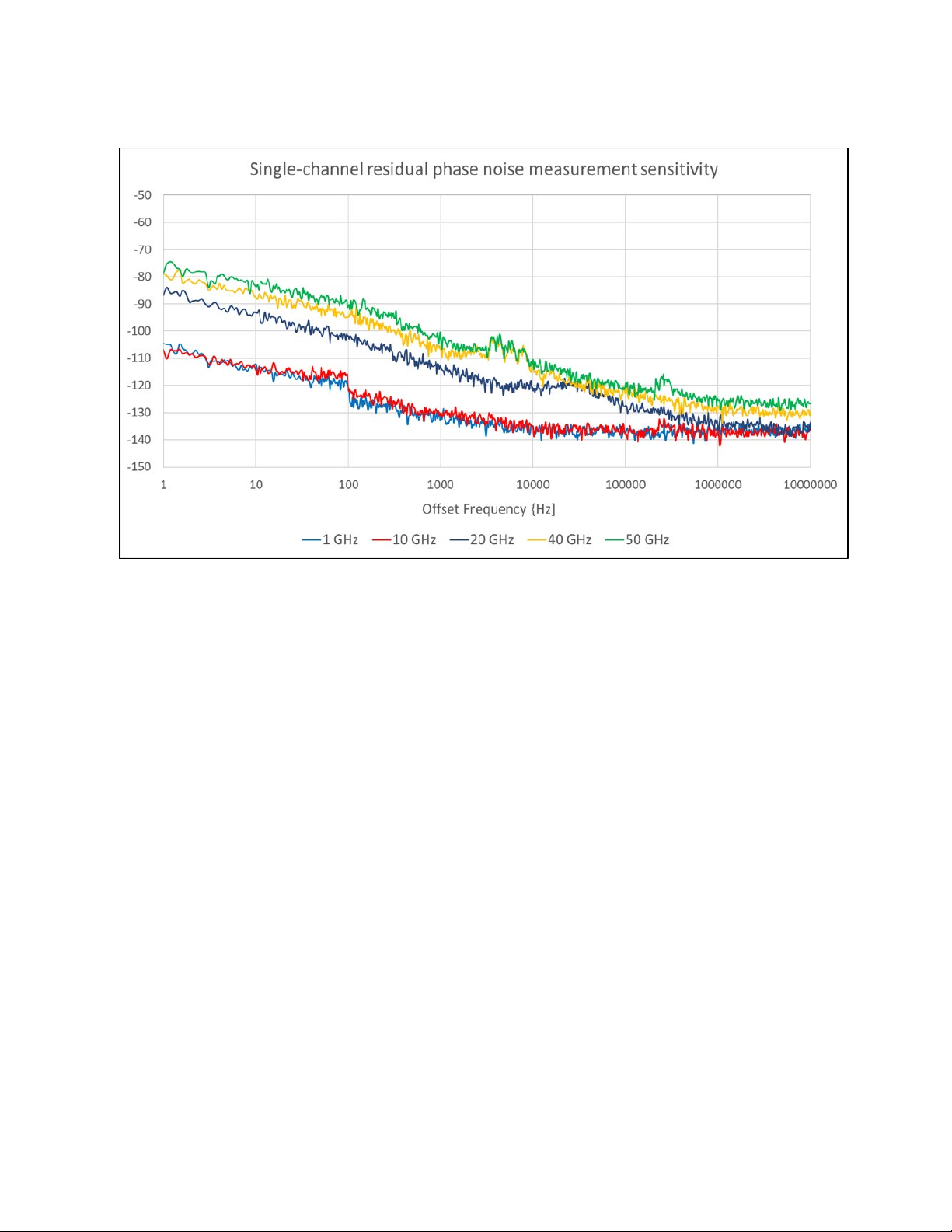
Find us at www. keysi ght.com Page 60 Single - Channel Residual Phase Noise Sensitivity (dBc/Hz) - Supplemental Performance Data

Find us at www.keysight.com Page 59
Single-Channel Residual Noise Measurement
3
Table 65. Single-Channel Residual Phase Noise Sensitivity (dBc/Hz), with Option UNY in Best mode - Supplemental
Performance Data
Input Power level: +10 dBm (+6 dBm at 40 GHz, -2 dBm at 50 GHz)
Residual Phase
Noise
Offset Frequency
Input Frequency 1 Hz 10 Hz 100 Hz 1 kHz 10 kHz 100 kHz 300 kHz 1 MHz 10 MHz
1 GHz
-102
-110
-115
-123
-131
-136
-136
-137
-137
10 GHz
-92
-99
-105
-113
-122
-131
-134
-139
-140
20 GHz
-83
-93
-100
-112
-118
-125
-124
-132
-136
40 GHz
-78
-85
-93
-106
-110
-122
-126
-128
-129
50 GHz
-75
-81
-91
-102
-110
-120
-119
-125
-125
Table 66. Single-Channel Residual AM Noise Sensitivity (dBc/Hz), with Option UNY in Best mode - Supplemental
Performance Data
Input Power level: +10 dBm (+6 dBm at 40 GHz, -2 dBm at 50 GHz)
Residual AM
Noise
Offset Frequency
Input Frequency
1 Hz
10 Hz
100 Hz
1 kHz
10 kHz
100 kHz
300 kHz
1 MHz
10 MHz
1 GHz
-97
-104
-112
-120
-117
-128
-130
-134
-138
10 GHz
-97
-106
-111
-120
-121
-129
-134
-137
-142
20 GHz
-99
-104
-112
-120
-123
-120
-123
-130
-136
40 GHz
-96
-102
-110
-117
-118
-128
-132
-131
-133
50 GHz
-91
-99
-109
-114
-120
-125
-118
-125
-127
3 The data is when a THRU device is connected, in other words, when the input and output frequencies are the same.
The single-channel residual noise measurement is used for the phase noise measurements for frequency converting
devices, and the sensitivity is determined as the absolute phase noise sensitivity at the embedded-LO frequency
(Table 63). In the single-channel residual noise measurement mode, the phase or AM noise of the DUT input signal is
not measured. The measurement can be done when the phase or AM noise of the signal generated by the DUT is
larger than that of the DUT input signal supplied by the PNA internal signal source.
Find us at www.keysight.com Page 60
Single-Channel Residual Phase Noise Sensitivity (dBc/Hz) - Supplemental Performance Data

Find us at www.keysight.com Page 61
Table 67. Single-Channel Residual Phase Noise Sensitivity (dBc/Hz), without Option UNY in Best mode - Supplemental
Performance Data
4
Input Power level: +10 dBm (+6 dBm at 40 GHz, 0 dBm at 50 GHz)
Residual Phase
Noise
Offset Frequency
Input Frequency 1 Hz 10 Hz 100 Hz 1 kHz 10 kHz 100 kHz 300 kHz 1 MHz 10 MHz
1 GHz
-94
-95
-100
-120
-133
-136
-138
-137
-136
10 GHz
-77
-78
-83
-102
-114
-124
-129
-135
-138
20 GHz
-70
-74
-75
-95
-109
-118
-127
-128
-133
40 GHz
-64
-67
-70
-92
-102
-112
-116
-121
-128
50 GHz
-61
-63
-66
-87
-101
-109
-113
-119
-125
Table 68. Single-Channel Residual AM Noise Sensitivity (dBc/Hz), without Option UNY in Best mode - Supplemental
Performance Data
Input Power level: +10 dBm (+6 dBm at 40 GHz, 0 dBm at 50 GHz)
Residual AM
Noise
Offset Frequency
Input Frequency
1 Hz
10 Hz
100 Hz
1 kHz
10 kHz
100 kHz
300 kHz
1 MHz
10 MHz
1 GHz
-105
-110
-123
-125
-134
-138
-139
-143
-138
10 GHz
-104
-110
-116
-125
-133
-134
-133
-141
-141
20 GHz
-104
-109
-116
-127
-127
-126
-128
-133
-137
40 GHz
-103
-110
-115
-125
-120
-130
-126
-130
-132
50 GHz
-98
-106
-111
-121
-124
-125
-122
-129
-129
4 The data is when a THRU device is connected, in other words, when the input and output frequencies are the same.
The single-channel residual noise measurement is used for the phase noise measurements for frequency converting
devices, and the sensitivity is determined as the absolute phase noise sensitivity at the embedded-LO frequency
(Table 63). In the single-channel residual noise measurement mode, the phase or AM noise of the DUT input signal is
not measured. The measurement can be done when the phase or AM noise of the signal generated by the DUT is
larger than that of the DUT input signal supplied by the PNA internal signal source.