N5227B.pdf - 第8页
Find us at www. keysi ght.com Page 8 Notes This docu ment prov ides tec hnical spec ificatio ns for th e 85058B calibrat ion kit and N4694A /D ECal module . Please d ownload o ur free U ncertainty Calculator from http://…

Find us at www.keysight.com Page 7
This is a complete list of the technical specifications for the N5227B PNA network analyzer with the
following options (see block diagrams at the end of this document):
2-Port Models
Option 200 - 2-port base model with standard test set.
Option 201 - To base model, adds front-panel jumpers and R1 receiver switch.
Option 219 - To base model, adds front-panel jumpers, R1 receiver switch, source and receiver
attenuators (extended power range), and bias-tees.
4-Port Models
Option 400 - 4-port base model with standard test set.
Option 401 - To base model, adds front-panel jumpers and R1 receiver switch.
Option 419 - To base model, adds front-panel jumpers, R1 receiver switch, source and receiver
attenuators (extended power range), and bias-tees.
Table 1. Low-Frequency Extension (LFE) Options
Option Description
2-Port Model
205
2-port standard test set (includes six front-panel access loops), R1 receiver switch, and low
frequency extension (LFE) hardware.
220
2-port standard test set (includes six front-panel access loops), R1 receiver switch, source
and receiver attenuators (extended power range), bias-tees, and low frequency extension
(LFE) hardware.
4-Port Models
405
4-port standard test set (includes six front-panel access loops), R1 receiver switch, and low
frequency extension (LFE) hardware.
420
4-port standard test set (includes six front-panel access loops), R1 receiver switch, source
and receiver attenuators (extended power range), bias-tees, and low frequency extension
(LFE) hardware.

Find us at www.keysight.com Page 8
Notes
This document provides technical specifications for the 85058B calibration kit and N4694A/D ECal
module.
Please download our free Uncertainty Calculator from http://www.keysight.com/find/na_calculator to
generate the curves for your calibration kit and PNA setup.
Typical performance information between 67 GHz and 70 GHz is shown in this document where
available. The performance is degraded at particular frequencies in this range due to the modes of the
1.85 mm connectors used in the analyzer, test port cables and adapters.
For all tables in this document, the specified performance at the exact frequency of a break is the
degraded value of the two specifications at that frequency.
Definitions
All specifications and characteristics apply over a 25 °C ±5 °C range (unless otherwise stated) and 90
minutes after the instrument has been turned on.
Specification (spec.): Warranted performance. Specifications include guardbands to account for the
expected statistical performance distribution, measurement uncertainties, and changes in performance
due to environmental conditions.
Characteristic (char.): A performance parameter that the product is expected to meet before it leaves
the factory, but that is not verified in the field and is not covered by the product warranty. A
characteristic includes the same guardbands as a specification.
Typical (typ.): Expected performance of an average unit which does not include guardbands. It is not
covered by the product warranty.
Nominal (nom.): A general, descriptive term that does not imply a level of performance. It is not
covered by the product warranty.
Supplemental performance data (SPD): A performance parameter that is tested on a minimal set of
products during design validation. It does not include guardbands, and is not covered by the product
warranty.
Calibration: The process of measuring known standards to characterize a network analyzer's
systematic (repeatable) errors.
Corrected (residual): Indicates performance after error correction (calibration). It is determined by the
quality of calibration standards and how well "known" they are, plus system repeatability, stability, and
noise.
Uncorrected (raw): Indicates instrument performance without error correction. The uncorrected
performance affects the stability of a calibration.
Standard: When referring to the analyzer, this includes no options unless noted otherwise.
Find us at www.keysight.com Page 9
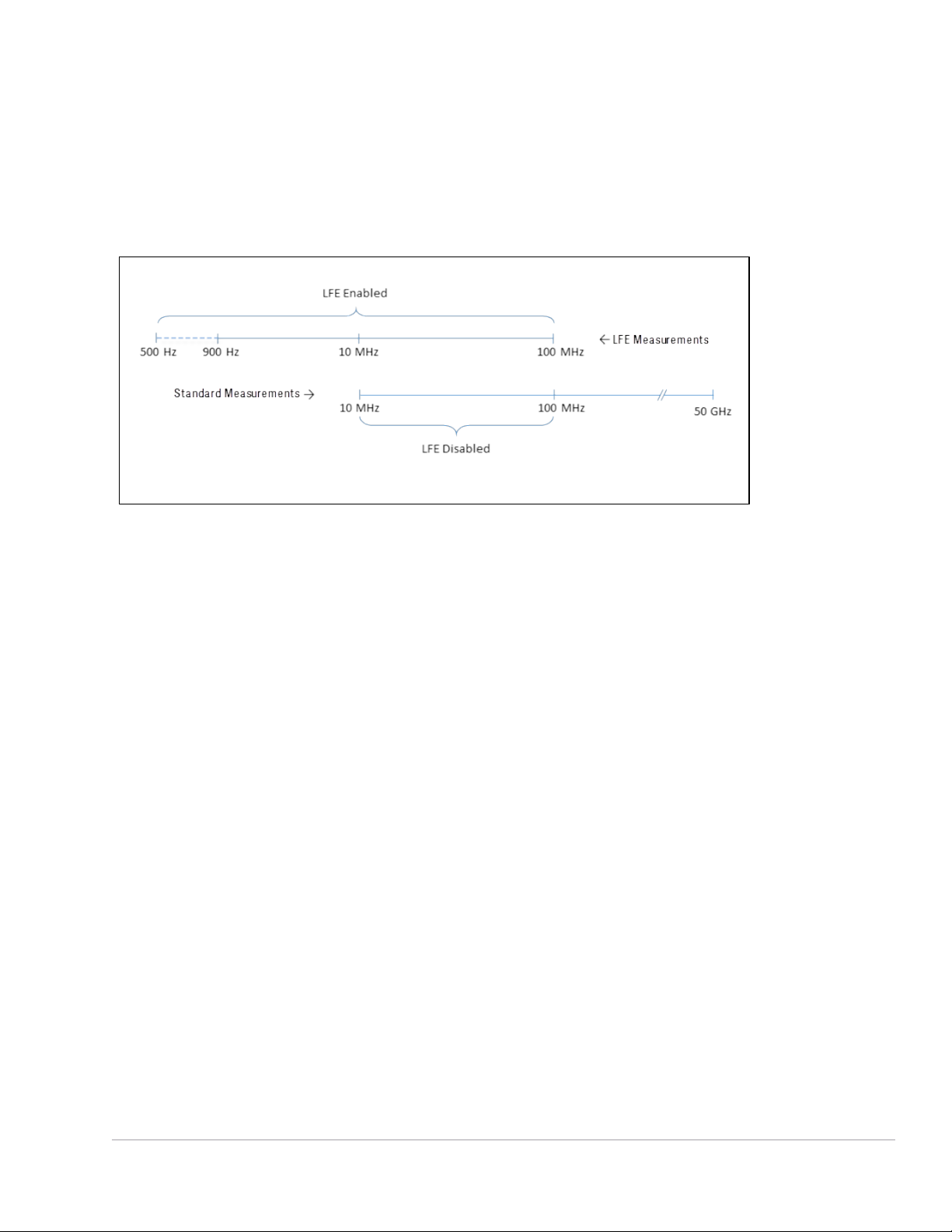
Standard and LFE measurements: With an LFE option, which adds low frequency extension (LFE)
hardware, the LFE measurement range overlaps with the standard measurement range from 10 MHz to
100 MHz. With LFE Enabled, measurements from 500 Hz to 100 MHz use LFE hardware. With LFE
Disabled, measurements from 10 MHz to 100 MHz use standard hardware. To measure below 10 MHz,
LFE must be enabled. All measurements above 100 MHz use standard hardware, regardless of the LFE
Enabled/Disabled setting.