HS50_advance_level 2.pdf - 第281页
Stud ent Gu ide HS-5 0 Adva nced II 07/2 002 Ed ition 9 Z-Axis 21

07/2002 Edition Student Guide HS-50 Advanced II
9 Z-Axis
20
3LFNXS&\FOHZLWKVSHFLDOPRGHV
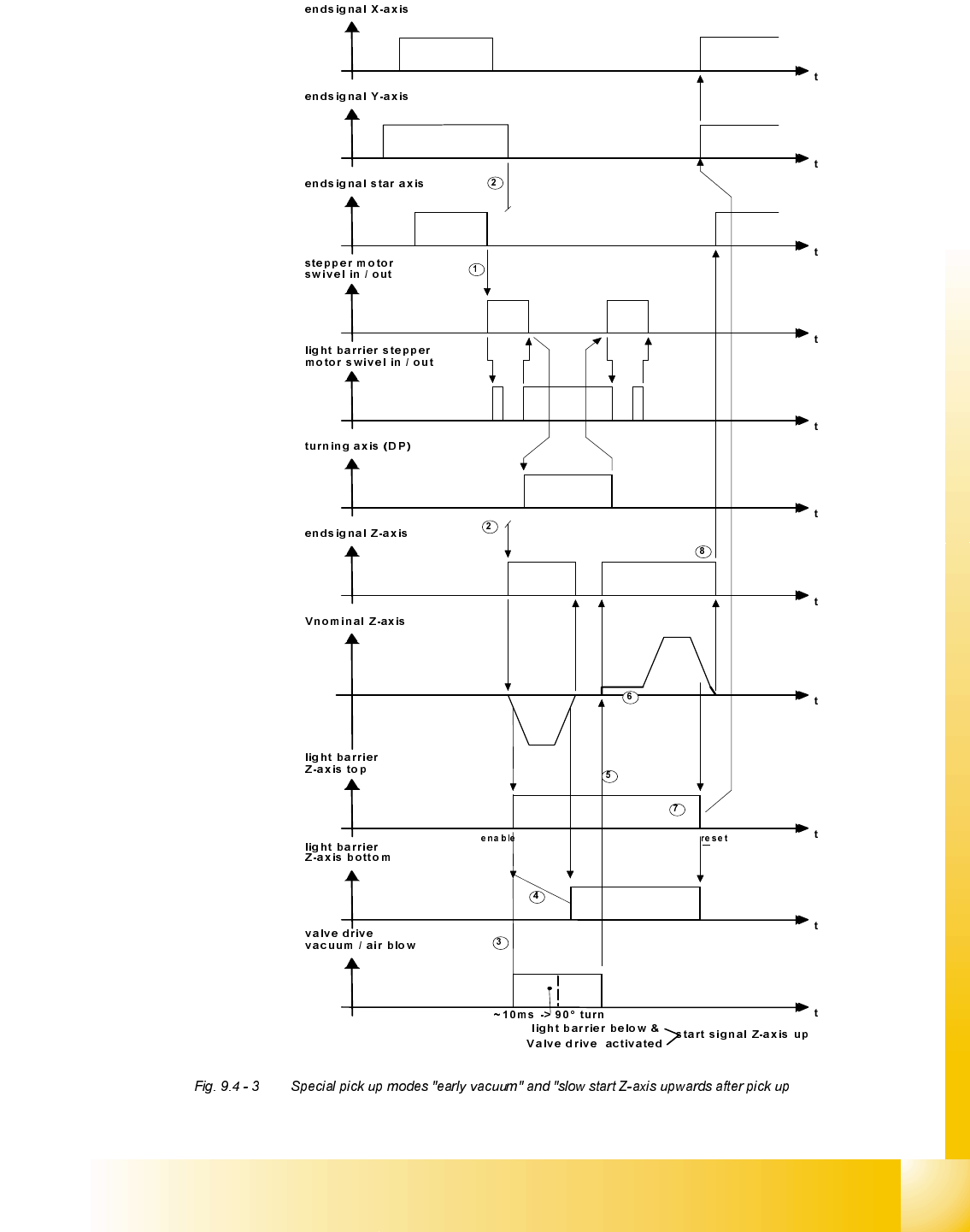
The special Z-axis modes "early vacuum" and "slow start upwards" explaind here in combination.
This combined usage could be programmed - but for the placement process it make less sense.
The slow start upwards (after pick up) is used with less than 100% acceleration of Z-Axis.
The slow start upwards take typically 20 ms longer!
1) The start of the pick up cycle is like the standard pick up cycle.
2) The last end signal from the X- Y- or Star axis and the OK-message "feeder ready" start the Z-
axis movement downward.
3) The upper light barrier switch the valve drive for the vacuum on when in the GF-Editor the but-
ton " Early Vacuum" is activeted. During the travel down timevacuum came to the open top of the
nozzle. At tiny nozzles you have a relatively high vacuum to suck the component on the nozzle.
Unfortunately the nozzle is open to suck dust from the environment (so not recomended for large
nozzles).
4) The slope at the upper light barrier enable the lower light barrier function. (see standard mode
diagram before
5) The end signal of the valve drive and the Z-axis on lower position (light barrier) start the Z- axis
with minimum speed for a 1 mm distance, if you used the right travel profil in the GF-Editor.
6) At this time of about 20 ms the vacuum between component and nozzle increase to the maxi-
mum. Than the Z-axis move on with standard speed profile (acceleration).
7) The signal of the upper light barrier switch off the signal of the lower light barrier and start the-
vacuum check after pick up and X- Y- movement.
8) The endsignal of the Z-axis (at 0-position) start the Star- axis.
Student Guide HS-50 Advanced II 07/2002 Edition
9 Z-Axis
21

07/2002 Edition Student Guide HS-50 Advanced II
9 Z-Axis
22
6WDQGDUGSODFHPHQWF\FOH
1) The end signal star axis starts the swivel - in function at the DP-station.
2) The last end signal of the X- Y- or Star axis start the downward movement of the Z-axis and
open the air blow valve. (A vacuum check before the placement will be performed before the Z-
axis movement)
2a.The LB-top-Signal activate the airkiss-electro magnet valve.
3) The end signal of the swivel in - function starts the DP-axis for an segment with component to
turn it to the placement angle (inclusive all corrections).
4) The end signal of the DP-axis starts the swivel - out function.
5) The end signal Z-axis down (LB- signal) starts the valve drive vacuum- /air kiss valve. The motor
rotates by 180° to connect the segment to the air kiss channel and give way for the next Star-axis
movement.
6) The 90 degree movement signal from stepper motor execute an airkiss check and starts the Z-
axis upwards. The stepper motor continue movement untill 180 degree.
7) The light barrier Z-axis on top reset the LB-signal Z-axis at the bottom and starts the gantry
axes.
8) The endsignal Z-axis in top position starts the Star axis.