HS50_advance_level 2.pdf - 第49页
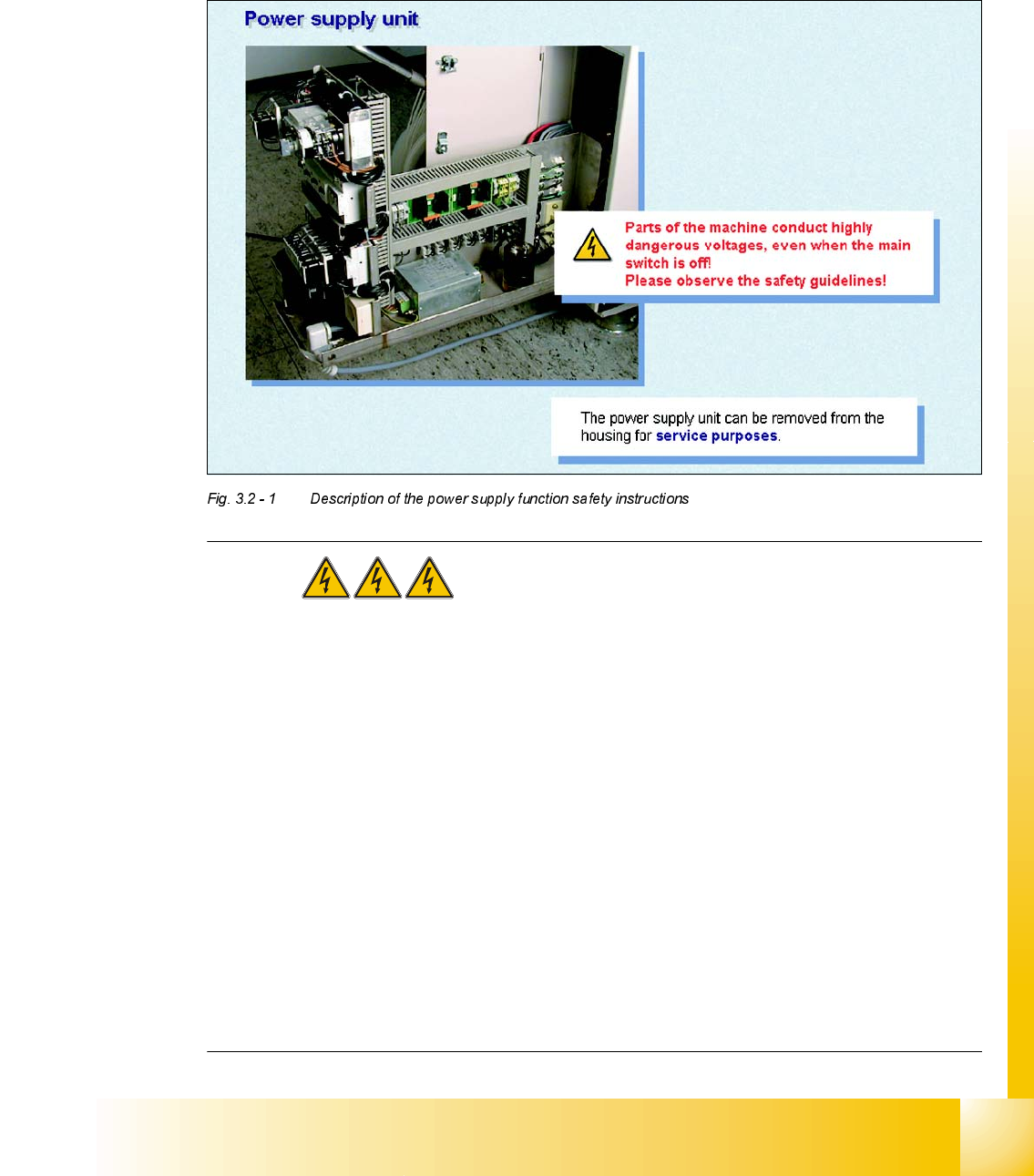
Stud ent Gu ide HS-5 0 Adva nced II 07/2 002 Ed ition 3 Power Supply 11 'HVFULS WLRQRIW KHSRZ HUVXSSO\IXQFWLRQ 6DIHW \ LQVWUXFWLRQV DANGER The placem ent sy stem is suppli ed with 3 x 400 V AC (3 x 2…

07/2002 Edition Student Guide HS-50 Advanced II
3 Power Supply
10
&RQWUROXQLW
When the main switch is switched on, the DC/DC converters in the control unit are supplied with
52 VDC by the power supply unit. The following voltages are then generated in the control unit:
+ 5 VDC to supply the digital electronic circuits
± 12 VDC to supply the digital electronic circuits
± 15 VDC to supply the analogue electronic circuits
+ 24 VDC to supply the control circuits, relays, etc.
The measuring points are shown in the block diagram "HS-50 control unit, front view, 00334808-
XXXXXXTD3" in chapter 3 of the detailed circuit diagrams.
0DLQGLVWULEXWLRQXQLW
Once the placement system has been switched on, the following voltages can be tapped at the
terminal strip for the main distribution unit (see block diagram "Main distribution unit, 00336154-
XXXXXXTD3 in chapter 3" of the detailed circuit diagrams):
6WDELOL]HGYROWDJHV
5 VDC, ± 12 VDC, ± 15 VDC, 24 VDC
1RQVWDELOL]HGYROWDJHV
10 VDC, 40 VDC, 52 VDC
6HUYRXQLW
When the main switch is switched on, the servo unit is supplied with the following voltages:
The test sockets are shown in the block diagram "HS-50 servo unit, front view, 00334810-
XXXXXXTD3, page 1" of the detailed circuit diagrams.
The ± 15 VDC supply voltages for the servo unit’s electronic circuits are generated from the ± 15 V
supply integrated in the servo unit and can be tapped at the measuring points of the power supply
unit (see HS-50 servo unit, front view, 00334810-XXXXXXTD3, page 2 of the detailed circuit dia-
grams).
0HDVXULQJSRLQW 0HDVXUHGDJDLQVW;9
X4 0 VDC for the servo amplifiers of the x/y axes
X3 4 VDC for the servo amplifiers of the star axis
X2 30 VDC for the servo amplifiers of the z and dp axes
Student Guide HS-50 Advanced II 07/2002 Edition
3 Power Supply
11
'HVFULSWLRQRIWKHSRZHUVXSSO\IXQFWLRQ
6DIHW\LQVWUXFWLRQV
DANGER The placement system is supplied with 3 x 400 VAC
(3 x 204 VAC / 3 x 230 VAC / 3 x 380 VAC / 3 x 415 VAC) ± 5 %, 50/60 Hz main voltage.
– Consequently, parts of the system carry potentially lethal voltages, even when switched off at
the main switch.
– Incorrect handling of the placement system can therefore result in death or severe injury or
considerable damage to equipment.
– Measurements and repairs must always be carried out by appropriately qualified personnel.
– Always follow the safety instructions in section 2 of this manual.
– Always follow the applicable accident prevention and VDE regulations (particularly DIN EN 60
204 part 1) or the regulations specific to your country.
– Before starting any repairs, switch off at the main switch and disconnect the placement system
from the main power supply.
– Secure the system to prevent it being switched on again. If these instructions are not followed,
it is possible to touch live parts, which could result in death or severe injury.
07/2002 Edition Student Guide HS-50 Advanced II
3 Power Supply
12
9ROWDJHVLQWKHSRZHUVXSSO\XQLW
3UHSDULQJWKHSRZHUVXSSO\XQLWIRUPHDVXUHPHQW
The power supply unit and main switch are located in the machine frame. In front of the unit there
is a set of safety doors which can be opened with the double-bit key.
The unit is fixed to the machine frame using an M8 hexagon socket-head screw.
To measure the power supply, proceed as follows:
➠ Switch the placement system off at the main switch.
➠ Loosen the M8 lock screw on the underside.
➠ Pull the unit out as far as the stop.
WARNING Make sure that the main power cable and supply lines do not be-
come caught up in the placement system, otherwise the insulation will be damaged.
➠ Switch the placement system on at the main switch and start it up.
0HDVXULQJYROWDJHVRQWKHIURQWSDQHORIWKHSRZHUVXSSO\XQLW
PLEASE NOTE: The placement system must be started in order to take these measurements.
This means that the protective covers and component flaps must be closed and the component
tables docked. The emergency stop button must be released and the Start button pressed. If this
is not the case, the operating voltages will not be switched through to the servo amplifiers, lifting
tables, etc.
The inputs to the modules all have odd numbers and the outputs have even numbers.
In the case of fuses (F1, etc), the input is always on the underside of the module, whereas with
contactors (SZ1, etc) and motor circuit-breakers (MS1 ...), it is always at the top.