00198481-01_Technical_Training_E_by_DEK_EN - 第82页
9 Station Software Overview 9.2 Product File Exercise 82 Technical Training E by DEK 12/2017 9.2 Product File Exercise Create a Product File Using the board and stencil provided by your instructor create a new product fi…
9 Station Software Overview
9.1 Creating a Product file
Technical Training E by DEK 12/2017 81
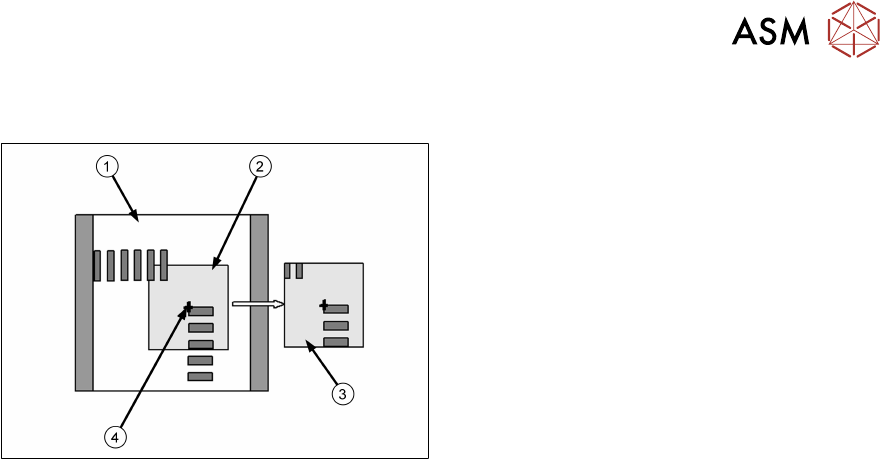
The image below is using the corner of a component and, of course, it will have a corresponding
set of apertures on the stencil to align to.
1. Field of view
2. Sample window
3. Learned model
4. Alignment point
Problems and Limitations
Video models should never be considered as a first choice for alignment as there are several
disadvantages:
●
Due to the normal practice of using aperture reduction, the alignment point of the stencil video
model is unlikely to match that of the board. Therefore, the need to program print offsets is
common when using video models.
●
The stencil capture score may deteriorate rapidly once the stencil is contaminated with paste.
Therefore, it is necessary to use the under-screen cleaner more often than is desirable,
sometimes after every print!
●
On a heavily populated board it is often difficult to find an area that contains a unique image.
The software may detect multiple possible targets within the field of view. If this happens it
may help to increase the Accept Score so that only the true video model will be captured.
Exercise
●
Create a new board file based giving it the name "Video" and ID "video model practice".
●
Setup two sets of video models.
9 Station Software Overview
9.2 Product File Exercise
82 Technical Training E by DEK 12/2017
9.2 Product File Exercise
Create a Product File
Using the board and stencil provided by your instructor create a new product file.
Creating a new product file form an existing file
This is often the quickest way to get started. It is the most efficient method if the new product has
similarities in size, process or 2Di to an existing one. There are however, precautions to remember:
Always zero any offsets from the old file and never assume that the under-screen cleaner or paste
dispense strategies are transferable – these should always be confirmed through test and
observation.
The board dimensions are width, length and thickness. It is very important that these are
programmed accurately as the printer software uses these values as the basis for many other
board file and machine parameters.
For each board dimension state what other board file parameter or mechanical settings will be
automatically adjusted:
●
Board Width …………………………………………………………………………………………..
●
Board Length ………………………………………………………………………………………....
●
Board Thickness ……………………………………………………………………………………..
9.3 Print Cycle
Exercise
Identify print cycle sequence.
Observe the machine as it carries out a print cycle.
Number these actions in the correct sequence:
……… Camera Moves to Board Stop position ……… Board exits machine
……… Tooling clearance check ……… Board Stop is lowered
……… Fiducial positions are captured ……… Board separates from stencil
……… Board travels to Board Stop position ……… Stencil alignment completed
……… Press PRINT ……… Board is unclamped
……… Board is clamped in rails ……… Board stop is raised
……… Camera homes ……… Print stroke carried out
……… Board lifts to stencil
9 Station Software Overview
Room for Your Sketches and Notes
Technical Training E by DEK 12/2017 83
Room for Your Sketches and Notes