PS288_OwnersMnl_PriorTo2009 - 第127页
System Theory • FlashCORE Programmer PS288 Owner’s Manual 4—3 FlashCORE programmers on the PS288 are made up of the following com- ponents: CPU - PowerPC Controller Board (RPX-Lite) The PowerPC Controller Board is based …
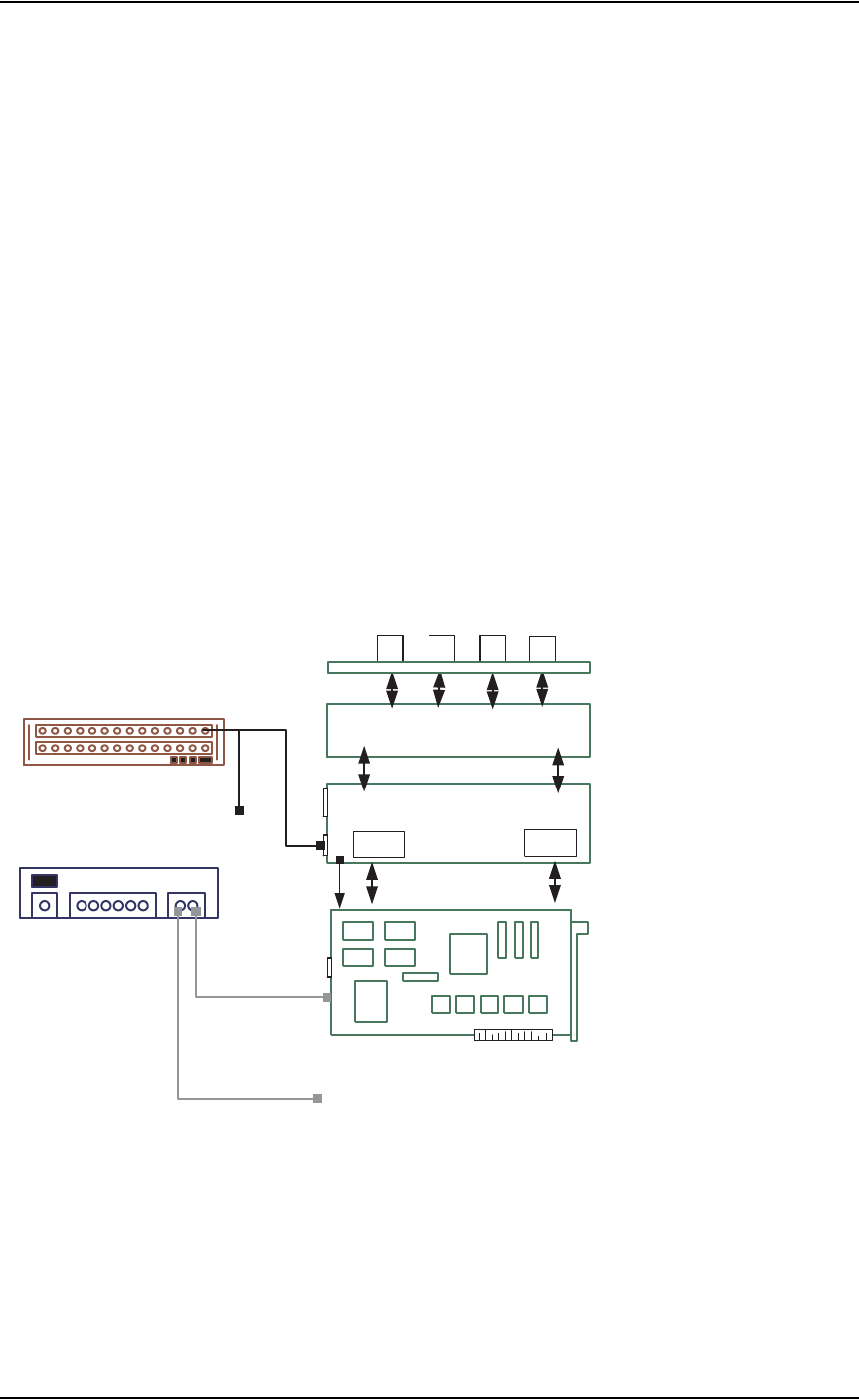
System Theory • FlashCORE Programmer
4—2 PS288 Owner’s Manual
The I/O Controller also provides an interface for all sensor systems, several
visual indicators, and power and control of other systems throughout the
PS288. Sensor conditions are reported back to the Handler Computer
through a series of connections on the rear of the I/O Controller. Connections
supported by the I/O Controller include:
• Air pressure sensors
• Light tower
• Tube vibration assemblies
• Component position optics
• Vacuum and pressure control solenoids and sensors
• Safety shield interlocks
• Tape output control and associated sensors
• Power contactor for the laser marking stage
• Label and laser marking system controls and associated sensors
• Additional connectivity for future options
For a listing of status indicator lights on the I/O Controller, see Appendix A,
“I/O Controller LED Status.”
FlashCORE
Programmer
FlashCORE programmer structure is shown in Figure 4-2:
Figure 4-2—Internal structure of FlashCORE programmer
Controller / CPU
RPX Lite
DW or DW-LGMEM
1
2 3
4
Backplane PCB
Waveform PCB
CPLD
FPGA
J3
J4
RJ45
P10
MON PM3
Socket Adapter PCB
ETH
PE3
MPC850SR PowerPC
FdrRoot\Admin.txt
FdrRoot\FdrCfg.txt
FdrRoot\Algs\2711410c.elf
FdrRoot\Algs\HWData_C.elf
FdrRoot\Jobs\<job_name>\FootNote.txt
FdrRoot\Jobs\<job_name>\JobParms.txt
FdrRoot\Jobs\<job_name>\SectProt.txt
FdrRoot\System\DiagLog.txt
FdrRoot\System\ErrOut.txt
FdrRoot\System\EventLog.txt
FdrRoot\System\FdrStat.txt
FdrRoot\System\
NetWork.txt
Programmer IP=139.138.240.4
Subnet Mask=255.255.255.0
Default Gateway=139.138.240.253
Day and Time Server IP=192.169.1.7
PC Port Number=0
Programmer Port Number=7527
Programmer Name=FC 4
SN Server Port Number=7500
SN Server IP=0.0.0.0
FdrRoot\Update\Boot.bin
FdrRoot\Update\HWData_C.elf
FdrRoot\Update\SysFlash.bin
Files on
PCMCIA Card in FlashCORE
J3
Power
+5V(1,2,3,4) GND(5,6,7,8)
+24V(9,10) +12V (11) -12V(12)
Power Supply
one for 2 FlashCORE Programmers
16-port Network Hub
To / from other FC programmers
To 2nd FC programmer

System Theory • FlashCORE Programmer
PS288 Owner’s Manual 4—3
FlashCORE programmers on the PS288 are made up of the following com-
ponents:
CPU - PowerPC Controller Board (RPX-Lite)
The PowerPC Controller Board is based on MCP850 PowerPC CPU and
includes many hardware elements, like 10 Base-t Ethernet port and a
PCMCIA interface.
It has a memory controller that allows the device programming algorithm to
control the bus cycle timing for the memory range used for programming.
The onboard I2C bus is used to address a serial EEPROM on the adapter
board of the programmer to collect statistics on a given socket. The I2C bus
is also used on the RPX Lite Board to address the temperature and thermal
monitor (STTM) and another onboard serial EEPROM used for RPX config-
uration storage.
Waveform Board
The core of the FlashCORE programmer design, the Waveform Board inter-
faces to the PowerPC Controller Board with two programmable logic
devices: a CPLD (non-volatile) and a FPGA (volatile). These two logic
devices make up the basic programmer control circuitry. The CPLD contains
logic to control the communications interfaces as well as the analog controls
of the programmer and configuration of the volatile FPGA. The FPGA is
used to route address, data and control signals from the PowerPC to the
devices in socket, and provide Device Insertion, V
PP
waveform generation,
and Self-test circuit control logic.
Backplane Board
The Backplane Board is a connection scheme to connect the Waveform
Board to the Socket Adapter board. In addition to supplying connections
between the two boards, it also supplies the circuitry for address line buffer-
ing to isolate each device so that a failing part cannot affect non-failing
devices and power and ground switching relays.
Socket Adapter Board
The Socket Adapter Board connects to the Backplane Board to supply the
electrical connections for programming to the individual sockets. It also con-
tains a 10 bit ID bus used to identify the adapter installed. A small EEPROM
exists on this board for maintaining socket cycle counts for this physical
adapter. By putting this EEPROM on the adapter itself, the socket cycle
counts for a specific Socket Adapter Board can be tracked independent of
the FlashCORE programmer it has been installed on.
In each FlashCORE programmer, there is a PCMCIA card that acts as the
local drive for the FlashCORE programmer. There are various sub-directo-
ries and files on this, as shown in Figure 4-2.
Power to FlashCORE programmers is provided by a universal power supply,
which powers two FlashCORE programmers.

System Theory • Computer System
4—4 PS288 Owner’s Manual
Each programmer is connected to the 16-port network hub via a UTP cable
with RJ45 connectors at both ends. The network hub is also connected to the
Handler Computer, which communicates to all FlashCORE programmers
during the device programming process and when running diagnostics tests
on a FlashCORE programmer.
Computer
System
The computer system of the PS288 consists of the Handler Computer and
various networking components that allow the Handler Computer to com-
municate with the FlashCORE programmers.
Handler Computer
The Handler Computer operates using the Microsoft
®
Windows XP operat-
ing system and the client network communications. It hosts TaskLink and
the AH500 operating software, as well as several subsystems within the
machine including:
• Vision system and software
• PNP head motion control system
• Label marking system
• I/O Controller interface
The Handler Computer communicates with the network by a 10BaseT Ether-
net connection, and contains mappings of all the major disk volumes used by
the network. Any data transfer required from a major network volume can be
accomplished on the Handler Computer using Windows
®
Explorer.
The PS288 user interface (AH500 software) is run from the Handler Com-
puter. It contains all graphic components that the system operator uses dur-
ing normal operation, including option configuration, programmer setup,
and system adjustments.
The vision interface card is installed in the Handler Computer, as well as its
operating software. This system is run in conjunction with the AH500 oper-
ating software to ensure proper alignment of programmable devices before
being placed into the programming sockets.
The motion control system interface allows the AH500 software to commu-
nicate with the PNP head gantry system. Movement commands and posi-
tional feedback are provided to the AH500 software with this system.
The Handler Computer and AH500 software communicate with the label
marking system via serial port on the rear of the Handler Computer. Label
data transfer and labelling system responses are sent to and from the label
marking stage through this connection.
The I/O Controller interface determines the condition of the various sensors
and systems located throughout the PS288 as reported to the I/O Controller.
These conditions are then read by the AH500 software to determine the state
of the machine before issuing system commands. See Appendix A, “I/O
Controller LED Status.”