PS288_OwnersMnl_PriorTo2009 - 第26页
Introduction • Laser Safety 1—16 PS288 Owner’s Manual T o avoid possible personal injury or damage to the equipment, please observe the following practices: ) Do not use the PS288 for any purpose other than its intended …
Introduction • Required Facilities for Operation
PS288 Owner’s Manual 1—15
Laser Interface
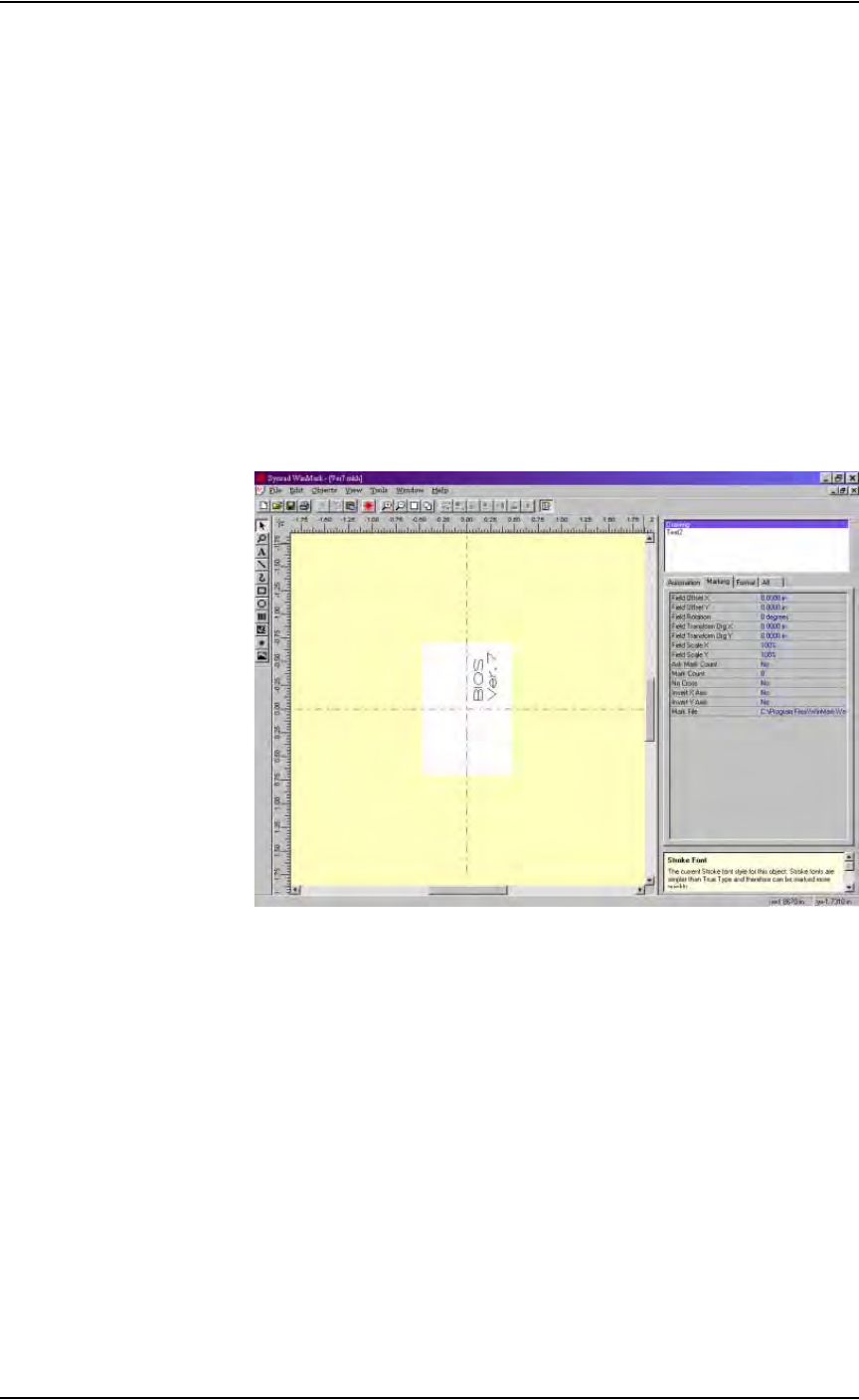
The Laser interface is used to create parameters required for laser jobs and
start laser marking. The software resides on the Laser Computer in the laser
marking system located in the Option Bay. The Laser Computer operates
using the Microsoft
®
Windows XP operating system.
The Laser Computer is accessed through the keyboard by pressing
CTRL-CTRL, typing "B" and pressing ENTER. The Laser interface is dis-
played on the monitor and controlled through the keyboard and touchpad.
The touch screen does not work while in Laser Computer mode. To return to
the Handler Computer, press CTRL-CTRL, type "A" and press ENTER.
When the laser marking system is set up and initialized, it receives com-
mands from the AH500 software initiating the marking sequence. See Fig-
ure 1-10 for an example of the laser interface configuration window. More
information about the laser interface follows in Chapter 2—Set Up and
Chapter 3—Operation.
Figure 1-10—Laser computer interface example
Required
Facilities for
Operation
The PS288 is a self-contained unit that creates most of its own power supply
voltages and signals required for proper operation. Power requirements are
208–240 VAC, 50/60 Hz, single phase electrical power. Air requirements are
clean, dry, oil-free air, input rated between 620 and 827 kiloPascals (90 to
120 PSI) from an industrial grade compressor with a tank of sufficient size to
maintain constant air pressure at 85 liters per minute (3 Standard Cubic Feet
per Minute).
Precautions for
Safe Operation
The PS288 has many safety features designed to make the system safe and
efficient to operate. The system can be dangerous if the safety precau-
tions and features in the manual are ignored.

Introduction • Laser Safety
1—16 PS288 Owner’s Manual
To avoid possible personal injury or damage to the equipment, please
observe the following practices:
) Do not use the PS288 for any purpose other than its intended use.
) Do not operate the system if the safety shields are not in their normal
operating positions.
) Do not operate the system when any of the outer sheet metal panels are
removed.
) Only qualified personnel trained by Data I/O to service and maintain
the PS288 (including laser safety training) should install, maintain,
repair, or troubleshoot the system.
) Do not operate a system while servicing, replacing, or adjusting any
component unless directed to do so in this manual. Make sure that the
system is properly shut down before performing any of these opera-
tions.
) Do not operate the PS288 unless you have been thoroughly trained and
have read and understand the instructions in this manual, particularly
those that describe the system’s safety features.
) Disconnect the external air line before servicing pneumatic parts.
) Do not place any part of your body near or in the direct path of moving
parts.
) Do not disable or attempt to defeat any of the safety features of this
system. Serious personal injury and/or equipment damage can occur if
any safety systems on the PS288 are disabled. If you suspect that a
safety feature of the system is damaged or malfunctioning, stop using
the PS288 immediately and contact your local Data I/O Support office.
) Read and follow the laser vacuum filter disposal requirements
described later in this section. Always dispose of any other hazardous
or residual by-products of the production process in accordance with
governing laws and regulations.
) Use extra caution when using the tape input/output modules or device
labeling option. The PS288 safety shields do not cover or fully enclose
these modules. It is possible that hands, body parts, or loose clothing
can get caught or pinched in these mechanisms.
Laser Safety
The laser marking system, located in the Option Bay attached to the PS288,
has been designed in accordance with the following safety guidelines:
• Operates as a Class 1 laser (CDRH classification).
• Fume extractor traps marking fumes and other by-products of the laser
marking operation.
• System designed to comply with OSHA guarding standards.
• Integrated safety interlocks prevent the laser from firing while any
interlock is activated.
• Refer to and follow laser and safety precautions in ANSI X136.1-1993,
American National Standard for the Safe Use of Lasers. Procedures
listed under the Standard include: appointment of a Laser Safety
Officer, operation of the product in an area of limited access by trained
personnel, servicing of the equipment only by trained and authorized
personnel, and posting of signs warning of potential hazards.
Introduction • Laser Safety
PS288 Owner’s Manual 1—17
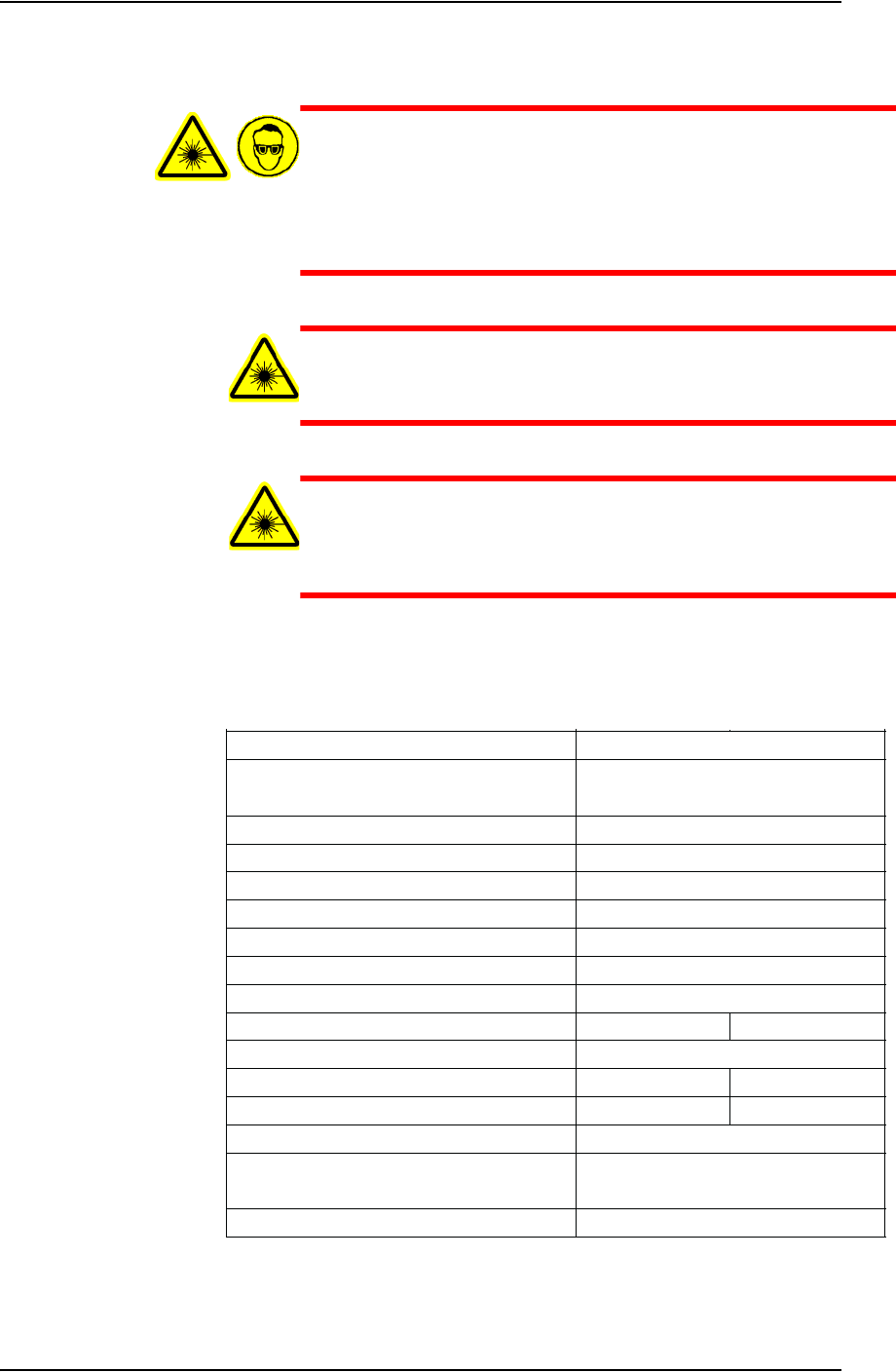
WARNING: Blindness hazard! Always wear eye protection when
the laser safety shields are open, such as during service. Direct or
diffuse laser radiation can damage eyes. Goggles must block
10.6 µm laser radiation. Goggles protect against scattered energy
but not against direct viewing of the laser beam or reflections
from metallic surfaces.
WARNING: Serious burn hazard! Direct or diffuse laser radia-
tion can cause serious burns. Keep hands and other parts of the
body out of the path of the laser bean when servicing.
WARNING: Toxic fume hazard! Laser marking generates vapors,
fumes, and particles that may be noxious, toxic, or even fatal.
Follow maintenance procedures on the fume extractor. Use
proper ventilation.
Laser Specifications
Specifications for laser Model 48-1(S) installed in the Option Bay are shown
in Figure 1-11.
Figure 1-11—Model 48-1(S) laser specifications
Weight
Output Power
Mode Quality
Ellipticity
Rise Time
Beam Diameter
Beam Divergence (full angle)
Wavelength
Power Stability, from cold start (guaranteed)
Polarization
Cooling
Air Water
Heat Load (max)
Flow Rate, Air
250 CFM x 2 N/A
Flow Rate, Water (18-22ºC)
N/A 0.5 GPM
Input Voltage / Current
Dimensions (in)
(mm)
3.5mm
4mR
10.57-10.63µm
Linear (Vertical)
±10
429 x 71 x 107
9 lbs / 4.1 kg
16.9 x 2.8 x 4.2
30 VDC / 7A
10W
300W
TEM
00
, 95% Purity
M
2
<1.2
<1.2
<150µsec