PS288_OwnersMnl_PriorTo2009 - 第33页
Introduction • Electrostatic Discharge (ESD) Precautions PS288 Owner’s Manual 1—23 The PS288 should be located in a ro om with adequate space to allow easy access to all enclosures. A minimum of one meter (36 inches ) of…
Introduction
1—22 PS288 Owner’s Manual
Standard plastic device packages typically contain antimony hydroxide as a
fire retardant, the source of the antimony in the vacuum filters. Other hazard-
ous materials may also be present depending upon the type of device pack-
ages that are laser marked.
After the initial profile is performed and on record with the company that
disposes of the facility’s hazardous waste, additional testing of contaminated
filters should not be needed unless the contents of the device packages or
type of device packages being marked changes significantly.
The licensed hazardous waste disposal company can provide the necessary
information to label the bags containing the filters and will complete the
paperwork required for transportation and disposal in a manner that meets
applicable government (local, state, and federal—or equivalent) hazardous
waste regulations.
Filter Handling and Storage
The procedure for replacing the laser vacuum filters is described in the fume
extractor manual. Following the precautions listed below will help ensure a
safe work area for all personnel using the PS288.
Ensure that protective gloves (disposable latex or vinyl) are worn during the
removal of the contaminated filters. Handle the contaminated filters in a
manner that minimizes the release of the particulate on the filters.
Dispose of the contaminated filters in a tightly sealed plastic bag (such as a
bag with a reusable locking seal). When all filters have been carefully placed
in the bag, pull off the disposable gloves (inside out), place them in the bag,
and seal the bag.
If it is determined that the by-products of laser marking contain potentially
hazardous materials, a hazardous waste label that meets government require-
ments (local, state, and federal—or equivalent) needs to be affixed to this
bag or other hazardous waste container.
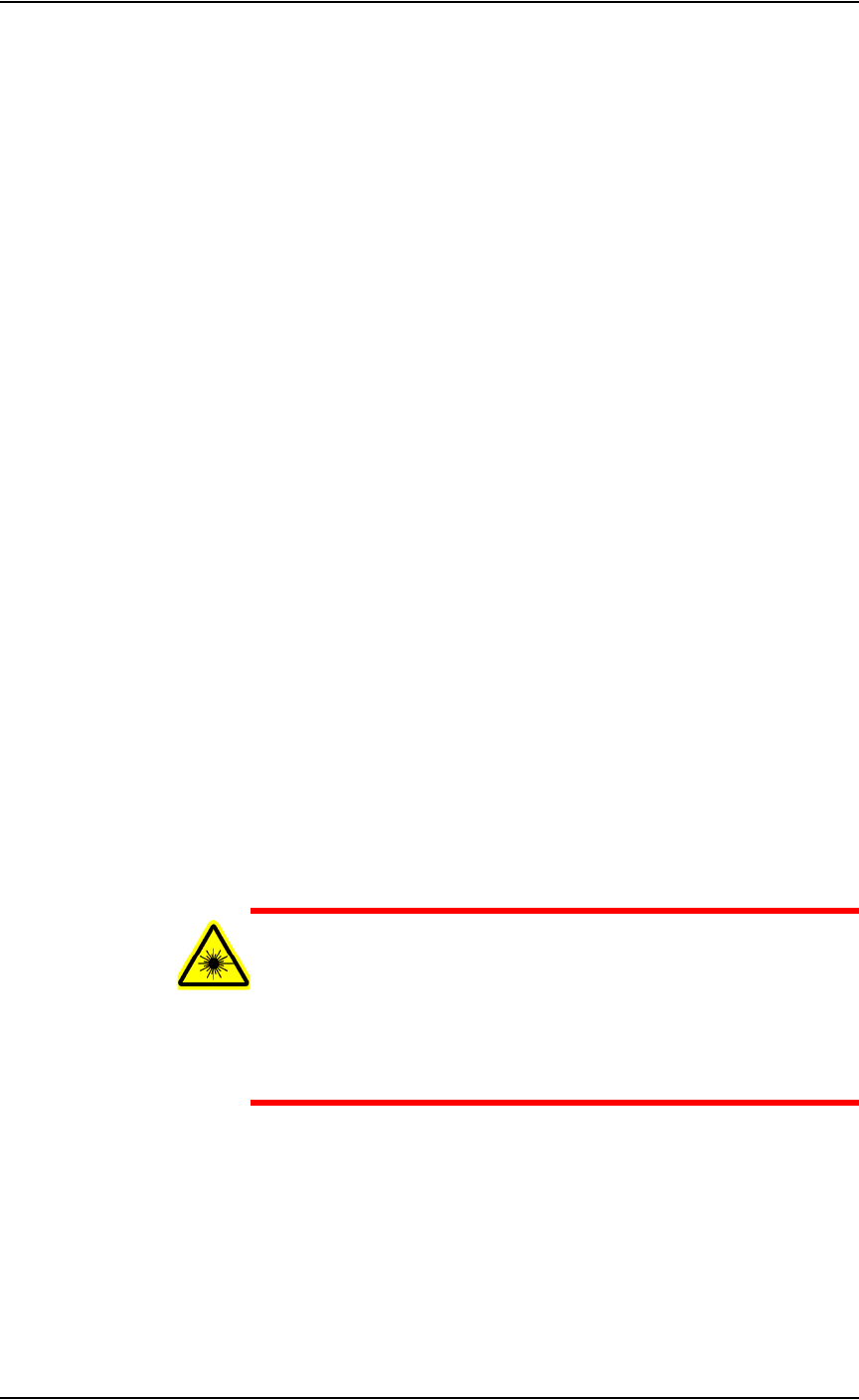
WARNING: Numerous government regulations apply to the stor-
age of hazardous waste. Ensure that contaminated filters are
properly labeled and stored in your hazardous waste storage area.
Also, make sure that they are not stored on your site longer than
government regulations allow (the typical limit is 90 days). Check
your government (local, state, and federal—or equivalent) regula-
tions for hazardous waste storage requirements.
Room
Ventilation
The PS288, its optional systems, and its label or laser marking system con-
tain mechanical components and associated electrical systems that generate
heat and extremely low levels of particulate matter.
Introduction • Electrostatic Discharge (ESD) Precautions
PS288 Owner’s Manual 1—23
The PS288 should be located in a room with adequate space to allow easy
access to all enclosures. A minimum of one meter (36 inches) of clearance
on all sides is required for removal of system components.
The room should be provided with suitable levels of general room heating,
ventilation, and air conditioning. For an occupied office area, the American
Society of Heating, Refrigeration, and Air Conditioning Engineers, Inc.
(ASHRAE) Standard 62-1992 specifies a minimum of 15 cubic feet per
minute (CFM) of air per occupant. This level of ventilation is intended to
provide the occupants of the room with sufficient air movement to provide a
comfortable environment. The air movement is intended to dissipate heat,
odors, and other exhalation products from respiration (such as carbon diox-
ide and water vapor).
Because the PS288 generates heat, an additional 85 CFM is recommended,
bringing the total room air exchange rate to 100 CFM. In a room with
dimensions of 10 feet by 10 feet, with an 8 foot ceiling (800 cubic feet of
total interior area), 100 CFM would provide approximately six room air
changes per hour.
Based on industrial hygiene monitoring performed during the worst case
operating scenario of a PS288 laser marking system, this rate of air move-
ment is sufficient to provide a safe and healthy airborne work environment.
WARNING: Operating the PS288 in an area that does not meet the
minimum ventilation requirements could result in a hazardous
operating environment.
Electrostatic
Discharge
(ESD)
Precautions
The circuit boards inside the PS288 are susceptible to electrostatic discharge
(ESD), which can damage the circuitry of the programming electronics.
Also, devices processed through the PS288 are very sensitive to static and
can be damaged by accidental and unintended electrostatic discharge while
being handled. The easiest way to prevent damage from ESD is to make sure
a common electric potential (ground) exists between a static-sensitive device
or component, its environment, and the operator.
Operators should wear an antistatic wrist strap connected to the grounding
socket on the front of the PS288. The wrist strap should contain a 1M-ohm
(minimum value) to 10M-ohm (maximum value) current limiting resistor.
Handling
Devices Safely
To prevent damage to device leads, use a vacuum tool to move or pick up
devices. The vacuum tool is designed to handle devices without damaging
them.
CAUTION: Do not touch devices with your hands or any imple-
ment other than the vacuum tool. Damage to fine-pitched leads may
result.
Introduction
1—24 PS288 Owner’s Manual
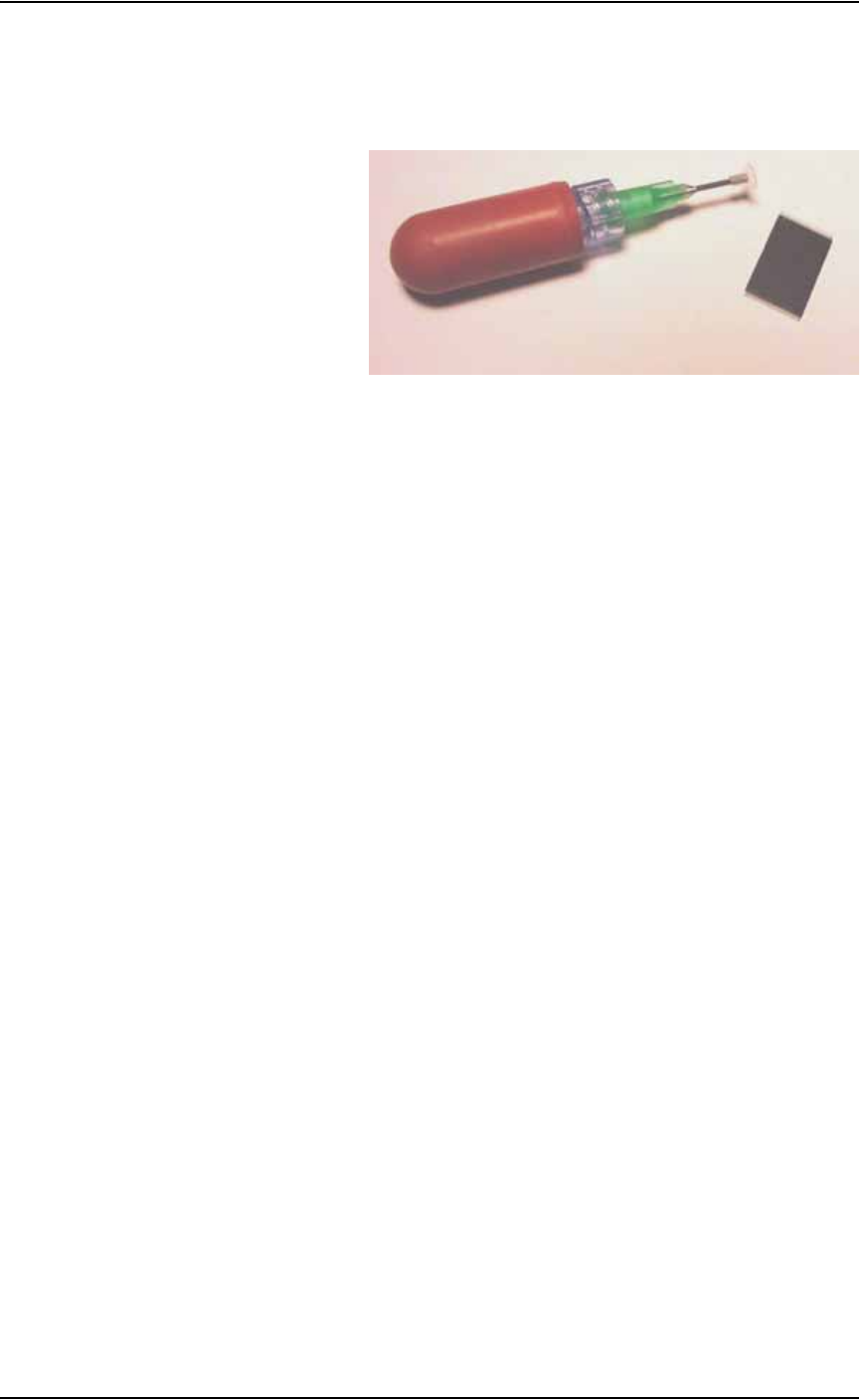
To pick up a device using the vacuum tool, squeeze the bladder, place its
rubber tip on the device body, release pressure on the bladder, and lift up.
Depending upon the physical size of the device, a different sized rubber tip
may need to be used to adequately handle the device. See Figure 1-17.
Figure 1-17—Semiconductor device vacuum tool (PN 565-8000-001)