PS288_OwnersMnl_PriorTo2009 - 第97页
Operation • Administrator Functi ons PS288 Owner’s Manual 3—37 Figur e 3-51— last Socket 7b) Click X,Y AutoFind . Figur e 3-52—X,Y AutoFind 7c) When the Attention message box pops up, check the Results field. 7d) If the …
Operation • Administrator Functions
3—36 PS288 Owner’s Manual
4c) By hand, adjust the Socket Actuator so that the ribs open the socket as
the probe tip descends and so the actuator does not interfere with the
device as it is picked up by the probe tip.
4d) On the input panel, push the main air valve up to the ON position.
4e) Click Socket OFF to raise the Socket Actuator.
5. Set R-axis value—
Follow the instructions in “Set R-axis rotation values” on page 3-22.
6. Pick the device—
6a) Click P1 to return the PNP head to Programmer 1.
6b) Press X,Y AutoFind. The PNP head picks the device, takes it to the
vision location and compares the orientation of the device to the orien-
tation in the reference vision file.
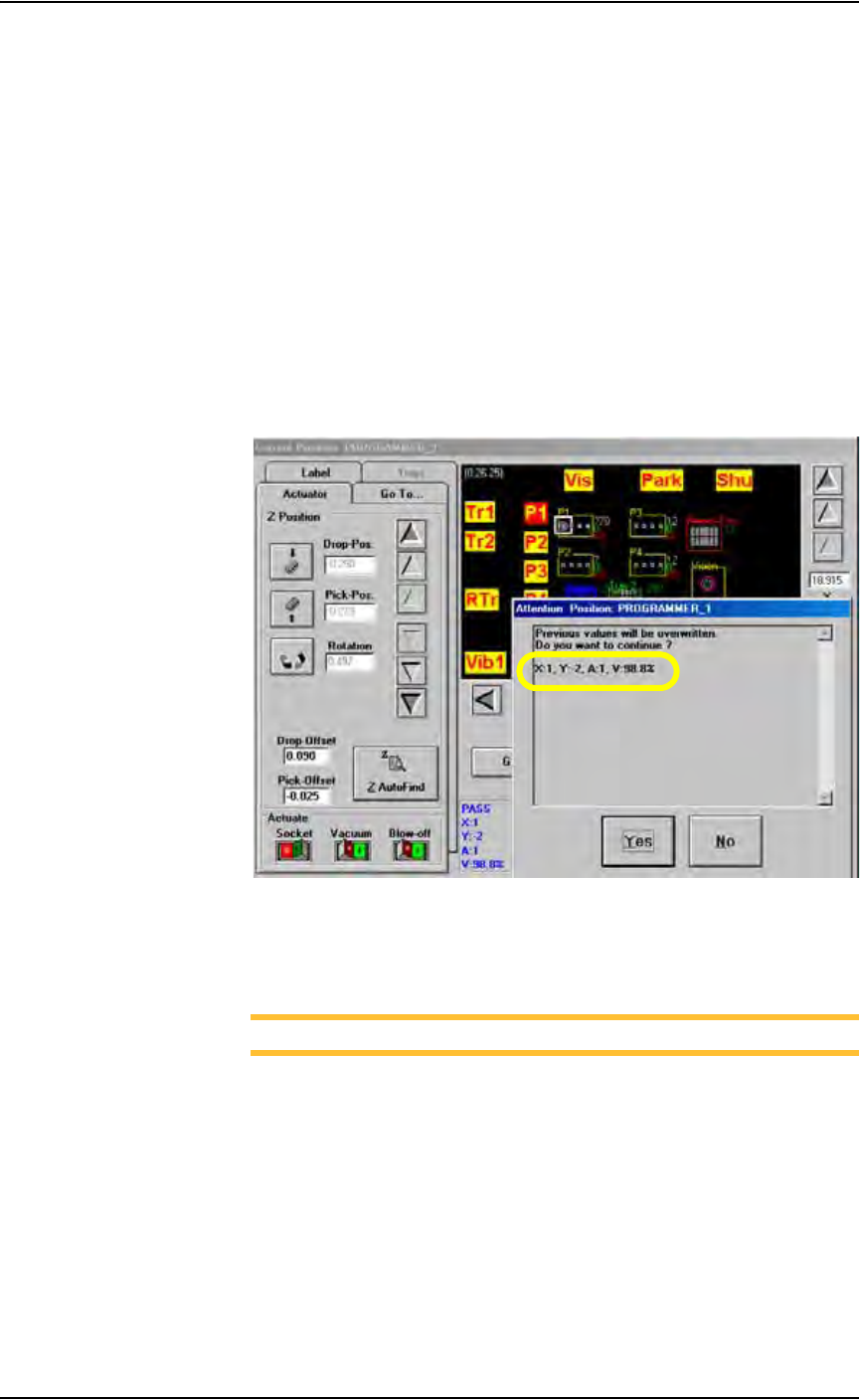
6c) When the Attention message box pops up, check the Results informa-
tion.
Figure 3-50—Results information
6d) If the new values for X and Y are >±5, press Ye s and repeat Step 6b.
If the new values for X and Y are <±5, press No.
NOTE: If the programmer has multiple sockets, complete Step 7.
7. Multiple socket programmers—
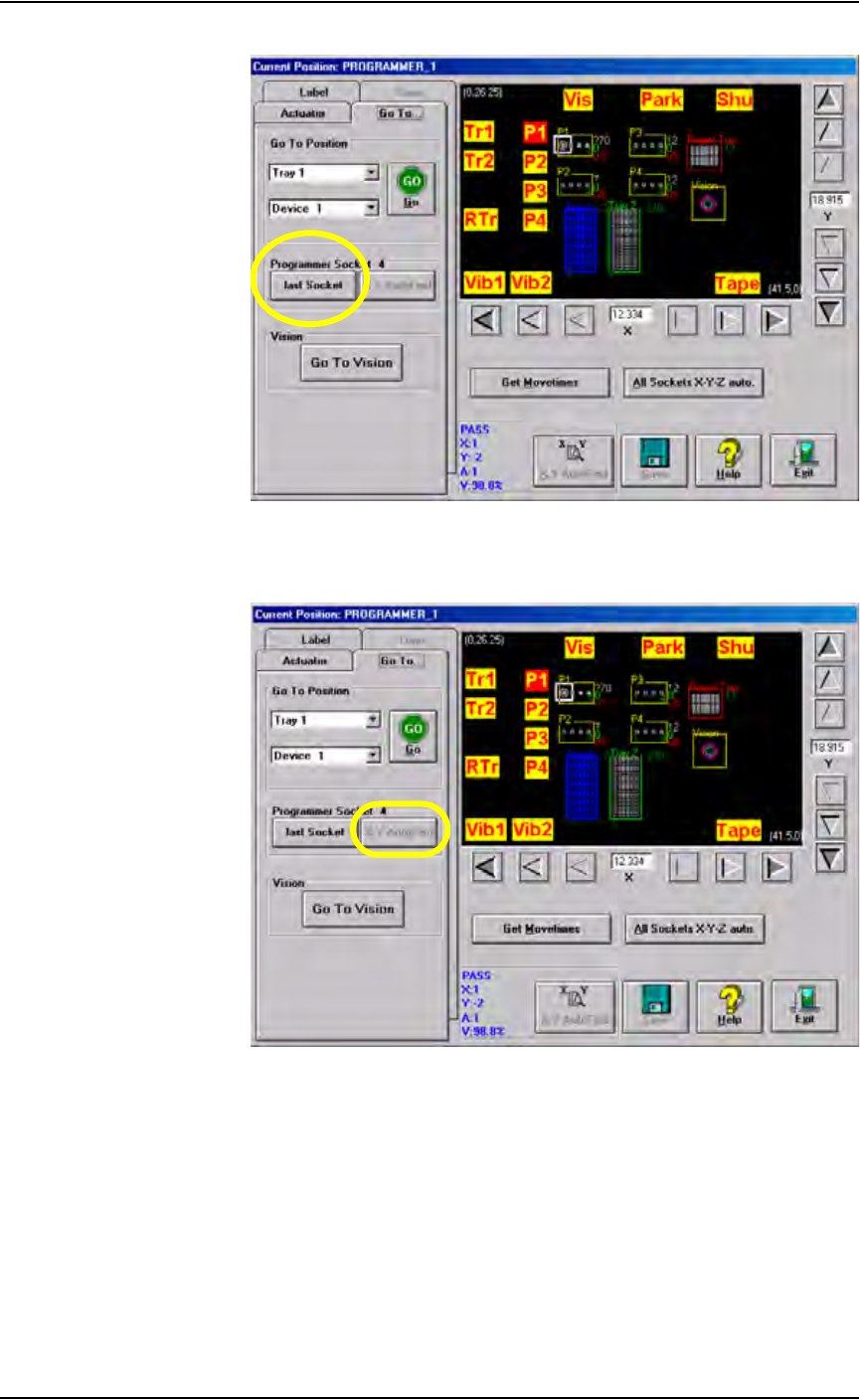
7a) On the Go To tab, click last Socket. See Figure 3-51.
Operation • Administrator Functions
PS288 Owner’s Manual 3—37
Figure 3-51— last Socket
7b) Click X,Y AutoFind.
Figure 3-52—X,Y AutoFind
7c) When the Attention message box pops up, check the Results field.
7d) If the new values for X and Y are >±5, press Ye s and repeat Step 7b.
If the new values for X and Y are <±5, press No.
This completes the process of teaching Programmer 1 locations. Repeat for
ALL programmers.
Operation • Administrator Functions
3—38 PS288 Owner’s Manual
Teach Tray Locations
The PS288 can have static tray or automatic tray feeder (TF20 or TF30)
input and output modules. Teaching tray locations is the same.
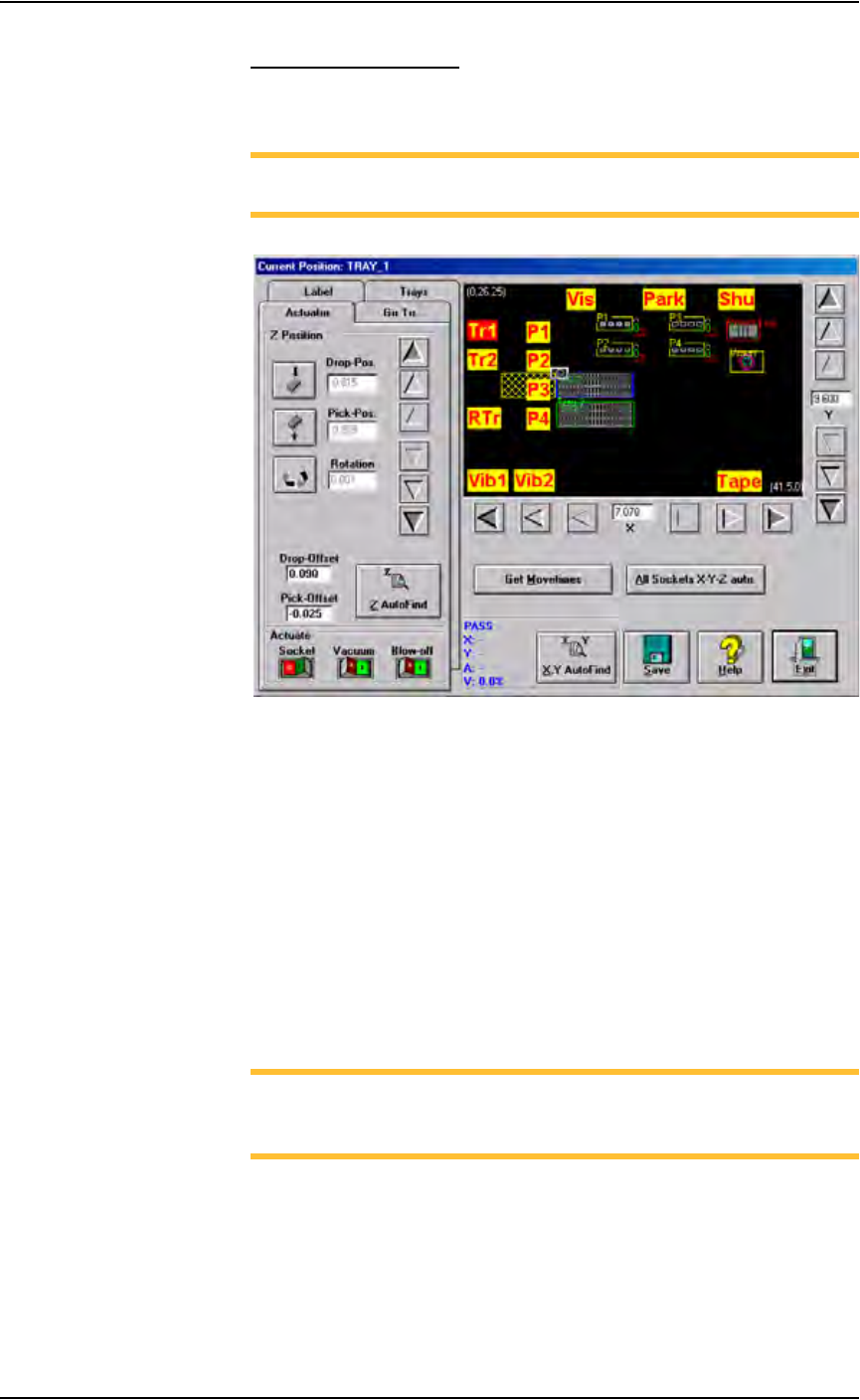
NOTE: If the automatic tray feeder option is installed, trays are
displayed in the Gantry window as shown in Figure 3-53.
Figure 3-53—Gantry window display with automatic tray feeder installed
1. Prepare the system—
1a) In Tray 1, insert devices in the upper left corner and lower right corner.
1b) In Tray 2, insert a device in the upper left corner only.
2. Teach upper left corner of Tray 1—
2a) Click Tr1.
2b) Adjust the location of the probe tip so that it is centered on the device
in the upper left corner of Tray 1. Use the up/down arrows for Y-axis
adjustments and the left/right arrows for X-axis adjustments. From the
inside working outward, the arrow buttons adjust the position ±0.001,
0.010, and 0.100 inches respectively.
2c) Click Save.
NOTE: When saved, these settings are kept in the appropriate
package file (.txt) in the directory C:\AH400_32\Package on
the Handler Computer.
2d) Click Z AutoFind. The PNP head lowers and the probe tip touches the
device. Click Yes to save the new values. The Z-axis reference position
is now set.
2e) Press X,Y AutoFind. The PNP head picks the device, takes it to Vision
and compares the orientation of the device to the orientation in the ref-
erence vision file.