Apollo1_Operators_Manuel.pdf - 第19页
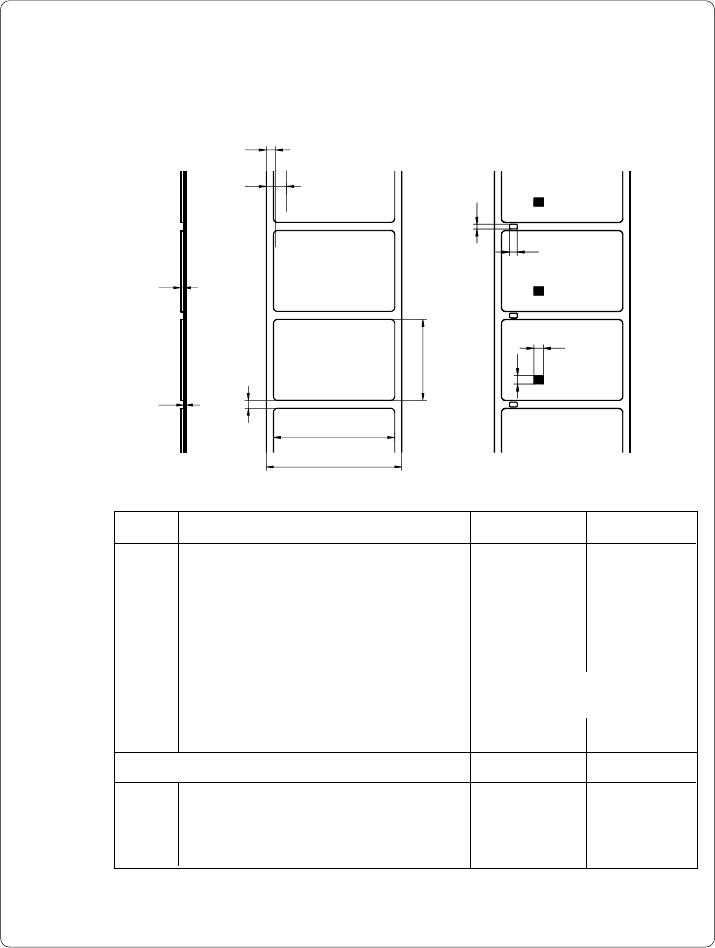
19 cab - Produkttechnik GmbH / Tharo Systems, Inc. Label/ T ag Media Specifications Label and tag media to be used for the Apollo can be found in the table below . Note this information before ordering your labels. E F D…

1 8 cab - Produkttechnik GmbH / Tharo Systems, Inc.
Print Media for Direct Thermal Printing
The print material must correspond to several important specifications, in order to
ensure high quality printing, and to avoid damage to the printhead or early wear.
Using labels which we have tested and which we recommend to our customers,
will guarantee a gentle treatment of the printhead. If you want to use material by
another supplier, please note the following requirements regarding the condition of
thermal printer paper :
1. To avoid damage to the printhead, the surface coating must cover the thermal-
reactive layer. If the coating is too thin, this may cause a "pitting" effect on the
printhead, i.e. very small explosions during the chemical reaction of the thermal
coating quickly resulting in damage to the printhead.
2. The surface of the labels should be very smooth to avoid a "sandpaper" effect
on the printhead.
3. Always choose material which can be printed on with the lowest possible heat
level. The greater the heat level, the shorter the life of the printhead.
Moreover, with highest heat levels the phases of heating up and cooling down
extend. This may have a negative effect on the print quality, especially if a high
print speed is required.
Print Media for Thermal Transfer Printing
In thermal transfer mode, a wide range of different label materials may be used.
(e.g. normal paper, tag stock, a variety of synthetic material such as polyester foil,
etc.)
The print quality greatly depends on the right combination of label material
and transfer ribbon.
The surface of the labels determines which ribbon material may be used.
Unsuitable ribbons may cause an extremely poor print image.
If in doubt, your local distributor will advise you on a good combination of suitable
material, or carry out tests to find out which ribbon fits your label material best.
F
19cab - Produkttechnik GmbH / Tharo Systems, Inc.
Label/ Tag Media Specifications
Label and tag media to be used for the Apollo can be found in the table below.
Note this information before ordering your labels.
E
F
D
A
B
K
I
L
M
C
G
H
Fig. 1.5 Label formats
Item MINIMUM MAXIMUM
A Label width .5 (12) 4.6 (116)
B Width of silicon liner .5 (12) 4.6 (116)
C Label length .2 (5) 21.5 (546)*
D Gap between labels .08 (2) 21.5 (546)*
E Label thickness .0024 (.06) .01 (.25)
F Thickness of silicon liner .0024 (.06) .01 (.25)
G Distance of the first printing position
from the edge of the silicon liner .08 (2)
H Distance of the label sensor
from the edge of the silicon liner .12 (3) 1.9 (48)
For special materials
I Width of punch hole .2 (5) -
K Height of punch hole .08 (2) .2 (5)
L Width of reflective mark .2 (5) -
M Height of reflective mark .08 (2) .2 (5)
* for Apollo 3 : 37.2 (945)
Table 1 b Label formats in inches (figures in brackets are in mm)

2 0 cab - Produkttechnik GmbH / Tharo Systems, Inc.
Transfer Ribbon
The choice of a suitable transfer ribbon is important for the print quality of your
printer as well as the useful life of the printhead.
Transfer ribbons of inferior quality may cause premature deterioration of
the printhead !
The ribbon material must be antistatic, because the extremely thin surface coating
of the thermal printhead can be damaged by electrostatic discharge.
Also, the material must be extremely resistant to high temperatures to avoid melting
the ribbon with the printhead.
The heat which arises during printing must be carried off by the label and by the
transfer ribbon itself. Transfer ribbons of inferior quality are often poor heat
conductors. This may cause overheating of the printhead in spite of electronic
protection.
Poor transfer ribbons also tend to lose parts of the coating which leads to accumu-
lating dirt on the printhead and the sensors. With some ribbons the color rubs off
and soils the printhead. All of these effects contribute to poor print quality.
We have carried out numerous tests with many different ribbons and we
recommend you use transfer ribbons made by well-known/ brand manufacturers
only. Depending on the label material, several transfer ribbons may be suitable.
The quality of print is determined by the right combination of these materials.
The recognition of the transfer ribbon is sensed by the rotation control of the
transfer ribbon unwinder, rather than by photocell sensors. As a result, ribbons
with a thinner coating or those with a colored coating can be used safely. To be
able to print all labels up to the exact end of the transfer ribbon, the length of the
uncoated trailer is limited.
When buying transfer ribbons, make sure that the trailer of the ribbon does
not exceed a length of 5.9 in (150 mm).
F
F