00195193-02 SG D4 FSE en (1).pdf - 第269页
Modular conveyor "Alignment Pin" option Description of the functions Student Guide SIPLACE D4 (FSE) EN 09/2006 Modular conveyor 253 1 1.1.7 "Alignment Pin" option This option is for unfavora ble lengh…

Modular conveyor
Description of the functions Checking the PCB position on the conveyor sections
Student Guide SIPLACE D4 (FSE)
Modular conveyor EN 09/2006
252
The conveyor side is mechanically connected to the driver by extending the pneumatically-actuated
fixing pins. This disables the clamping of the conveyor side (at the steel strip).
Once the new PCB width is reached the fixing pins of the driver are retracted once more. The
conveyor side is clamped again.
On the dual conveyor, the widths of the conveyor tracks have to be set one after the other (just one drive
for both conveyor tracks). The maximum and minimum PCB widths are protected by limit switches. If the
two conveyor sides of a conveyor lane are not parallel, this is automatically corrected during the width
adjustment. The two adjustment units are moved under the fixed conveyor side and the other conveyor
side is adjusted. Adjustment relates to the center point between the positions of the two adjustment units.
The adjustment unit which reaches its position under the flexible side first, locks the side. The process
continues until the second adjustment unit has reached its position and has also locked the flexible
conveyor side. The position of the conveyor side has now been recorded, fixed with the adjustment unit
and is ready to set the correct board width.
The flexible dual conveyor can also be used as a single conveyor by closing up track 2 (max. PCB format
368x380mm).
11.1.4 Checking the PCB position on the conveyor sections
The positions of the PCBs is identified using light barriers (transmitter modules and receiver modules).
The transmitter light barriers are positioned below the transport belts. They are directed past the
transport belt to the opposite conveyor side to the receiver above the belt.
The signal from the light barriers stops PCBs in the input conveyors, intermediate conveyors and output
conveyors. These three light barriers can be assembled into four different positions to recognize also
"irregular" circuit boards (PCB with cutouts).
In the placement area, the light barrier triggers the deceleration or braking procedure via the DC
motors. A time period has already been set in the software for slow board approach towards the laser
light barrier.
A PCB moving control check the start- and arrival time at the conveyors. This is necessary because of
the PCB-information (bad mark -, PCB recognition) we transfer from PA1 to PA2. The operator is not
allowed to remove PCB’s from the intermediate conveyor.
11.1.5 Stopping the PCB
The PCB in the placement area is recognized by a laser light barrier. The laser beam looks for the front
edge of the board and stops it, as a result there is no shock against the stopper. The positioning accuracy
of the clamped PCB is +/-0.5 mm -precise enough for PCB recognition.
11.1.6 "Long Board" option
In this option, the "long board" is clamped down twice in placement area 2, so that the placement head
(C&P head) can reach the whole board.
The hardware is mounted in the output conveyor:
Mechanical stopper
Light barrier
With this option the standard conveyor light barriers and lasers remain active!
Modular conveyor
"Alignment Pin" option Description of the functions
Student Guide SIPLACE D4 (FSE)
EN 09/2006 Modular conveyor
253
11.1.7 "Alignment Pin" option
This option is for unfavorable lenght/width relationship, for cut outs at the leading edge at a PCB board
or for wide and short boards. (This also allow to combine the conveyor systems when the PCB have a
steped leading edge.) Mechanical stopper pins are mounted on a flexible conveyor side at the lifting
table. This option can be enabled or disabled with a switch. The lifting table move up, so that the top of
the pin is at the same height as the board. The laser recognize the PCB board and the conveyor stops
after a defined time and the clamping is completed. The clearance under the PCB board is reduced to
25mm.
11.1.8 Lifting table
Depending on the version (single/dual conveyor), one or two independent lifting tables are used in each
placement area. The lifting table drive works indirectly via a pneumatic cylinder controlled by a 5/3-way
valve. PCB‘s of different thickness will automatically be compensated for. The PCB is guided in the Z
direction at four points on the lifting table plate. The lifting path is determined via a distance measuring
system.
The top position of the lifting table is identified by the position measuring system and a fork light barrier
for lane A and B. The top position of the lifting table and the correct clamping of the board are checked
in current mode via the conveyor motors. The lowest lifting table position is detected by the incremental
measuring system and an end position BERO on the pneumatic cylinder. The default clearance under
the PCB is 40 mm.
If you use a dual conveyor as an single conveyor you must couple both lifting tables.
11.1.9 Firmware functions
Transporting, clamping, temporarily storing the PCBs, positioning the PCB using a laser light barrier,
mechanical stopper for long PCBs as an option
Single functions for controlling the conveyor
Adjusting the conveyor width
Controlling the inputs/outputs (using the Sitest program)
Downloading the firmware via SITEST
Setting the conveyor parameters (conveyor speed) in Sitest
Synchronous transport mode
Calibrating the conveyor sides (SITEST function)
Saving the machine conveyor data
NOTE:
The red, 74 mm board supports, previously used for S20, F4, S25HM, S27HM,
F5HM, HS50, HS50+, are not suitable for use in HS60, HF, X or D machines.
Use the black 94 mm board supports for HS60, HF, X and D machines.
Modular conveyor
Description of the functions Conveyor Control TSP 301
Student Guide SIPLACE D4 (FSE)
Modular conveyor EN 09/2006
254
11.1.10 Conveyor Control TSP 301
The conveyor control TSP 301 supports the following options:
Flexible left conveyor side fixed (default: right conveyor side fixed)
"Long PCB" option
PCB Alignment pin
Vacuum tooling
PCB barcode
SMEMA interface, SIEMENS (option)
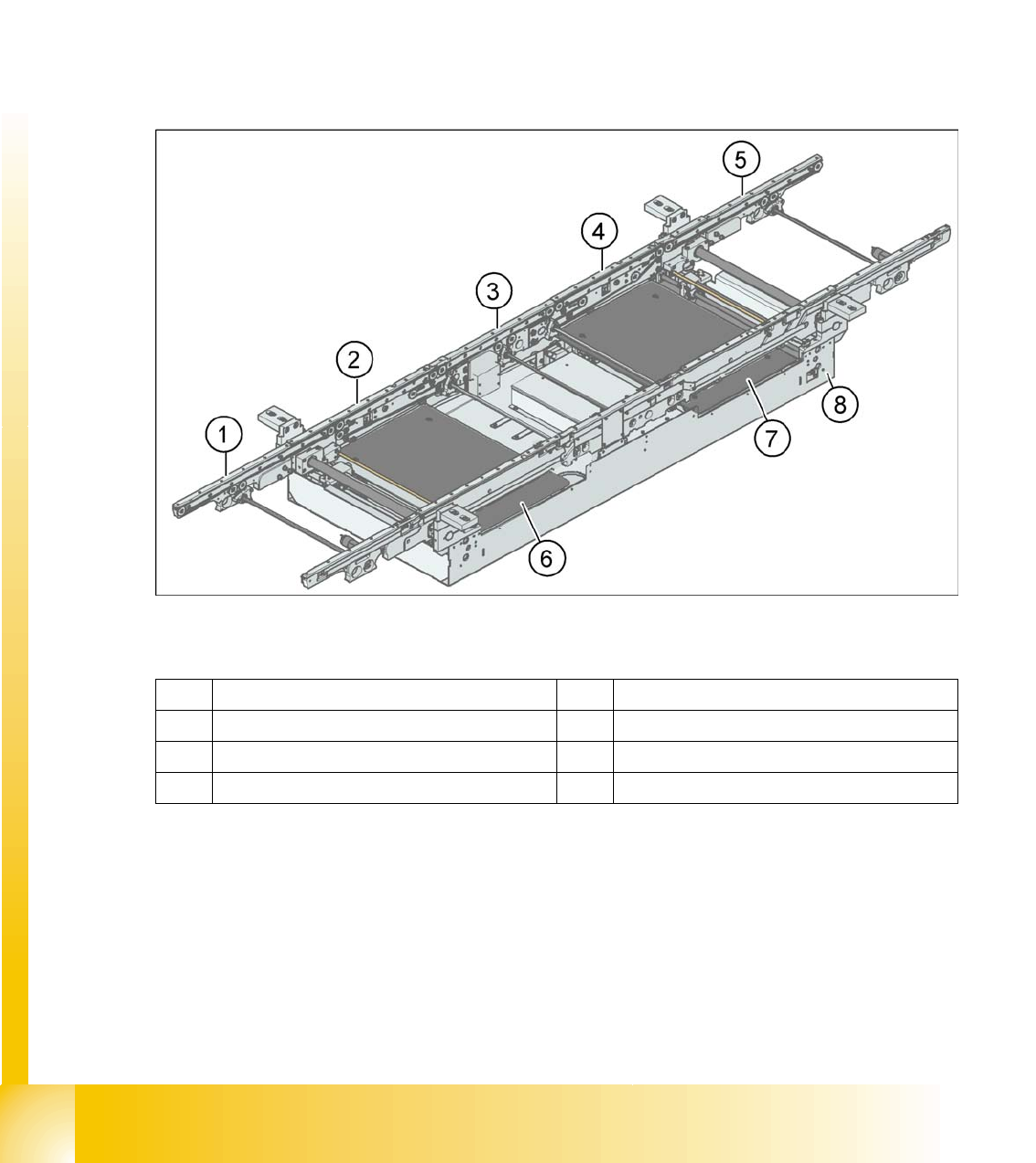
11.1.11 Structure of the single conveyor
11.1 - 1: PCB transport - single conveyor
Legend
In SIPLACE machines, the single conveyor system consists of an input conveyor, two placement areas,
the intermediate conveyor and the output conveyor. The conveyor has an automatic width adjustment
unit and a lifting table for clamping the PCB.
1 Eingabeband 5 Ausgabeband
2 Placement area 1 6 Lifting table, placement area 1
3 Intermediate conveyor 7 Lifting table, placement area 2
4 Placement area 2 8 Mounting frame