Techcon-Piezo-Jet-Valve-Dispensing - 第3页
Jet valv es—both the older pneumatic jet technology and the new er piez o jet technology—gain a signifi - cant speed advantage primarily b y eliminating the Z axis of mo vement. T he height sensing and re-po - sitioning …
If your operation needs
the ultimate in speed and
precision, the cutting edge
of dispensing technology
may be right for you.
By Can La, Product Manager, Techcon
Selecting the automated dispensing technology that
is the best fit for a specific application from the half
dozen or so familiar technologies available—such as
the auger valve, progressive cavity pump, time pres-
sure valve or pneumatic jet valve—is not a consid-
eration to be made lightly. For most operations, the
consequent match is adequate, and attributes such as
throughput and quality are well suited to the applica-
tion on an ongoing basis. For others, however, such as
medium to high volume mobile device, LED, consum-
er electronic and medical device assemblers, there is a
constant drive for the ever higher yields that can drive
improved profitability, and for an advanced dispens-
ing technology that can better help them achieve it.
For these users, there is a relatively new technology
that can increase dispensing rates for adhesives and
other fluids by some 20x or more—at rates, for com-
parison purposes, as fast as 1500 Hz continuously
with up to 2000 Hz maximum burst. It’s called the
Piezo Actuated Jet Dispensing Valve, and it dispenses
at about twice the speed of even the pneumatic jet
valve.
Operators are also often amazed at the impressive
placement precision and small and neat dot sizes
generated by a piezo jet valve, especially considering
that a) it is moving so fast, and b), the material is be-
ing shot and not being physically placed, as would be
the case with most dispensing solutions that rely on
actual contact with the substrate. Using sophisticated
controllers, shot sizes can be achieved as small as .5
nanoliter, with outstanding consistency and repeat-
ability. This precision also makes the piezo jet suitable
for some other niche applications where speed is less
of a factor, but where operators have a challenging
time achieving the desired dispensing of ultra-small
dots or ultra-thin lines consistently over time.
2X FASTER
than pneumatic
jet solutions

Jet valves—both the older pneumatic jet technology
and the newer piezo jet technology—gain a signifi-
cant speed advantage primarily by eliminating the
Z axis of movement. The height sensing and re-po-
sitioning and the up and down motion that is nec-
essary for contact-based valves such as progressive
pump and auger valve technologies—with the needle
moving down to touch the substrate to dispense the
fluid and then pull back up—while reasonably fast by
most criteria, account for a high percentage of the
required dispensing time. Contact-less jet dispens-
ing, by contrast, shoots the material accurately from
a fixed location above the substrate, shot after shot.
This enables the pneumatic jet valve to reclaim this
excess motion time and dispense at speeds some 10x
faster than contact-based valves.
However, while the pneumatic jet valve technology
leaves the speed enhancement at “only” 1000%, the
piezo jet valve ups the ante considerably. In these de-
vices, rather than relying upon air pressure, a piezo-
electric actuator converts an electrical signal into a
highly precise motion that dispenses the material
in the desired pattern far faster than a mechanical
pneumatic based solution, which must open and
close and reset, a process which ex-
pends some 20 extra millisec-
onds each time. In this
way, speeds up
to 2000%
faster than contact-based solutions—2x faster than
pneumatic jet solutions—can be achieved. For speed
sensitive, high volume, high throughput applications,
the increase in yield can be extraordinary—and highly
profitable.
Further, the ability of the piezo technology to deliver
the smallest dots or lines—with micro shots as small
as .5 nanoliters—is hard to beat. As is the accuracy
and repeatability of each and every dispense.
Another huge advantage of the piezo jet technology
is its ability to deliver this up to 1500 Hz speed even to
those operations involved with the production of sub-
strates with irregular heights, or those where hard-
er-to-access “nooks and crannies” must be reached.
Since the fluid is shot rather than dropped, nozzles
can be more readily angled to reach the exact point
where material is required. Further, since the nozzle
doesn’t need to drop down on the item, products
with irregular protrusions such as a motherboard with
high spots won’t be damaged as they might be when
utilizing a contact-based valve that must come down
close to the substrate, eliminating a common source
of damage, waste and downtime.
Rather than relying upon air
pressure, a piezo electric actuator
converts an electrical signal into a
highly precise motion
Piezo Jet Technology
where the speed comes from
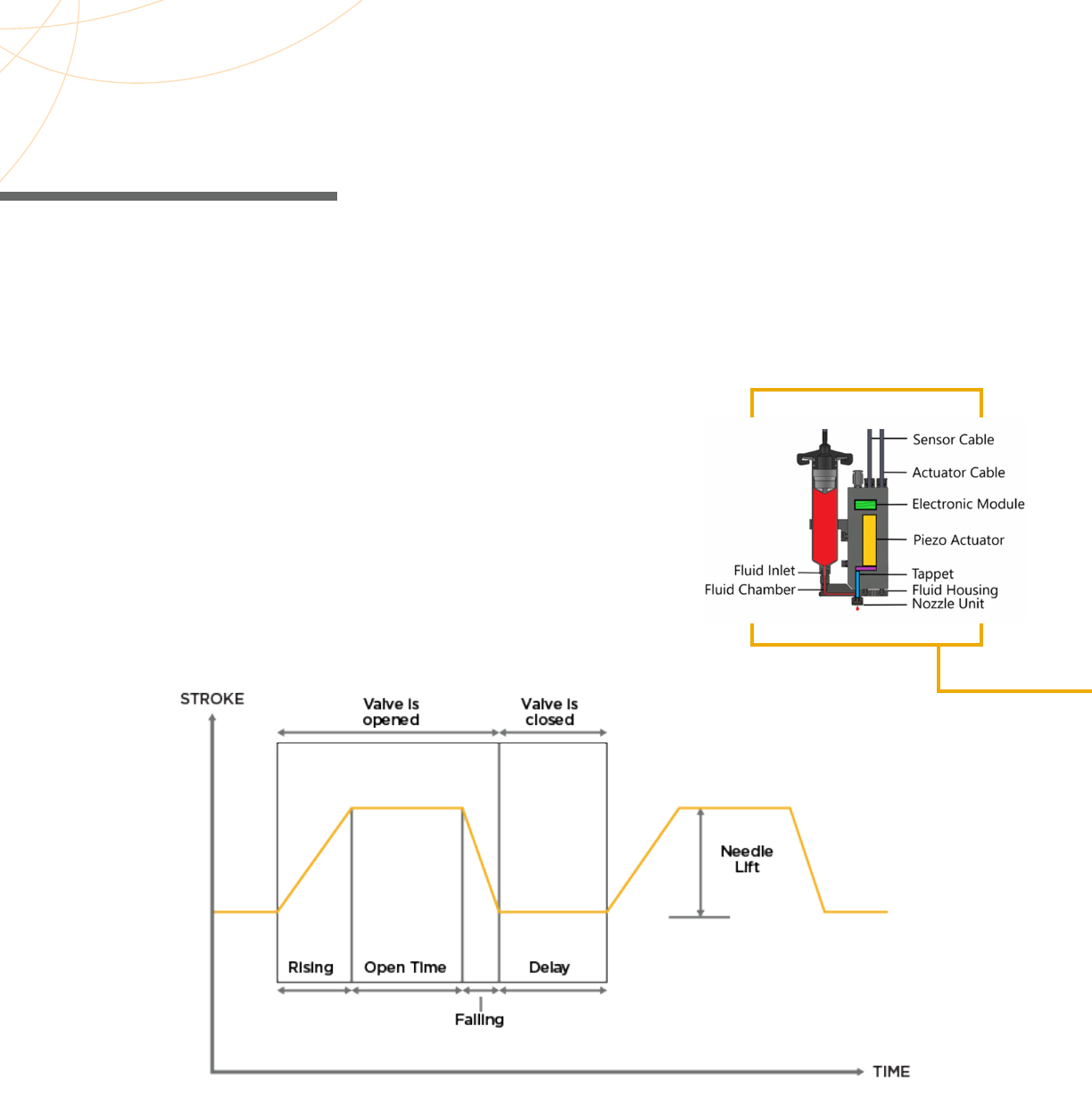
In a piezo jet valve cycle, the fluid starts up inside the valve, held between the tappet (piston) and the
nozzle. The electronic piezo crystal oscillates up and down at a high rate of speed, generating kinetic
energy that forces the fluid to shoot out under carefully controlled pressure to form a perfect bead of
material at the target location.
How It Works
A complete, five step piezo jetting cycle consists of:
• Rising Time - Total time for the tappet to move to open position
• Open time - Total time the valve stays opened
• Falling time - Total time for the tappet to move to closed position
• Needle lift - is the stroke length, based on the viscosity of the materal.
• Delay time - Time the valve stays closed, waiting for the next cycle
All of these steps can occur, repeated over and over again, up to 1500 times per second continuously, with that
number an objective basis for comparison with other dispensing methods being considered. Under real world
conditions, the number of drops dispensed per second will be impacted by factors such as desired shot size,
the viscosity of the material, and the speed of the horizontal movement of the substrates being assembled.
In use, as noted, contact-less piezo jet valves can typically dispense about 20x faster than any contact valve.