Techcon-Piezo-Jet-Valve-Dispensing - 第5页
When considering upgr ading to the po wer of a piez o jet valv e dispensing sy stem, a vital point to be a war e of is that the phr ase “jet valv e” can refer t o both the older pneumatic jet v alve as w ell as the new e…
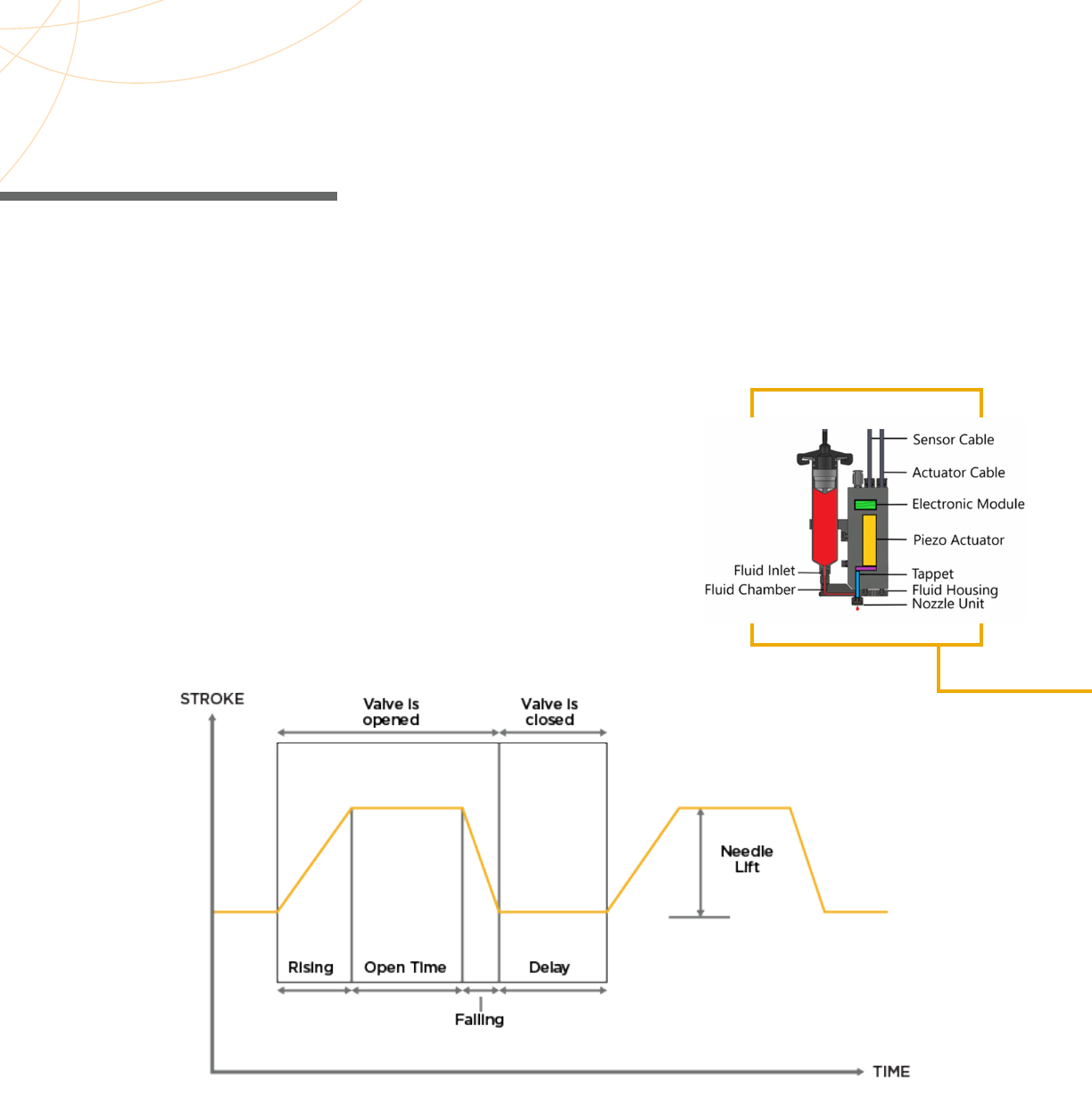
In a piezo jet valve cycle, the fluid starts up inside the valve, held between the tappet (piston) and the
nozzle. The electronic piezo crystal oscillates up and down at a high rate of speed, generating kinetic
energy that forces the fluid to shoot out under carefully controlled pressure to form a perfect bead of
material at the target location.
How It Works
A complete, five step piezo jetting cycle consists of:
• Rising Time - Total time for the tappet to move to open position
• Open time - Total time the valve stays opened
• Falling time - Total time for the tappet to move to closed position
• Needle lift - is the stroke length, based on the viscosity of the materal.
• Delay time - Time the valve stays closed, waiting for the next cycle
All of these steps can occur, repeated over and over again, up to 1500 times per second continuously, with that
number an objective basis for comparison with other dispensing methods being considered. Under real world
conditions, the number of drops dispensed per second will be impacted by factors such as desired shot size,
the viscosity of the material, and the speed of the horizontal movement of the substrates being assembled.
In use, as noted, contact-less piezo jet valves can typically dispense about 20x faster than any contact valve.
When considering upgrading to the power of a piezo
jet valve dispensing system, a vital point to be aware
of is that the phrase “jet valve” can refer to both the
older pneumatic jet valve as well as the newer piezo
crystal driven jet valve technology. While both tech-
nologies, as noted, are significantly faster than familiar
contact dispensing options such as the auger valve
or progressive cavity pump, the newer piezo version
of the jet valve ups the ante considerably, and as not-
ed can deliver some 2x the speed of the incumbent
pneumatic version. Nevertheless, since for so many
years “jet valve” referred only to “pneumatic jet valve,”
many people still use the terms interchangeably, and,
indeed, many potential users and even valve manu-
facturers are relatively unfamiliar with the piezo jet
valve or have not yet had the impressive experience
of seeing it in action. In other words, it behooves the
buyer to specifically refer to “piezo” in all discussions
to ensure that everyone is on the same page.
Currently several manufacturers provide piezo jet
valve dispensing solutions, and, as one would expect,
a number of aspects of their design as related to both
the valve itself and the related controller can differ
significantly.
For example, a key issue to consider is the relative
ease of identifying the right “recipe,” the combination
of parameters to ensure correct placement and the
correct amount of material. Piezo valves gain much of
their small dot consistency through not only making
use of tiny aperture nozzles but also by providing
the flexibility to fine-tune both material pressure
and jetting pressure. Once the correct parameters
are determined, the valve is extremely accurate and
consistent in maintaining them, but getting to that
point can and often does take some trial and error.
Key in reducing the challenge are the capabilities
of the controller provided, as well as any assistance
that might be available from the manufacturer. As to
the latter, some manufacturers might just look at an
MSDS and render an opinion. Others will offer some
level of hands-on testing of your material in their labs
to assure efficacy. Further, they might be willing to
use the knowledge gained to help you more quickly
fine tune the parameters back in your operation. It
pays to inquire before the sale.
Even more impactfully, the user interface of the con-
troller can make a huge difference in the relative ease
in determining the proper parameters, and therefore
the level of potential wasted product or loss of pro-
ductive uptime during initial product set up.
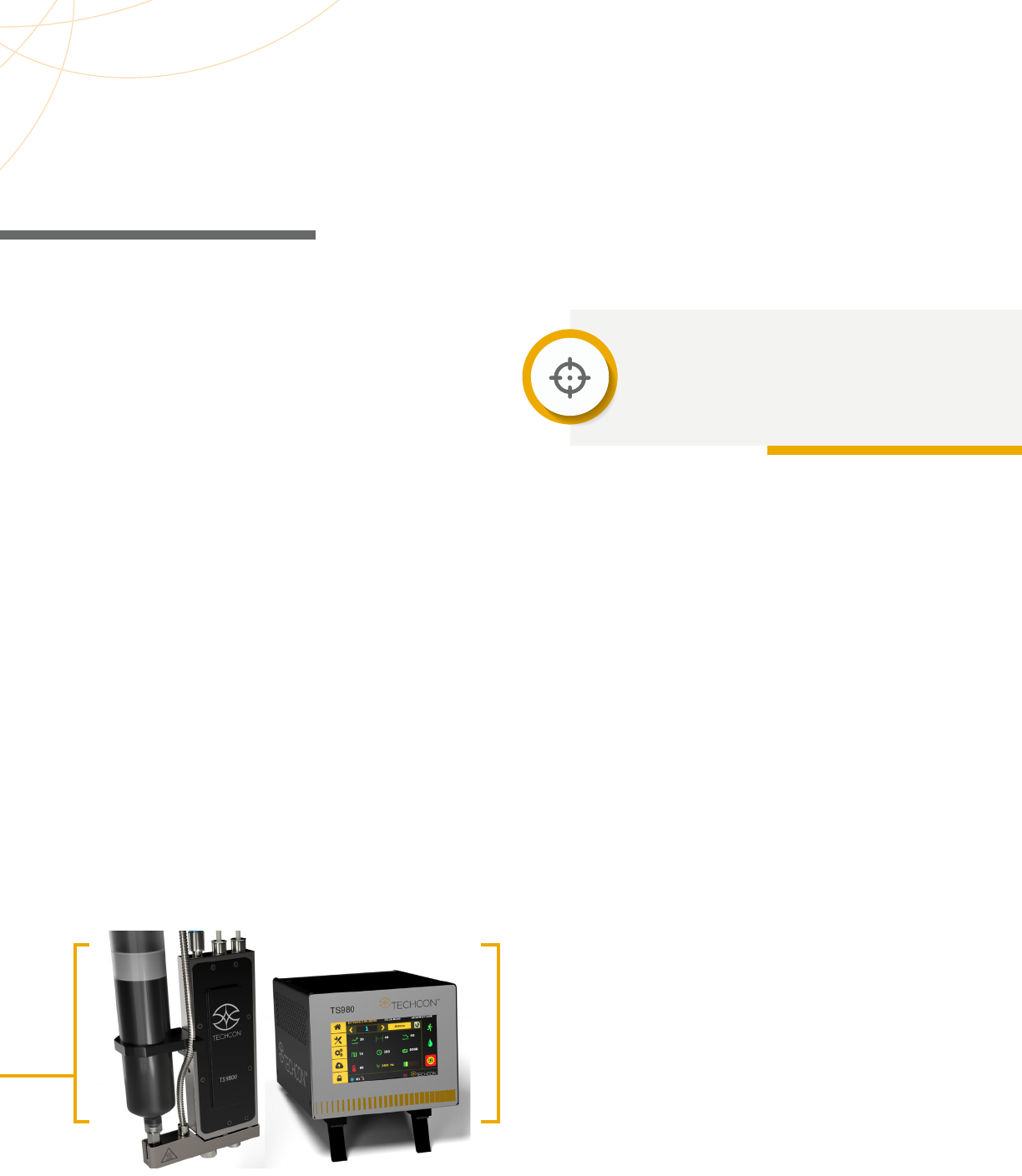
Techcon TS9800 Series Jet Valve
Highly repeatable and precise
dispensing for outstanding
process control
Ease of use, size of footprint
and other purchasing considerations

Some piezo jet dispensing systems require manual
tweaking with varying levels of precision; others pro-
vide the ability to fine-tune using software allowing
the operator to modify the jetting properties for dif-
ferent fluid types and optimize the process for repeat-
able dispensing; and some are entering the market
that include even more full-featured controllers with
touch screens and graphic interfaces that optimize
usability and make set up faster and more intuitive
than in the past. Some manufacturers are raising the
bar even further by providing the ability to set param-
eters as well as monitor and troubleshoot remotely,
allowing operators to control their systems from any-
where at any time, even from across the ocean, using
an app on their phone or tablets. These piezo jet valve
models would fit right in to the operation of a sophis-
ticated Industry 4.0-based smart factory—or one that
is working towards becoming one.
The amount of space that the piezo jet units require
may also be of great importance to both benchtop
users and machine integrators. For the former, sleeker
units mean smaller work area demands and more
efficient delineation of factory space. For the latter,
with the speed and precision benefits of the piezo jet
valve, machine builders are more and more frequently
looking to build one or several units into high end
automation application equipment, combining them
in the cabinet with robots and other complementary
devices to deliver truly best-in-class capabilities to
their customers. Towards this end, the relative size,
weight and footprint of the individual brand piezo
jetting dispensing valves being considered may be
worth noting.
A more esoteric issue is the fact that, of all the dis-
pensing valve technologies available on the market,
in addition to being the most advanced, the piezo
jet is also, by far, the most challenging to manufac-
ture. The tolerances on components such as the
nozzle and tappet are extremely tight, and crafting
them accurately is beyond the capabilities of many
parts fabricators. Piezo jet models that cut costs us-
ing less complying components would be likely to
quickly demonstrate issues such as fluids dispensed
out of place, inconsistent speeds, cleaning challeng-
es, frequent failures and other problems that would
negatively impact productivity and quality. Speaking
to other users about their experiences in this regard
might be a good part of the due diligence process as
one weighs the relative benefits of different models.
20x faster dispensing
speeds compared
to a contracting
dispensing valve
Industry 4.0 compliant
for remote access
and control over
Ethernet networks
Reduces downtime and
scrap by eliminating risk
of needle crashing
into the workpiece
Ease of use, size of footprint
and other purchasing considerations
(cont.)
4.0