Techcon-Piezo-Jet-Valve-Dispensing - 第6页
Some piez o jet dispensing syst ems requir e manual tweaking with v arying lev els of precision; others pr o - vide the ability to fine-tune using softw are allo wing the opera tor to modify the jetting pr operties for d…
When considering upgrading to the power of a piezo
jet valve dispensing system, a vital point to be aware
of is that the phrase “jet valve” can refer to both the
older pneumatic jet valve as well as the newer piezo
crystal driven jet valve technology. While both tech-
nologies, as noted, are significantly faster than familiar
contact dispensing options such as the auger valve
or progressive cavity pump, the newer piezo version
of the jet valve ups the ante considerably, and as not-
ed can deliver some 2x the speed of the incumbent
pneumatic version. Nevertheless, since for so many
years “jet valve” referred only to “pneumatic jet valve,”
many people still use the terms interchangeably, and,
indeed, many potential users and even valve manu-
facturers are relatively unfamiliar with the piezo jet
valve or have not yet had the impressive experience
of seeing it in action. In other words, it behooves the
buyer to specifically refer to “piezo” in all discussions
to ensure that everyone is on the same page.
Currently several manufacturers provide piezo jet
valve dispensing solutions, and, as one would expect,
a number of aspects of their design as related to both
the valve itself and the related controller can differ
significantly.
For example, a key issue to consider is the relative
ease of identifying the right “recipe,” the combination
of parameters to ensure correct placement and the
correct amount of material. Piezo valves gain much of
their small dot consistency through not only making
use of tiny aperture nozzles but also by providing
the flexibility to fine-tune both material pressure
and jetting pressure. Once the correct parameters
are determined, the valve is extremely accurate and
consistent in maintaining them, but getting to that
point can and often does take some trial and error.
Key in reducing the challenge are the capabilities
of the controller provided, as well as any assistance
that might be available from the manufacturer. As to
the latter, some manufacturers might just look at an
MSDS and render an opinion. Others will offer some
level of hands-on testing of your material in their labs
to assure efficacy. Further, they might be willing to
use the knowledge gained to help you more quickly
fine tune the parameters back in your operation. It
pays to inquire before the sale.
Even more impactfully, the user interface of the con-
troller can make a huge difference in the relative ease
in determining the proper parameters, and therefore
the level of potential wasted product or loss of pro-
ductive uptime during initial product set up.
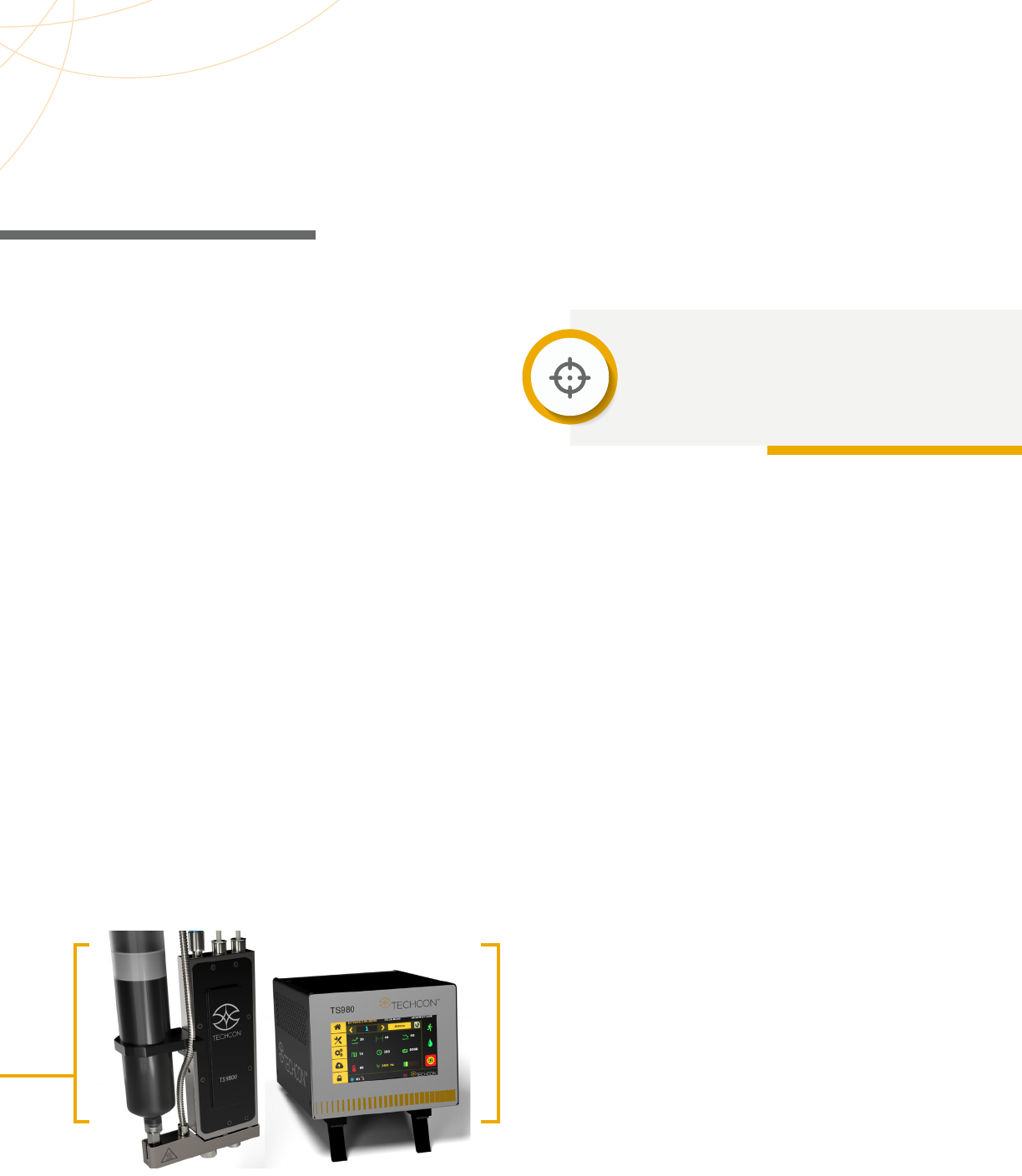
Techcon TS9800 Series Jet Valve
Highly repeatable and precise
dispensing for outstanding
process control
Ease of use, size of footprint
and other purchasing considerations

Some piezo jet dispensing systems require manual
tweaking with varying levels of precision; others pro-
vide the ability to fine-tune using software allowing
the operator to modify the jetting properties for dif-
ferent fluid types and optimize the process for repeat-
able dispensing; and some are entering the market
that include even more full-featured controllers with
touch screens and graphic interfaces that optimize
usability and make set up faster and more intuitive
than in the past. Some manufacturers are raising the
bar even further by providing the ability to set param-
eters as well as monitor and troubleshoot remotely,
allowing operators to control their systems from any-
where at any time, even from across the ocean, using
an app on their phone or tablets. These piezo jet valve
models would fit right in to the operation of a sophis-
ticated Industry 4.0-based smart factory—or one that
is working towards becoming one.
The amount of space that the piezo jet units require
may also be of great importance to both benchtop
users and machine integrators. For the former, sleeker
units mean smaller work area demands and more
efficient delineation of factory space. For the latter,
with the speed and precision benefits of the piezo jet
valve, machine builders are more and more frequently
looking to build one or several units into high end
automation application equipment, combining them
in the cabinet with robots and other complementary
devices to deliver truly best-in-class capabilities to
their customers. Towards this end, the relative size,
weight and footprint of the individual brand piezo
jetting dispensing valves being considered may be
worth noting.
A more esoteric issue is the fact that, of all the dis-
pensing valve technologies available on the market,
in addition to being the most advanced, the piezo
jet is also, by far, the most challenging to manufac-
ture. The tolerances on components such as the
nozzle and tappet are extremely tight, and crafting
them accurately is beyond the capabilities of many
parts fabricators. Piezo jet models that cut costs us-
ing less complying components would be likely to
quickly demonstrate issues such as fluids dispensed
out of place, inconsistent speeds, cleaning challeng-
es, frequent failures and other problems that would
negatively impact productivity and quality. Speaking
to other users about their experiences in this regard
might be a good part of the due diligence process as
one weighs the relative benefits of different models.
20x faster dispensing
speeds compared
to a contracting
dispensing valve
Industry 4.0 compliant
for remote access
and control over
Ethernet networks
Reduces downtime and
scrap by eliminating risk
of needle crashing
into the workpiece
Ease of use, size of footprint
and other purchasing considerations
(cont.)
4.0

In addition, there are some limitations to consider. For
examples, potential users should take into account
the type of materials they wish to dispense. Piezo jet
valves can be used with materials demonstrating a
very wide range of viscosities—up to two million cen-
tipoise or more and including materials as thick as sil-
icone and urethane rubber. However, due to the need
to evenly shoot the material, those that have solid par-
ticles blended into them, such as solder paste with its
ultrafine metal particles, are usually not the best can-
didates for any jet valve dispensing technology.
Lastly, and there’s no way around it—obtaining the su-
perior cutting edge technology of a piezo jet valve
likewise represents a larger upfront investment than
that of contact dispensing systems. However, it can be
surprisingly comparable in cost to the older pneumat-
ic jet valve considering how much faster it is. Further,
helping significantly defray the life cycle cost is the
fact that the most expensive part of the system, the
piezo assembly, is highly robust and rated at around
one billion—yes billion with a “b”—cycles. Neverthe-
less, if your process is not one that can benefit from
the highest speed dispensing available anywhere as
well as super high precision, the investment might not
be worth it. However, if a quantum leap in throughput
with super accuracy would be valuable to you, helping
to boost your profitability significantly almost over-
night, then a piezo jet valve might be a highly desir-
able investment indeed.
Is a Piezo Jet Valve right for you?
10800 Valley View Street
Cypress, CA 90630
U.S. Corporate Headquarters
OK International/Techcon Headquarter
714-230-2355
714-828-2001
oemorders@okinternational.com
www.techcon.com
European Corporate Office
OK International/Techcon
Eagle Close, Chandler’s Ford Industrial Estate, Eastleigh
Tel: English +44 2380 489 100
Tel: Français: +33 176 710 403
Tel: Deutsch: +49 (0)3222 109 1900
Email: Europe-Orders@okinternational.com
China Corporate Office
OK International/ Techcon
4th floor East, The Electronic Building Yanxiang Industrial
Zone High Tech Road, Guangming New District
Shenzhen, P.R.C
Tel: +86-755-2327 6366
Fax: +86-755-2329 5492
Email: china@okinternational.com
Highly robust
and rated at around
1 BILLION CYCLES