80S-20用户手册 - 第146页
3 Introduction and basic concepts SIPLACE 80S-20/F4 User Manual 3.3 User interface - views and me nus Software version S R.407.xx 01/2001 US Edition 146 Cluster for fi ne calibration. .. 3 In the "S tand alon e"…
SIPLACE 80S-20/F4 User Manual 3 Introduction and basic concepts
Software version SR.407.xx 01/2001 US Edition 3.3 User interface - views and menus
145
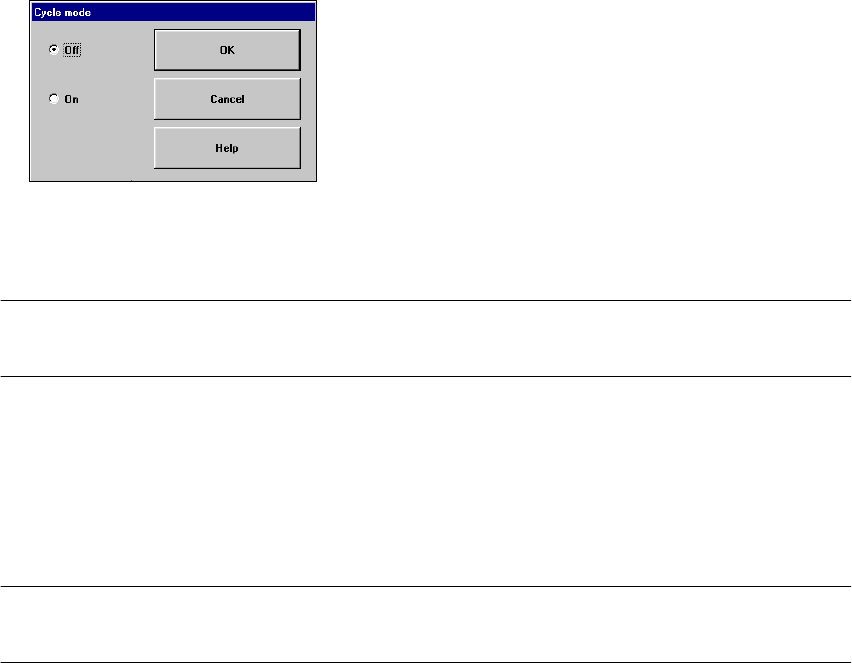
Cycle mode... Alt+t 3
You use this menu item to switch the station to cycle mode (e.g. to localize errors). 3
Å Click the menu item Cycle mode... or press the key combination ALT+t. The "Cycle mode"
settings box is opened.
Å Click the On radio button to activate cycle mode or the Off radio button to deactivate it.
Å Click the OK button. Cycle mode is now either activated or deactivated.
NOTE
In cycle mode, you must press the Start button on the machine for every operating step. 3
Load table program 3
This menu item allows you to reload the table program into the memory of the table program
controller. You may need to do this, for example, if a machine error has resulted in the loss of the
table program. 3
NOTE
This function cannot be executed in "Operator" access mode. 3
Å Click the menu item "Load table program".
The program is loaded. (The loading process can take some time).
Video image > Alt+8 3
In the case of certain actions, it may be necessary to display the camera image of the MVS system
on-screen (vision analysis unit) during assembly. 3
Å Click the menu item Video image > or press the key combination ALT+8.
The display area is switched to the MVS system camera image in processing area 1.
Å Press then ESC key to restore the display area to the normal view.

3 Introduction and basic concepts SIPLACE 80S-20/F4 User Manual
3.3 User interface - views and menus Software version SR.407.xx 01/2001 US Edition
146
Cluster for fine calibration... 3
In the "Stand alone" control mode, you can use this menu item to load the data of a selected
cluster (placement program) from the station computer’s hard disk. 3
NOTE
The data for the cluster selected in the box is designed for the assembly of special glass compo-
nents on a glass PCB. The assembled glass PCB is then used for fine calibration in conjunction
with the SITEST test program. 3
Å Click the menu item Cluster for fine calibration...
Å In the box which is now displayed, select the entry corresponding to the required cluster and
click OK to confirm your selection.
The cluster data is now loaded.
GEM-Defaults ... 3
You use this item to specify the GEM parameters which are used as the default parameters when
the station is switched on. 3
Å Click the menu item GEM-Defaults...
The window in which you set the GEM default parameters is now opened.
For a detailed description, refer to Chapter 12
.
Fluxing ... 3
In order to apply flux for placing flip-chips on a PCB, the process data for the flip-chip must be
entered in a list and general flux application parameters must be entered on the station computer.3
Å Click the menu item Fluxing....
For a more extensive description of the procedure refer to 11
.
PCB barcode ... 3
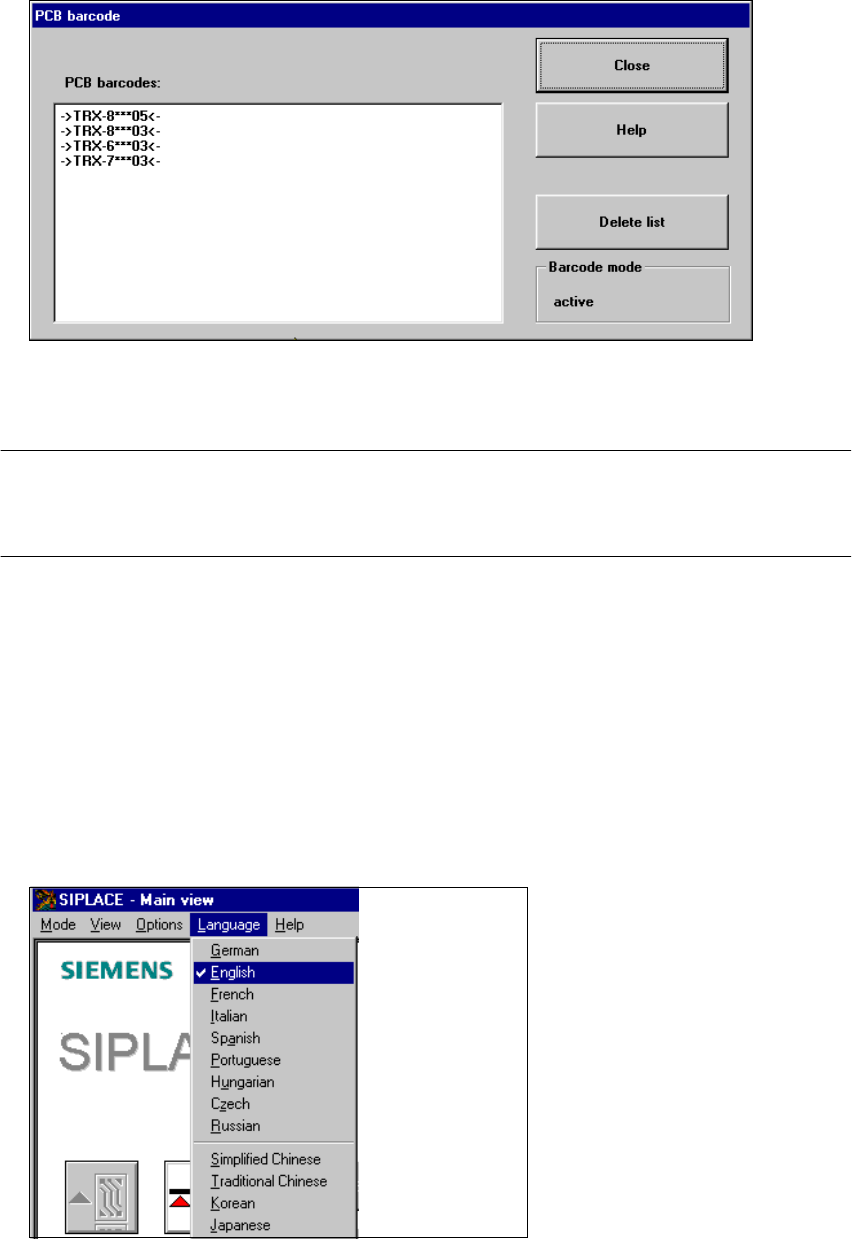
You use this item to display a dialog box with a list of the barcodes most recently read by the PCB
barcode reader.
This dialog box also informs you if an error occurred while reading the barcode, if the file format
is incorrect or if no data is available. 3
NOTE
You cannot call the menu item "PCB barcode ..." unless the PCB barcode reader has been
installed in the machine and has been activated in the machine options. 3
Å Click the menu item PCB barcode ...
The "PCB barcode" dialog box is opened.
SIPLACE 80S-20/F4 User Manual 3 Introduction and basic concepts
Software version SR.407.xx 01/2001 US Edition 3.3 User interface - views and menus
147
3
Å Click the Delete list button if you want to delete all the entries in the list.
Å Click the Close button to close the dialog box.
NOTE
The current status of barcode operation is displayed below the "Delete list" button. Barcode
operation is activated or deactivated in the LC program. 3
3.3.2.4 "Language" menu
You can use the "Language" menu to select between the language versions which are integrated
in the SC software.
You can chose between the languages "German", "English", "French", "Italian", "Spanish", "Portu-
guese", "Hungarian", "Czech", "Russian", "Simplified Chinese", "Traditional Chinese", "Korean"
and "Japanese". 3
Å Click the menu item corresponding to the required language.
The user interface texts are displayed in the selected language.
3