80S-20用户手册 - 第219页
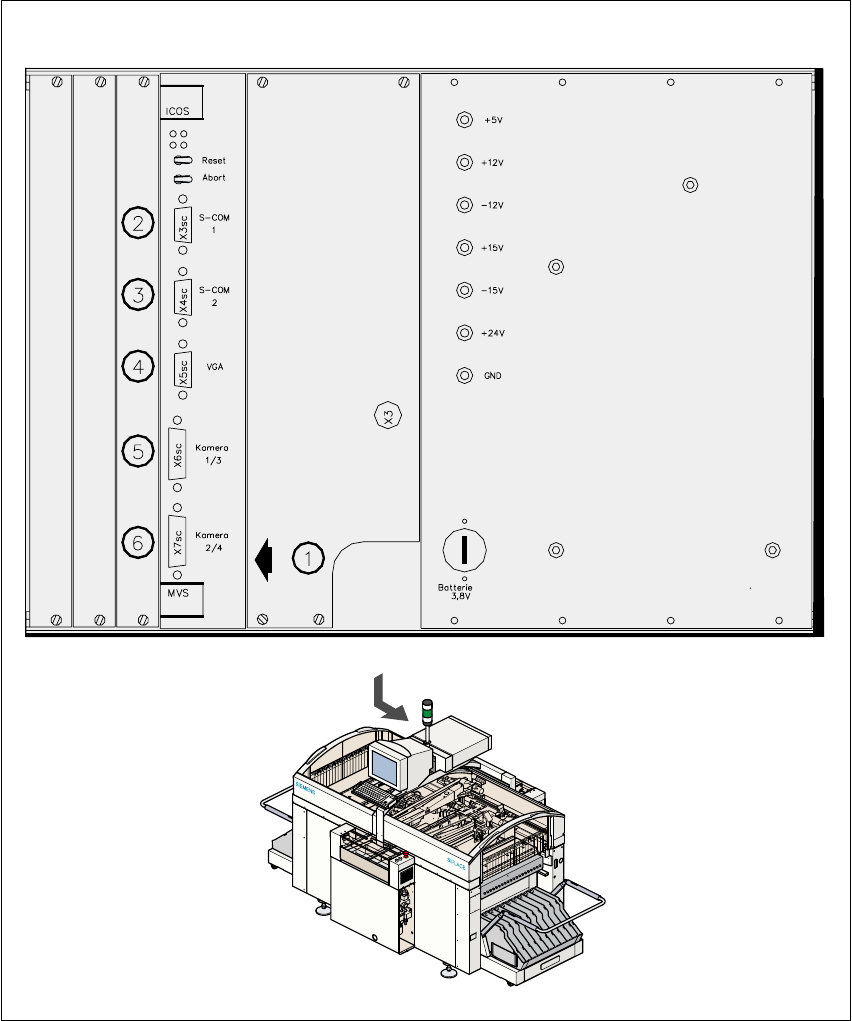
SIPLACE 80S -20/F4 User Manual 6 Vision functions Software version SR.407.xx 01/2001 US Edition 6.1 The vision systems on the placement machine 219 6 Fig. 6.1 - 6 Vision analys is unit 6

6 Vision functions SIPLACE 80S-20/F4 User Manual
6.1 The vision systems on the placement machine Software version SR.407.xx 01/2001 US Edition
218
6.1.4 Vision analysis unit
The vision analysis unit (see item 1 and 2 in Fig. 6.1 - 6) plugs into the machine’s control unit. It
processes and analyzes the electrical signals from the component and PCB camera systems.
Corrected values are calculated from any deviations from setpoint. These values are then used to
recalculate the placement positions and rotational angle for placement. 6
The vision analysis unit also performs a component identification process. If the synthetic model
and the package form measurement do not tally, for example, the component will not be placed. 6
The precise component pick-up position, which is particularly important for small components, is
also determined in the vision analysis unit. Fiducials on the feeders are used to determine the de-
viation in position of the individual feeders. 6
The electronic image signals from components, PCB fiducials, and feeder fiducials can be trans-
ferred from the vision analysis unit, via the video multiplexer, to the station monitor, where they are
used for measuring and testing purposes. 6
6
6
6
Key to Fig. 6.1 - 6
(1) Vision analysis unit
(2) COM1 interface
(3) COM2 interface
(4) HS
3
L interface
(5) Camera connections:
(6) Camera connections
6
6
S-20 F4
1 PCB camera, gantry 1 PCB camera
3 CO camera, gantry 1 CO camera, 12-segment Collect&Place head
S-20 F4
2 PCB camera, gantry 2 Fine-Pitch-vision modul
4 CO camera, gantry 2 Flip-Chip-vision modul
SIPLACE 80S-20/F4 User Manual 6 Vision functions
Software version SR.407.xx 01/2001 US Edition 6.1 The vision systems on the placement machine
219
6
Fig. 6.1 - 6 Vision analysis unit
6

6 Vision functions SIPLACE 80S-20/F4 User Manual
6.2 PCB vision system Software version SR.407.xx 01/2001 US Edition
220
6.2 PCB vision system
The PCB vision system records the precise position of the PCB by measuring fiducials, and cal-
culates the offset in the X and Y directions, the angle of rotation relative to the PCB transport di-
rection and the shear acting on the PCB. Reject fiducials (ink spots) are also recorded and
analyzed by the PCB vision system. 6
6.2.1 System description
The PCB vision system for detecting the position of PCBs consists of the optical PCB position de-
tection system and the vision analysis unit 6
Optical PCB position detection system 6
Each gantry has a separate PCB position detection system (see Fig. 6.1 - 5 on page 216). 6
Vision analysis unit 6
On each machine, an analysis unit for PCB and component position recognition is housed in the
control unit (see Fig. 6.1 - 6
, page 219). 6
A CCD camera (SONY XC75) with integral mapping and illumination lens forms the optical PCB
position detection system. The field of view of the PCB module is 5.7 mm x 5.7 mm. The size and
position of the search field can be programmed as required within the fields of view. The mapping
lens is a special measuring lens which corrects most errors caused by the curvature of the PCB.
The illumination is switched on only while fiducials are being recorded. 6
The vision analysis unit (MVS) is a single-board system conforming to VME standards. The hard-
ware consists of 6
– the MVS motherboard with vision processor and interface connections
– and the MVS camera interface for up to four CCD cameras.
MVS motherboard with vision processor and interface connections 6
The two VME bus connections are located on the back of the VME module. 6
The front panel of the VME module contains connectors for 6
– the monitor (VGA mode, 15-pin SUBD connector)
– the high-speed interface (HS
3
L), 9-pin SUBD connector
– up to 4 camera inputs (2 x 15-pin SUBD connector)
– two serial interfaces (RS232 for COM1 with a 25-pin SUBD connector and COM2 with a
9-pin SUBD connector)