00198442-04_UM_TX-V2_EN.pdf - 第73页
Instruction manual SIPLACE TX 2 Operational safety From software version 714.0 12/2020 2.4 Safety instructions for operation 73 2.4 Safety instructions for operation 2.4.1 Safety instructions for c losing the protective …
2 Operational safety Instruction manual SIPLACE TX
2.3 Classification of camera systems From software version 714.0 12/2020
72
2.3.2 Classification of the camera systems
2.3.2.1 Camera types with bright LEDs - risk group 1
The bright LEDs are fitted in the following cameras. These are classified as risk group 1, according
to IEC 62741:.
– Component camera type 23, 30, 41 and 45
– Stationary component camera type 25 and 33
– PCB camera, type 54
2
2.3.2.2 Camera types with blue LEDs - risk group 2
The ultra-bright blue LEDs are fitted in the following cameras. These are classified as risk group
2, according to IEC 62741:.
– Component camera, type 48
2
2
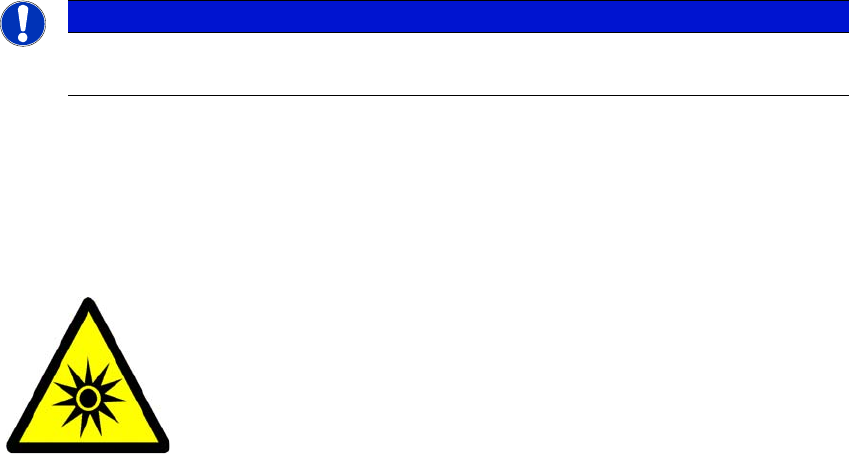
PLEASE NOTE
Risk group 1
Do not look into the beam of the ready-for-operation camera!
2
Risk group 2
The beam from cameras with ultra-bright blue LEDs can be a haz-
ard.
Do not look into the beam of the ready-for-operation camera!
Instruction manual SIPLACE TX 2 Operational safety
From software version 714.0 12/2020 2.4 Safety instructions for operation
73
2.4 Safety instructions for operation
2.4.1 Safety instructions for closing the protective covers
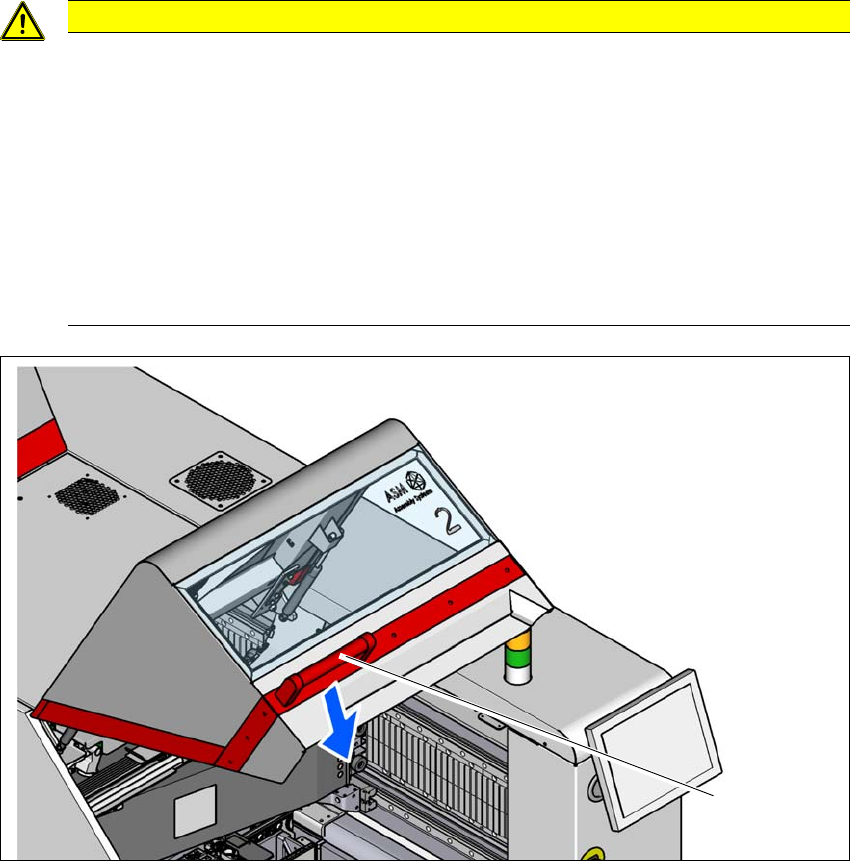
The protective covers can be opened upwards in two positions (45° or 60°). To avoid risk of injury
when closing the protective covers on the placement machine, the operator must instruct the per-
sonnel concerned to always follow the instructions below when handling the protective covers.
2
2
Fig. 2.4 - 1 Safety instructions for closing the protective covers
(1) Handle
CAUTION
Risk of crushing hands!
Risk of crushing hands if the protective covers are not closed correctly.
Close the protective covers in accordance with the following instructions.
To open or close the protective covers, always take hold of these by the grab
handles (1).
When closing, do not reach into the gap between the protective cover and
panel.
When closing the protective cover, make sure that the area in which it is swiv-
eled is free of obstruction and that no other people are at risk of injury.
(1)

2 Operational safety Instruction manual SIPLACE TX
2.4 Safety instructions for operation From software version 714.0 12/2020
74
2.4.2 Manual insertion of board into the input conveyor
2
Observe the warning instructions when inserting boards into the input conveyor.
Start moving the board into the conveyor with the Move Board In function on the SC GUI.
2.4.3 Safety instructions for processing capacitors
There is a risk associated with processing capacitors based on powdered metal (e.g. tantalum).
The risk is that
– an exothermic reaction, i.e. a sudden build-up of heat, may occur, if these components are
damaged. If the ambient conditions are unfavorable, and depending on the capacitance, this
buildup of heat can cause damage.
– This effect can occur when these components are cut.
Please contact your suppliers to clarify whether the components that you handle are affected.
In extremely rare cases, this risk can occur in the tape cutter of SIPLACE placement machines,
with the remote possibility of causing a smoldering fire in the waste tape.
The ambient conditions are unfavorable if:
(1) The components remain on the tape while the set tape cycle is checked (since the operator
can cycle the feeder module onward without removing components during this check).
(2) The components remain on the tape, e.g. due to a tear in the cover foil.
WARNING
Risk of injury to hands!
When manually inserting the board into the input conveyor, hands could be caught by the
gantry and injured due to unprohibited access to the hazard area of the gantry.
Do not manually place boards into the placement machines or placement lines re-
leased for production.
Manual insertion of boards is only permitted during the installation phase of the
placement machine (placement machine calibration, test placement, etc.).
Only qualified staff may manually insert boards.
The operating company is responsible for ensuring that the input and output convey-
ors are covered to prevent anyone reaching into these areas with hands or arms. All
upstream and downstream modules (screen printers, conveyors, inspection sys-
tems, ovens, etc.) must take these same precautions.