00191369-01.pdf - 第343页
User’s Manual SIPLACE HS-50 8 E rror In formation Software Vers ion SR.501.xx E dition 01/99 8.2 Calling error information 341 &DOOLQJH UURULQIR UPDWLRQ If an error occurs d uring op eration, a corresp ondin g …

8 Error Information User’s Manual SIPLACE HS-50
8.1 General Software Version SR.501.xx Edition 01/99
340
*HQHUDO
If errors occur during operations at the placement station, you can all up information
concerning the possible causes and ways of eliminating the error in question. To do this, you
start the help system for the station computer (see Chapter 9).
– You call error information on the currently displayed error by clicking the "Error information"
button in the main view (see section 8.2.1
).
– You can call up information on an observed error of a specific type by clicking the "Error
information" button in the corresponding error display (see section 8.2.2
).
User’s Manual SIPLACE HS-50 8 Error Information
Software Version SR.501.xx Edition 01/99 8.2 Calling error information
341
&DOOLQJHUURULQIRUPDWLRQ
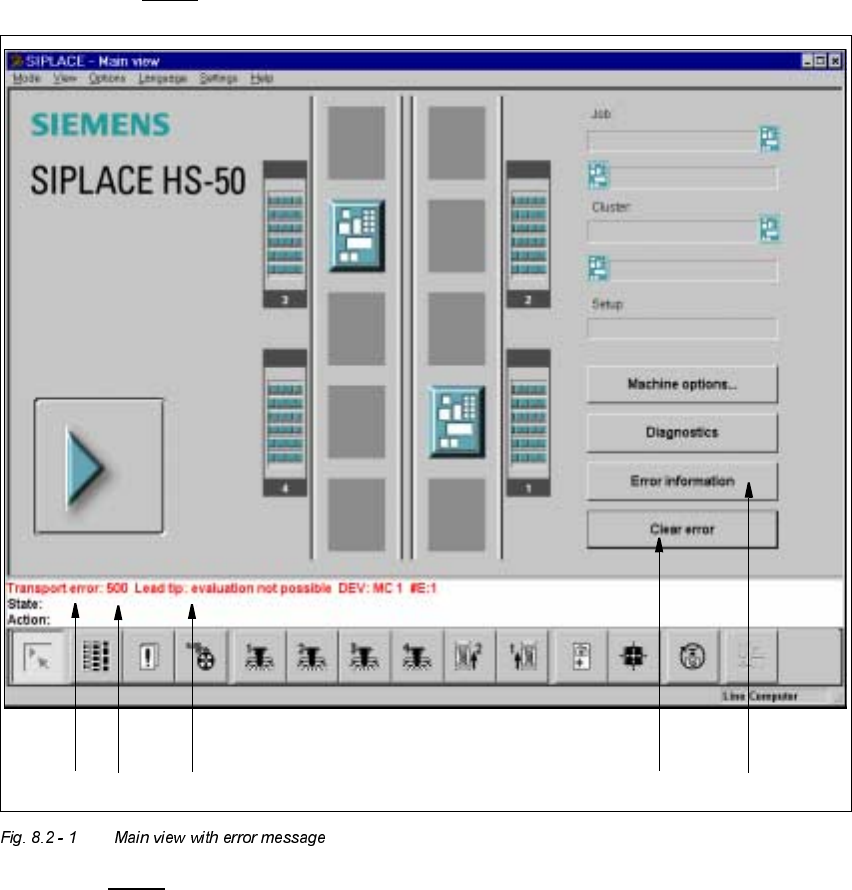
If an error occurs during operation, a corresponding error message is displayed in the status
bar in the user interface. In main view, the (UURULQIRUPDWLRQ and& OHD UHUURU buttons are
active (see Fig. 8.2 - 1
).
.H\WR)LJ
(1) Type of error (track, machine, transport or general error)
(2) Error number (the error number assigned to the error)
(3) Error message (summary information on error)
(4) "Clear error" button (to acknowledge the error after error elimination)
(5) "Error information" button (to call up help on the current error)
12 3 4 5
8 Error Information User’s Manual SIPLACE HS-50
8.2 Calling error information Software Version SR.501.xx Edition 01/99
342
'LVSOD\LQJLQIRUPDWLRQRQWKHFXUUHQWHUURU
Å In the main view, click the (UURULQIRUPDWLRQ button.
The main help system window is opened with error information on the current error (see
example in Fig. 8.2 - 3
).
'LVSOD\LQJLQIRUPDWLRQRQDVHOHFWHGHUURU
Å Click the icon in the toolbar in main view.
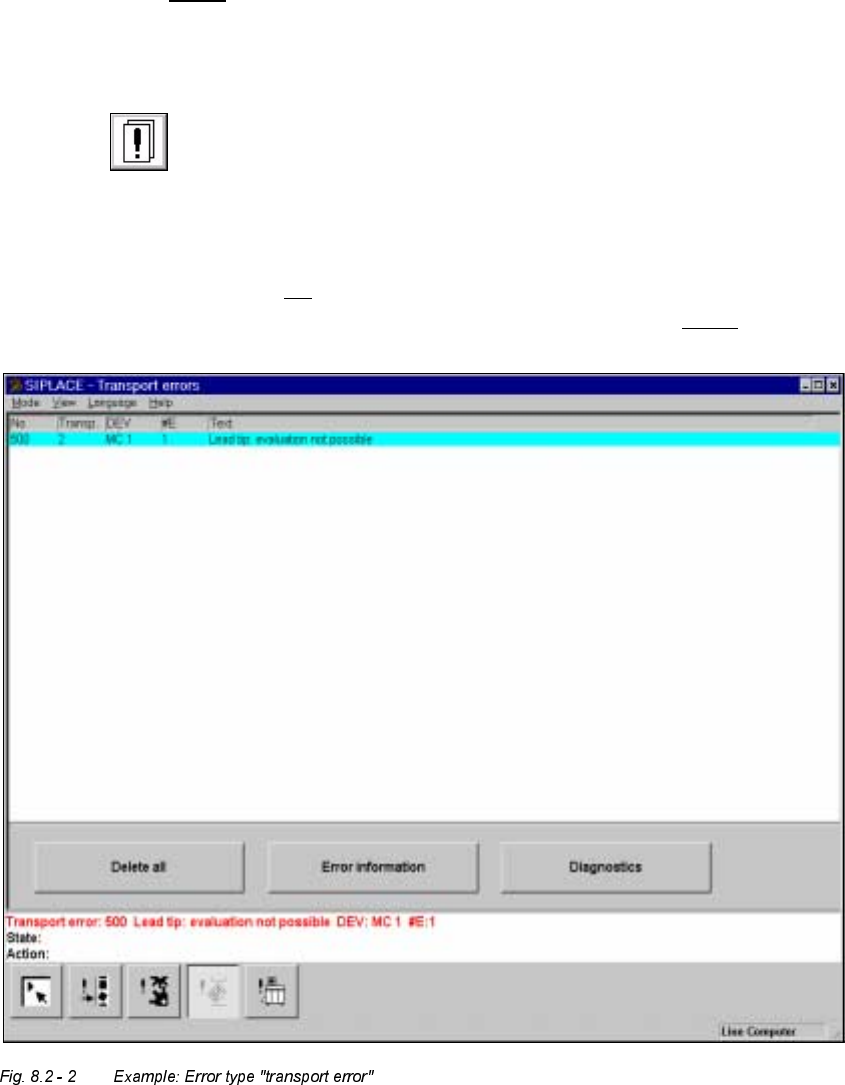
The user interface switches to the error display for the last error type to be active. All the
errors of the current error type which have occurred are listed in the display area.
Å If necessary, use the corresponding toolbar icon to switch the view to the required error
type (see Chapter 4, section 4.2
).
The display area is switched to the selected error type (see example in Fig. 8.2 - 2
).