Technical_reference - 第105页
Technical Service Manual 105 Revision Dat e: August 2004 THREE ACT UAT OR SYSTEM The f ollowing initialization procedure applies to a three actuator system and requir es two people to com plete it: 1. W ith the bonnet in…

Technical Service Manual 104 Revision Date: August 2004
TWO ACTUATOR SYSTEM
The following initialization procedure applies to a two actuator system and requires two people to complete it:
1. With the bonnet in the down position and the actuators properly connected mechanically and electrically, raise the
heat zone no more than 1".
2. Disconnect the power to the control box by shutting off the circuit breaker (F52) for at least 5 seconds.
3. On the operator control panel, turn the Hood selector switch to the DOWN position and hold while reconnecting
the main power to the actuator control box. Listen for a buzzing sound coming from the control box. At this point
the hood selector switch will activate the LEFT actuator and lower the heat zone on that side.
4. Keep the hood selector switch engaged making sure the left actuator pulls the main heat zone down tightly
against the lower channel, then release the hood selector switch.
5. Disconnect the power to the control box again by shutting off circuit breaker (F52) for at least 5 seconds
6. On the operator control panel, and turn the hood selector switch to the UP position and hold while reconnecting
the main power to the actuator control box. Listen for a buzzing sound coming from the control box. At this point,
the hood selector switch has been used to activate the RIGHT actuator causing it to raise the heat zone on that
side. Once you notice the right side rising slightly, immediately turn the selector switch to the DOWN position and
lower the heat zone completely. Caution: Moving the heat zone any more than the prescribed distance may
cause structural damage to the system.
7. Keep the hood selector switch engaged making sure the right actuator pulls the main heat zone down tight
against the lower channel, and then release the hood selector switch.
8. Disconnect the power to the actuator control box again by shutting off circuit breaker (F52) for at least 5 seconds.
The initialization process is now complete.

Technical Service Manual 105 Revision Date: August 2004
THREE ACTUATOR SYSTEM
The following initialization procedure applies to a three actuator system and requires two people to complete it:
1. With the bonnet in the down position and the actuators properly connected mechanically and electrically, raise the
heat zone no more than 1”.
2. Disconnect the power to the control box by shutting off the F52 circuit breaker for at least 5 seconds
3. On the operator control panel, turn the hood selector switch to the UP position while reconnecting the main power
to the actuator control box. Listen for the buzzing sound coming from the control box. At this point turn the hood
selector switch to the DOWN position; this will activate all three actuators to the DOWN position.
4. Keep the hood selector switch engaged making sure that each actuator pulls the main heat zone down tightly
against the lower channel, then release the hood selector switch.
5. Disconnect the power to the control box again by shutting off the F52 circuit breaker for at least 5 seconds. The
initialization process is now complete.
Periodic Inspection and Maintenance:
Clean the piston rod in the fully extended position and inspect for mechanical wear or damage. Inspect the attachment
points, wiring, plugs, and control box. The LINAK actuator is an enclosed unit and does not require any internal
maintenance or lubrication.
Troubleshooting:
------------------------------------------------------------------------------------------------------------------
Symptom: No motor sound or movement of piston rod.
Possible Causes:
1. The actuator is not plugged securely into the control box.
2. Blown fuse in the control box.
3. Cable damage.
------------------------------------------------------------------------------------------------------------------
Symptom: Movement of actuators not synchronized.
Possible Cause: Control box out of initialization.
Technical Service Manual 106 Revision Date: August 2004
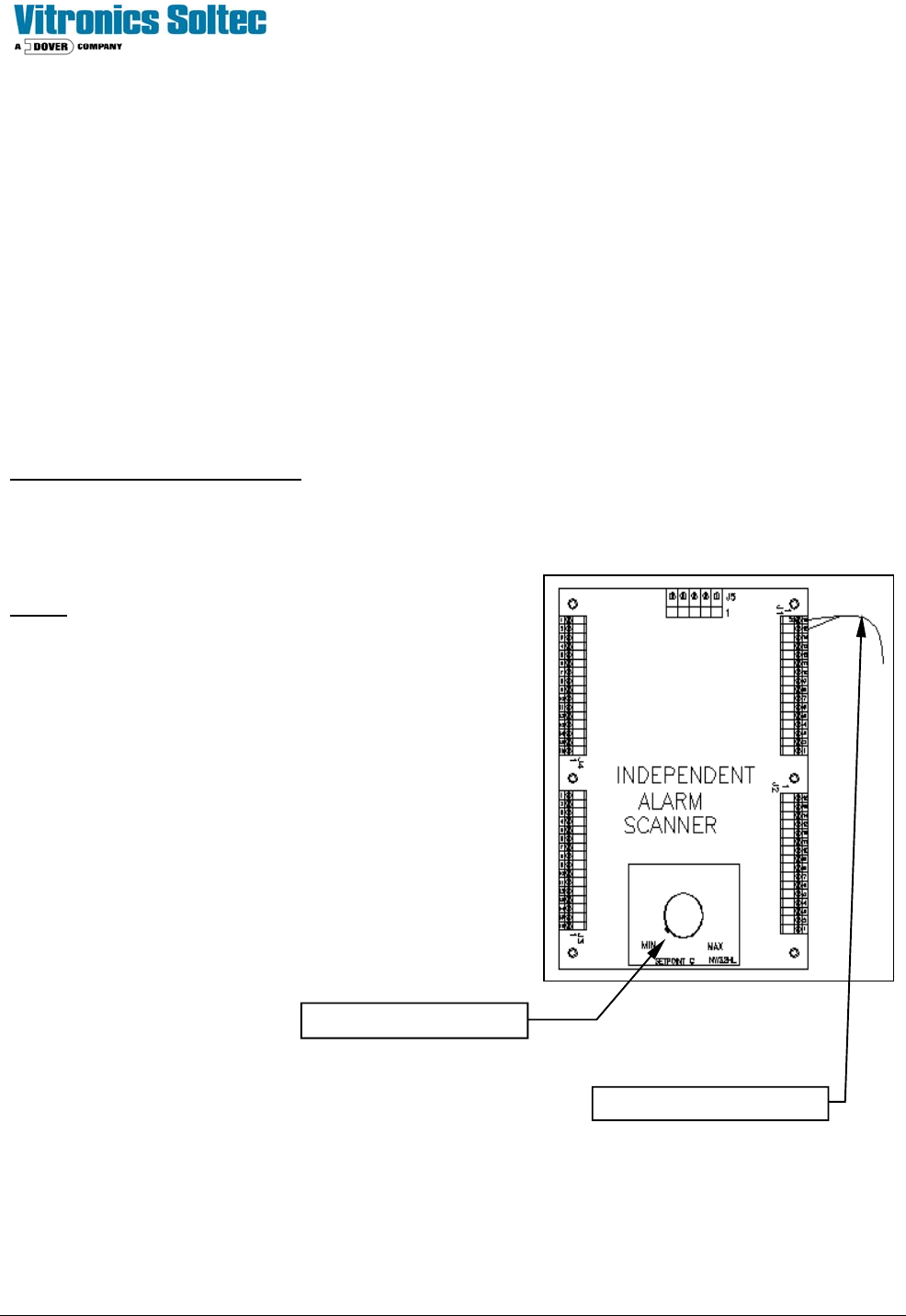
INDEPENDENT ALARM SCANNER OVER-TEMP & ALARM/SHUTDOWN
The Independent Alarm Scanner is:
! Standard, (installed on all ovens) ) An option, (NOT installed on all ovens)
DESCRIPTION:
The Independent Alarm Scanner & Alarm/Shutdown (IAS) system provides a redundant temperature backup system in
the event that a heating cell exceeds the critical temperature safety limit. The hardware consists of one (1) additional
thermocouple per heat cell, and the Independent Alarm Scanner (IAS) instrument, which can monitor as many as 32
thermocouples.
A second type K thermocouple is clamped on the face of every addition to the standard T/C
The Independent Alarm Scanner (IAS) receives each of these thermocouple signals as separate inputs and scans them
for an over-temperature indication.
The control circuit inter-action is:
In the event that an alarm condition (generated from the Redundant T/Cs) occurs, the IAS' alarm contact interrupts the 24
VAC to relay K4. This in interrupts the 120 VAC to the coil of heater contactor K2, and supplies an alarm signal to the
controller. The IAS unit scans all redundant thermocouples wired to it for an “Over-temperature” condition.
Notes:
Þ All unused T/C terminals MUST be jumpered.
Þ In case of a nuisance trip, the defective T/C can be found by
placing a jumper on the T/Cs one-at-a-time until the “alarm” is
eliminated.
Þ The setpoint should be set slightly higher than the temperature
expected during “normal oven operation”.
Þ The IAS will go into an alarm state in case of an IAS failure or
loss of power. A jumper on the output contacts will allow the
oven to be operated without the IAS until a replacement can be
installed.
Alarm setpoint adjustment
Thermocouple conductors