Technical_reference - 第109页
Technical Service Manual 109 Revision Dat e: August 2004 The m aster controller initiates MODBUS com m ands to up to three other 3152202 boards connec ted on a RS485 network to gather digital input status inf orm ation f…
Technical Service Manual 108 Revision Date: August 2004
CELL OVER TEMPERATURE SWITCHES
Preliminary Testing
Verify continuity of the heater over temperature switch circuit from wire number 2400 on zone 1 top to the coil of K4 on
the back panel.
Verify that the harness wiring is correct on connector P3 (1479508 8 position connector) of each 3152701 cell interface
board by unplugging the heater over temperature switch connector P1 (1479502 2 position connector) on each cell
interface board.
The red led on each cell interface board will light when the heater over temperature switch connector is unplugged to the
board. If the red led fails to light and continuity is OK in the heater over temperature switch circuit then the wires are
reversed in position 1 and 2 of connector P3.
Alarm Testing
Disconnect the following heater over temperature switches one at time by unplugging connector P1 (1479502 2 position
connector) on the corresponding 3152701 cell interface board.
Verify that each alarm message is displayed on the PC and that the alarm message text corresponds to the cell location
that has the alarm. It takes up to 68 seconds for an alarm condition to be detected and reported on the PC.
Verify that an IAS alert alarm message is present, which indicates that K4 on the back panel is shutting off when a heater
over temperature switch is opened.
This test verifies that each 3152202 board is configured correctly and is also communicating correctly with the DI board
and that relay K4 on the back panel shuts off when a heater over temperature switch is opened.
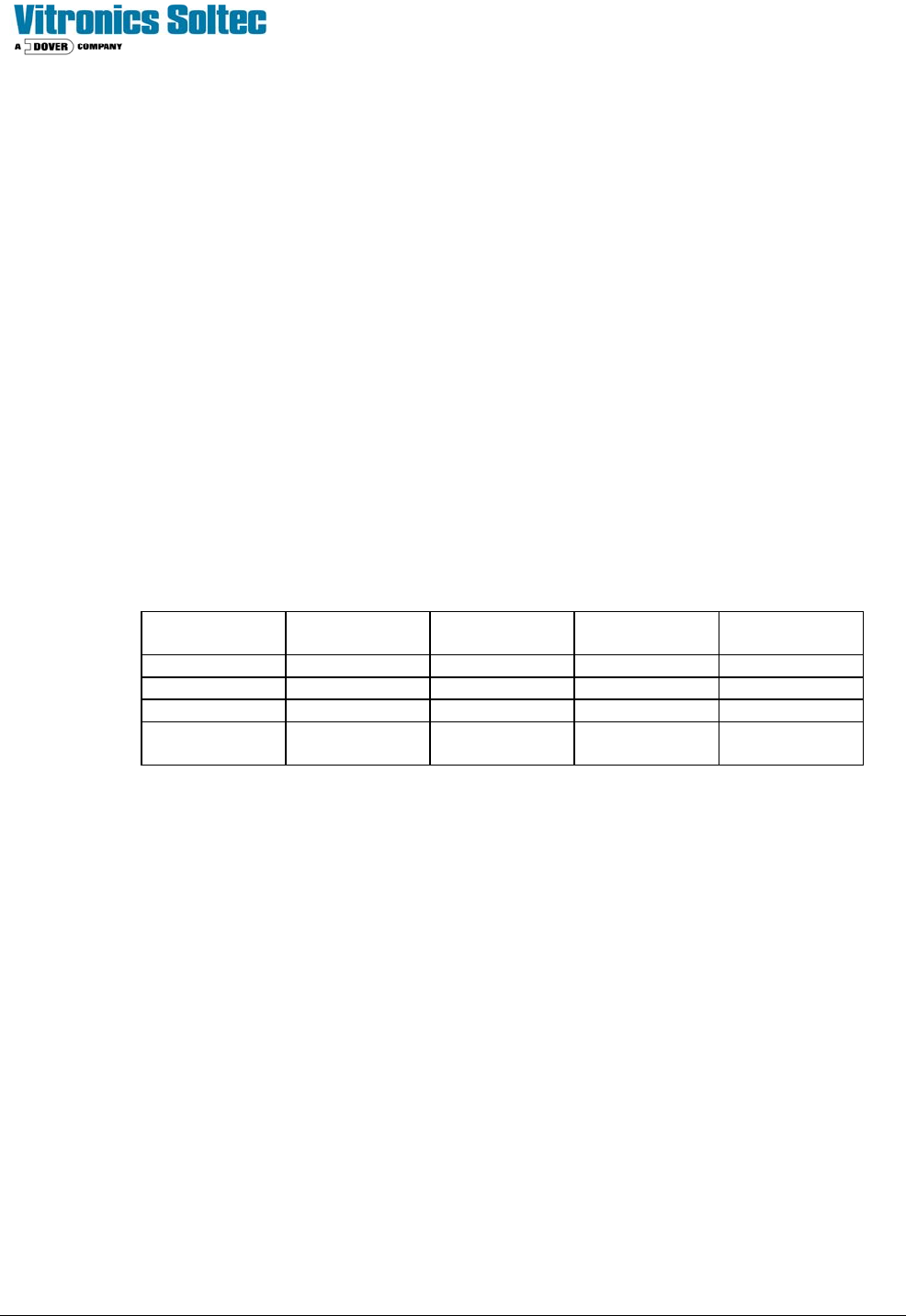
3152202
Board#
Model 520 Model 730/820 Model
940/1030
Model 1240
Master Zone 1 Top Zone 1 Top Zone 1 Top Zone 1 Top
Board 2 Zone 1 Bottom Zone 1 Bottom Zone 1 Bottom Zone 1 Bottom
Board 3 Zone 7 Top Zone 9 Top Zone 12 Top
Board 4 Zone 7 Bottom Zone 9 Bottom Zone 12
Bottom
3152202 Assembly 16 Channel Input Board Theory of Operation
The Atmel Atmega8 micro-controller is the main component on the board. The Atmega8 has one built in UART. The
UART is used to communicate to an RS485 connection on a multi-drop network through MODBUS protocol.
The RS485 port is not used directly with the existing controller since the existing controller does not have additional serial
ports available. Instead a frequency generator output from the micro-controller is used on the controller that is set as the
Master through switch 4 of dip switch S1 to communicate digital input status data to the existing controller through using a
counter input on the existing controller. The frequency generator output is derived by using the timer/counter compare
output of timer 1 of the Atmega8 micro-controller.
Technical Service Manual 109 Revision Date: August 2004
The master controller initiates MODBUS commands to up to three other 3152202 boards connected on a RS485 network
to gather digital input status information from each board. The master controller transfers digital input status information
for itself and for up to three other 3152202 boards using a digital input handshake with the existing controller. The
frequency generator output transfers digital input status data as one nibble at a time (4 bits) to a counter input on the
existing controller. There is a special frequency output setting that serves as an identity stamp to mark the very first nibble
of the possible 16 nibbles that are sent. The existing controller momentarily sets a digital output that is connected to a
digital input on the 3152202 board serving as a Master. This is to signal that a frequency has been read correctly and to
prompt the Master to send the data for the next nibble or the identity stamp depending on where the Master controller is in
the send sequence. The existing controller checks the counter input once a second and signals the Master to send data
for the next nibble when the past and current counter values are equal, which is typically 4 seconds. It takes 68 seconds
to transfer all of the digital input status information for four 3152202 boards.
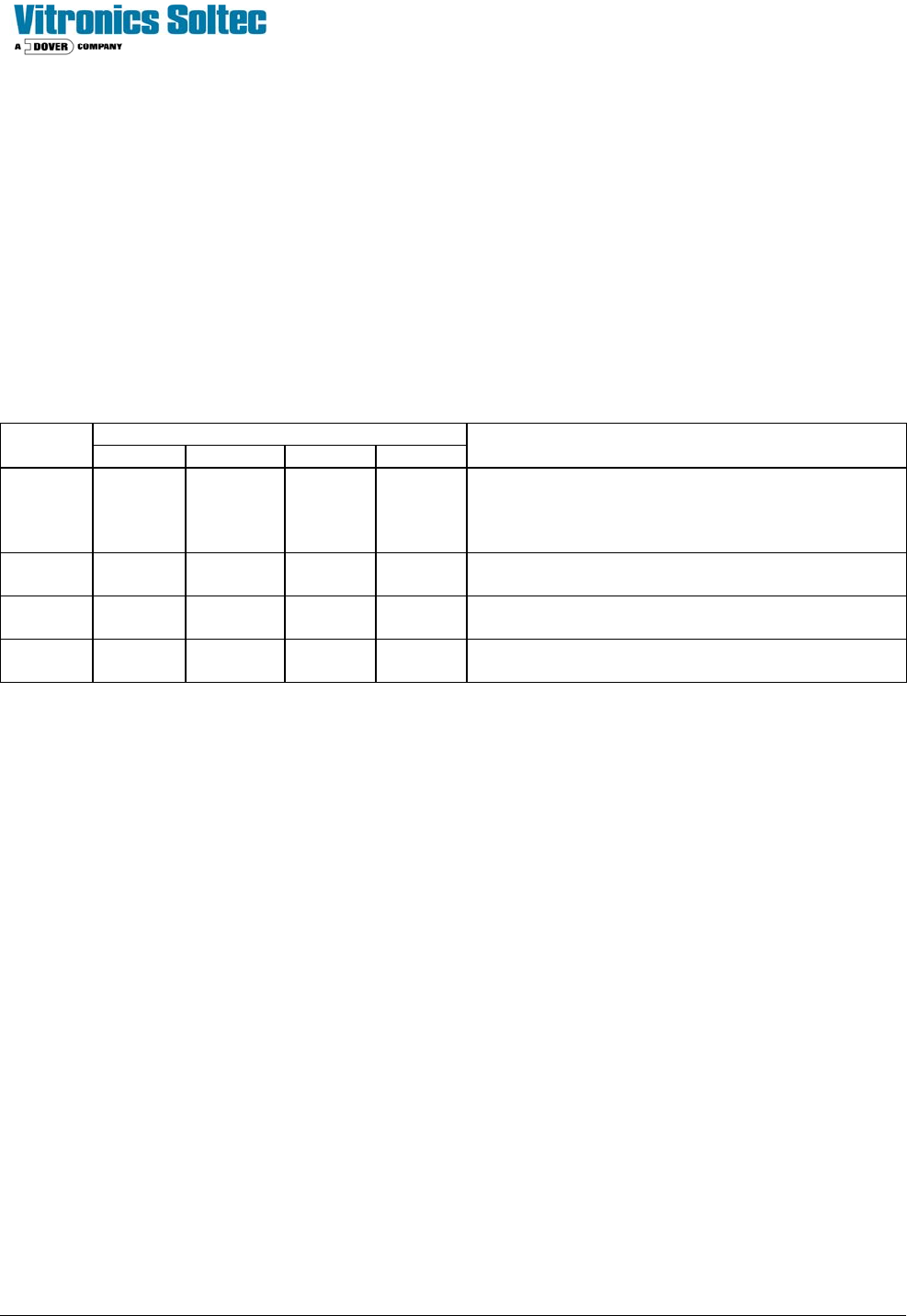
Table 1.0
S1 Dip Switch Settings
Board
Switch 1 Switch 2 Switch 3 Switch 4
Description
Master OFF OFF OFF ON
Board address offset 0, board functions as a
master on a MODBUS network and initiates
MODBUS commands to other boards on the
network
Board 2 ON OFF OFF OFF
Board address offset 1, board functions as a slave
on a MODBUS network
Board 3 OFF ON OFF OFF
Board address offset 2, board functions as a slave
on a MODBUS network
Board 4 ON ON OFF OFF
Board address offset 3, board functions as a slave
on a MODBUS network
Technical Service Manual 110 Revision Date: August 2004
HEATER CELL OVER-TEMPERATURE SWITCHES
Heater cell over-temperature switches are:
) Standard, (installed on all ovens) ! An option, (NOT installed on all ovens)
DESECRIPTION:
Each heating cell is equipped with a bimetallic over-temperature switch mounted on the backside of the heater panel.
When the cell temperature exceeds the switch temperature, the internal contacts open. This will interrupt the 3- phase
power to the heaters, and a signal is sent to the Oven Controller indicating an "over-temperature" condition. This will
generate an IAS alert alarm message.
This system generates only an IAS alert alarm message and will not indicate the cell location that generated the alarm.
The faulty cell must be found by diagnostically testing the functions of the cell over-temperature switches, looking for
either continuity (machine power removed) or voltage loss across the switch.
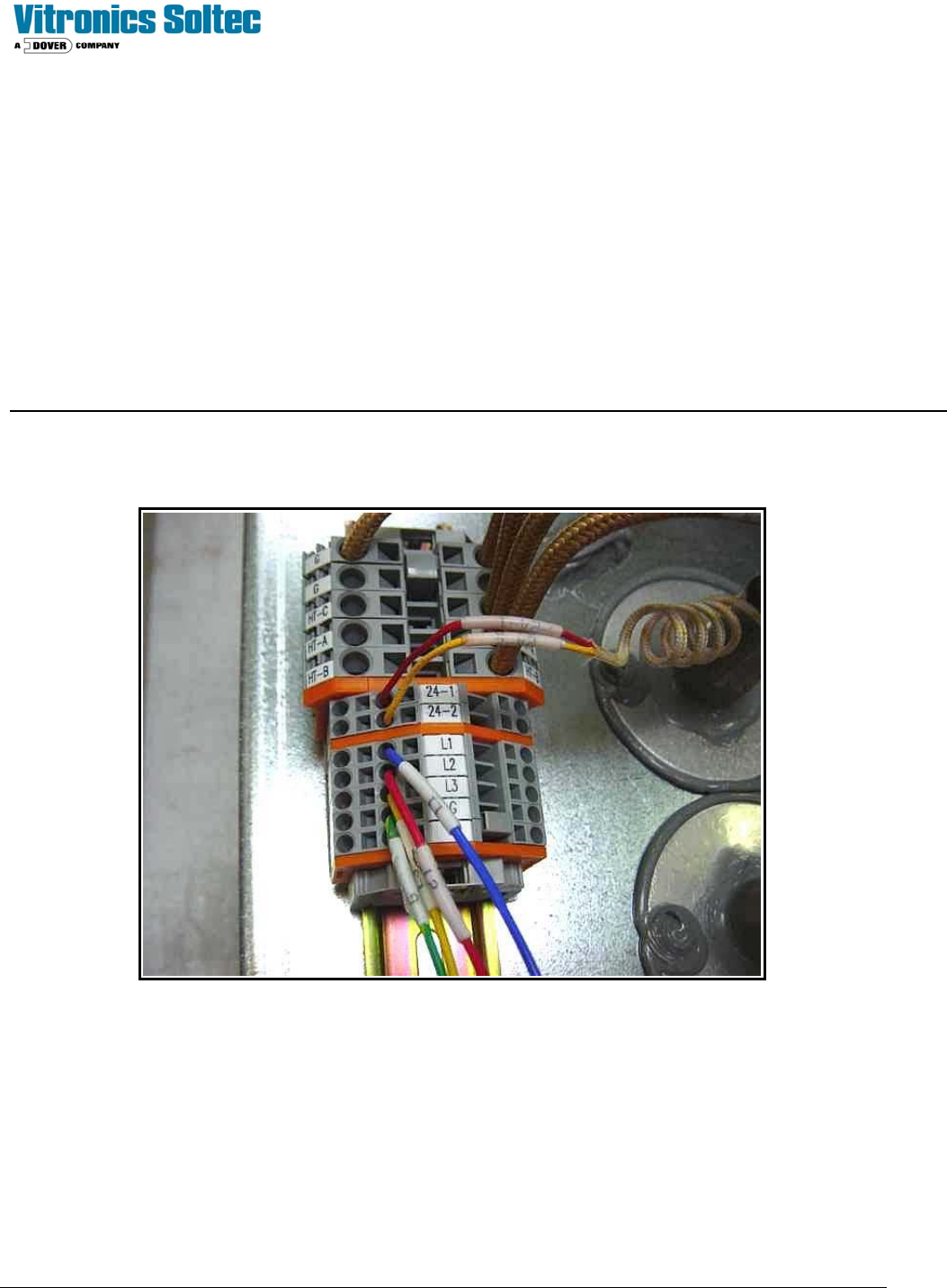
On the back (top / bottom side) of each heater cell is a terminal block assembly.
Check for either continuity or +24 VDC between terminals 24-1 and 24-2. To read continuity machine power must be
completely disconnected.
To read voltage place the positive lead in terminal 24-1 and the negative lead in ground to verify input voltage to the
switch. If input voltage is present, then move the positive lead to terminal 24-2. If there is no voltage present, the switch
is open. If the switch continuity or voltage checks are good, then move on to the next switch. Is it easiest to start at the
last heat zone on the top and then divide the machine in half for each subsequent check. If the last top heat zone switch
checks good, move directly to the bottom heat cells.