Technical_reference - 第83页
Technical Service Manual 83 Revision Dat e: August 2004 ADDRESSING DIP SW ITCHES ON DI BOARD The f ollowing shows the DI board DIP switches and m eanings: The s tatus of the s witches can be viewed in the Oven Control Pr…
Technical Service Manual 82 Revision Date: August 2004
OVEN CONTROLLER
The Vitronics Control System is comprised of one DI (Digital Input /Output) board, a back-plane board, and one or more
AI (Analog Input) boards. One AI board controls up to 32 process loops. Each additional AI board increases the number
of control loops by 32. The Vitronics Control System controls the temperature of the cells, drives the conveyor and rail
drive motors, and drives various logic signals through the I/O board.
The Vitronics Control System receives all of its instructions from the computer by a serial interface.
NOTE: DI OR AI BOARDS SHOULD NEVER BE INSERTED OR REMOVED WITH POWER APPLIED TO THE
VITRONICS CONTROL SYSTEM!
Test procedure for D.C. input voltage:
The power requirements for the Vitronics Control System, with one AI board, is:
+5.0 - +5.07 VDC @ 2 Amps max
+15 VDC @ 0.1 Amps max (+12 to +15 VDC)
-15 VDC @ 0.1 Amps max (+15 to -15 VDC)
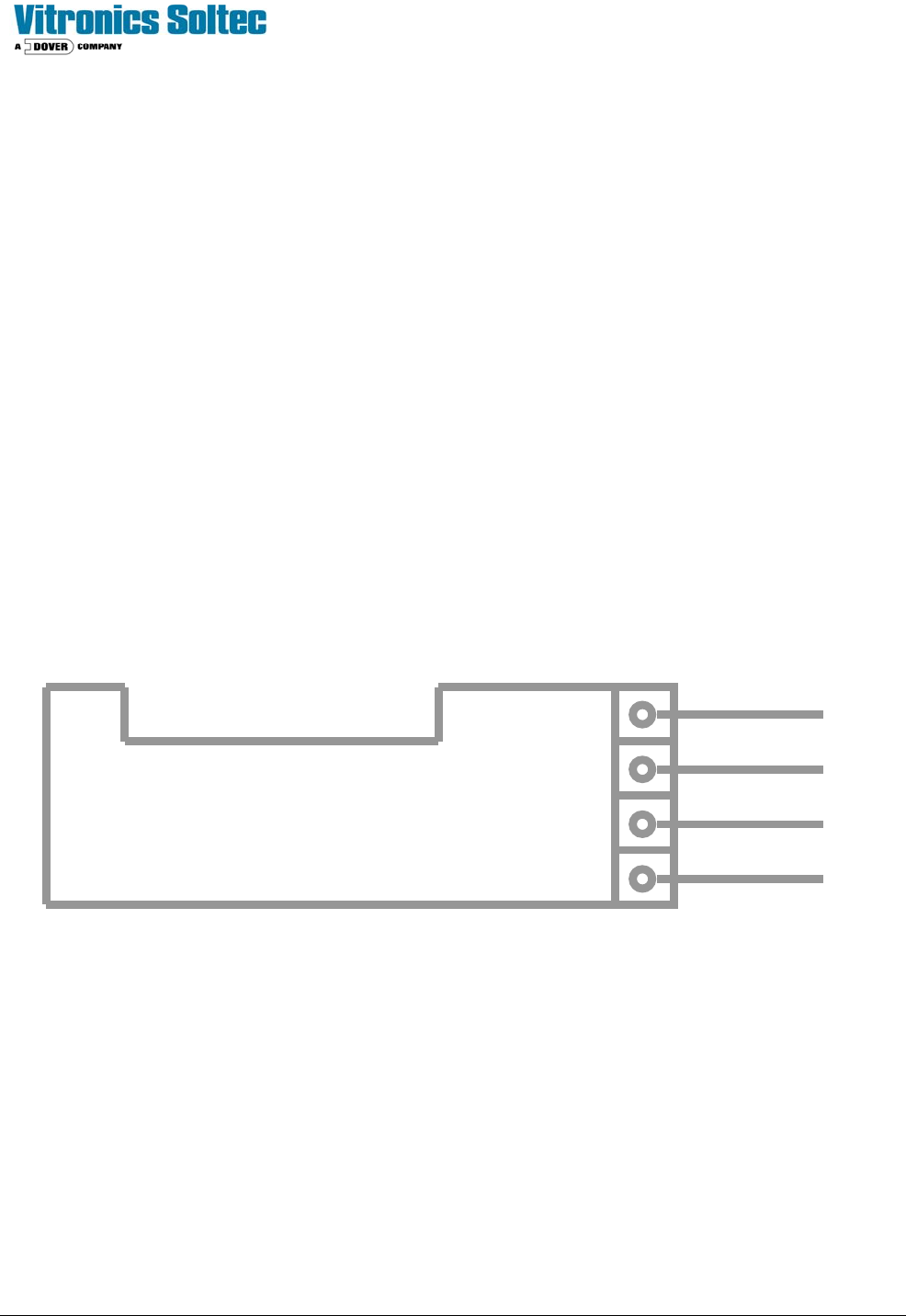
ð Shut off circuit breaker F55 supplying 120 VAC power to DC power supply.
ð Remove DI and AI boards from Vitronics Control System.
Þ Reactivate 120 VAC power to DC power supply. Using a DC Voltmeter, measure the DC voltages at the backplane
connector:
Oven Controller
Circuit Board
Common
+5V
-15V
+15V
1007
1001
1002
1003
Technical Service Manual 83 Revision Date: August 2004
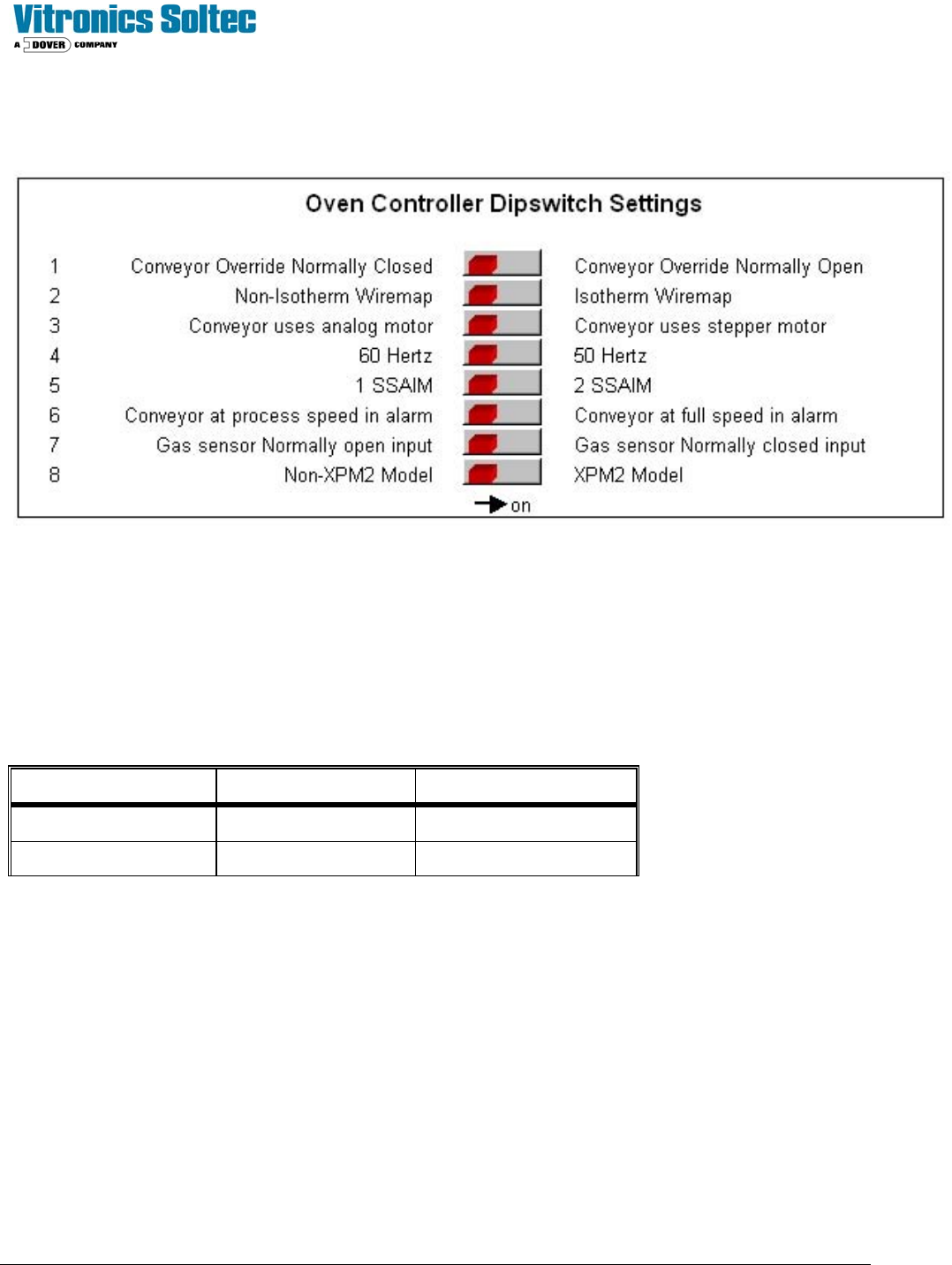
ADDRESSING DIP SWITCHES ON DI BOARD
The following shows the DI board DIP switches and meanings:
The status of the switches can be viewed in the Oven Control Program by selecting “DEBUG”, then “I/O”, then Anafaze
Dipswitch Setting.
(It is not necessary to physically remove the electrical enclosure doors and actually view the actual switches on the Oven
Controller)
ADDRESSING LINKS ON AI BOARD
The AI board contains two series of jumpers, combinations of which dictate the address of the AI board. The following
table identifies the required jumper settings for the first two AI boards in a system:
Board number Channels Jumpers set
1 1 to 32 JU1 and JU11
2 33 to 64 JU2 and JU10
CONTROLLER STATUS
Upon power up the AI board's status lights should be in the following states:
Þ Green light: On, steady.
Þ Orange light: On, flashing at approximately once per second.
Þ If the status lights are not in the above states check the +5 VDC at the terminal block mounted on the motherboard.
If the voltage at this point reads less than +5.00 VDC, check that the minimum load of the power supply is sufficient.
If minimum load conditions are being met, then adjustment of the power supply output voltage may be attempted.
If no problems are detected with the power supply, then replace the EPROM on the DI board.
NOTE: WHEN REPLACING AN EPROM WEAR A STATIC GUARD WRIST STRAP (GROUNDED APPROPRIATELY)
AND USE AN EXTRACTION / INSERTION TOOL TO REMOVE AND REPLACE THE EPROM. ENSURE THAT THE

Technical Service Manual 84 Revision Date: August 2004
EPROM IS CORRECTLY ORIENTED.
If the status lights are still not in the correct state then replace the controller boards, one at a time, in the following order:
AI, DI, Mother board.
RS-232 SERIAL COMMUNICATION CHECK
Make sure the connections on the Oven controller are correct. Check that jumper E20 on the DI board is in place.
Using an Ohm meter check the continuity of the communications cable. The pin assignments should be as follows:
• DB-9 Pin #2 (RX of computer) to I/O Board PX11-17 (TX of VCS)
• DB-9 Pin #3 (TX of computer) to I/O Board PX11-18 (RX of VCS)
• DB-9 Pin #5 (SG) to I/O Board PX11-19 (SG)
The direction of communication failure may be determined by connecting an LED and 470 ohm resistor in series between
PX11-17 and PX11-19 on the Oven I/O board, and a similar LED and resistor network between PX11-18 and PX11-19 on
the Oven I/O board. If both LED's flash and there is no communications, and the computer is not receiving any data, this
could indicate a fault with the cable or the computer serial port. If the LED connected to PX11-18 flashes, then data is
being transmitted to the controller, but the controller is not responding. This could indicate a faulty DI board, EPROM in
the controller, or possibly, the TX and RX cables are reversed. If neither LED flashes then the computer is not
transmitting any data. This could indicate a fault with the cable or the computer serial port (check that the
communications cable is connected into the correct serial port (COM1) on the computer).
A further test is to use an oscilloscope to look at the voltages at PX11-17 (TX) and PX11-18 (RX). The signal should
switch between a positive value (+12 VDC to +16 VDC) and a negative value (-12 VDC to -16 VDC). The signal should
be free from noise greater than +/- 0.2 VDC.
Noisy communication lines can be corrected by grounding the shield of the communication line, as well as moving the
communication link away from any high voltage sources (especially running parallel to the communications lines).