Technical_reference - 第91页
Technical Service Manual 91 Revision Dat e: August 2004 AUTO CHAIN LUBE TANK/PUMP ASSY Operation : The lubric ation pum p m otor speed is 1 r pm with a displac em ent of .06cc per strok e (r ev). T he pump will supply 1 …
Technical Service Manual 90 Revision Date: August 2004
COMPUTER CONTROLLED EDGE-RAIL LUBRICATION
Computer Controlled Edge-Rail Lubrication is:
! Standard, (installed on all ovens) ) An option, (NOT installed on all ovens)
DESCRIPTION:
The edge-rail lubrication system is designed to improve the lifetime of the rail chain conveyor by periodically applying
lubrication to the chain during oven operation.
Two modes of lubrication are available, automatic and manual. Systems with automatic chain lubrication are also
capable of performing manual chain lubrication, initiated by the operator, through the Oven Operation Program.
OPERATION:
Þ Following the enabling of an output from the controller, the system pumps oil from the reservoir, through tubing, to
stainless steel brush/wheels which are touching the chain and the oil is applied to the chain.
Þ It is the user’s responsibility to ensure that this reservoir is always filled with the required lubricant. The system
generates a warning message when it calculates that the oil in the reservoir is getting low.
Þ The lubricant type is DARMEX OIL # 773ND
During the lubrication process, the oil is applied for two complete cycles of the chain at the minimum calibrated conveyor
speed. The user may determine the number of chain cycles between automatic lubrications. 275 is the default number.
The number of complete lubrications held within one reservoir is set to the factory default of 50. The system will display a
warning whenever it calculates that the reservoir level is getting low when the number of lubrication cycles that have
occurred reaches the tank count number in the lubrication setup screen. Since the amount of oil dispensed in one
application is system dependent, the number of complete lubrications is best found by trial and error.
Construction:
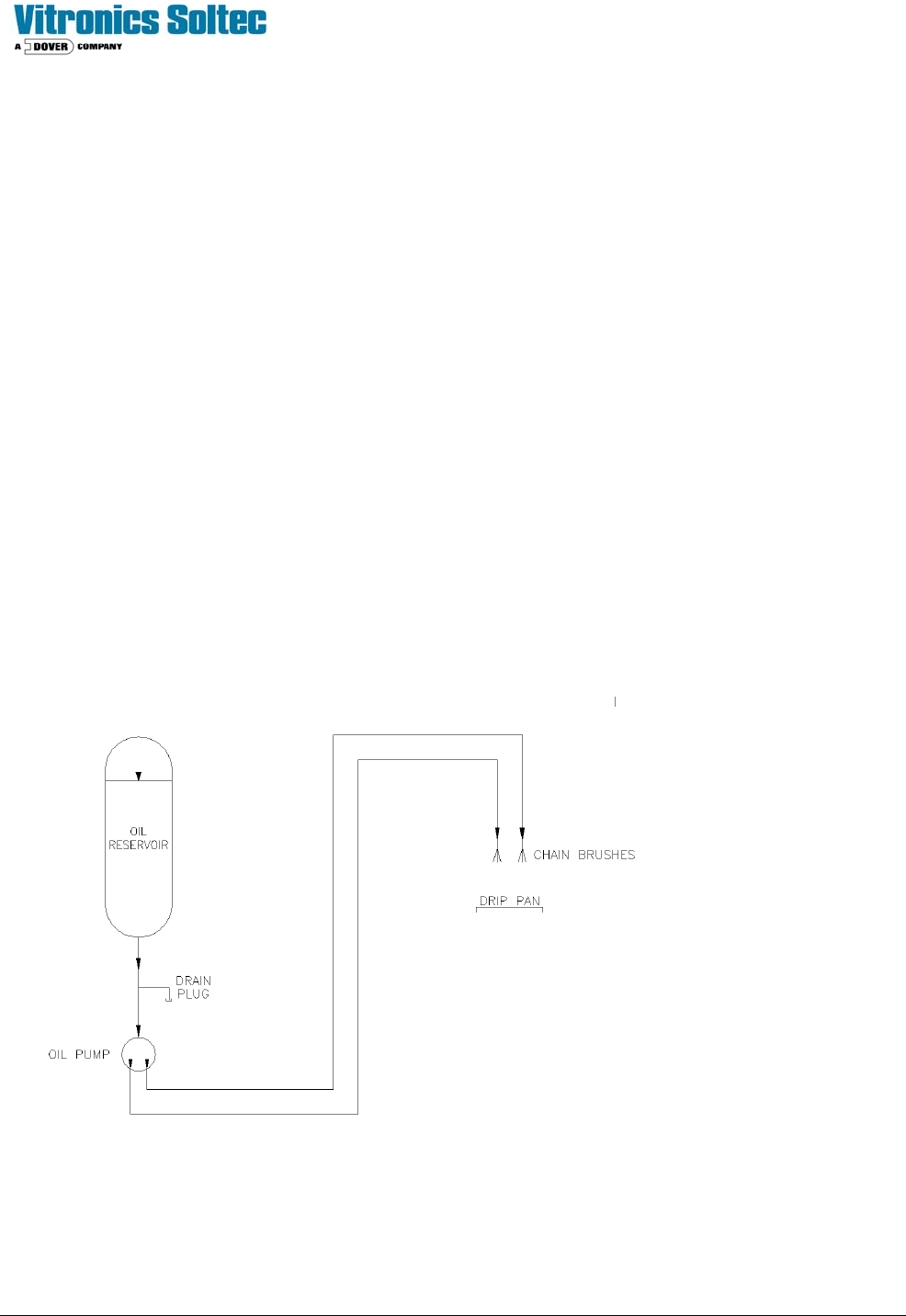
The Auto Chain Lube System
consists of a 1liter polypropylene
oil reservoir, drain plug,
electrically powered pump, tubing
for oil distribution, and two
stainless steel brushes for the
application of lubricating oil
directly to both oven conveyor
chains.
Auto Chain Lube System Schematic
Technical Service Manual 91 Revision Date: August 2004
AUTO CHAIN LUBE TANK/PUMP ASSY
Operation:
The lubrication pump motor speed is 1 rpm with a displacement of .06cc per stroke (rev). The pump will supply 1 drop of
oil to the chain for each minute of conveyor chain travel. Therefore: if the conveyor is traveling at 14 in/min, 1 drop will be
placed on the chain every 14 inches. (A lube is done at whatever speed the conveyor is running at that time). A “Lube
Cycle” duration is (manual or automatic) is two complete chain cycles.
Priming:
Priming the system through the software can be very time consuming because of the low displacement of the pump... it
is best to use an oil can (not supplied with oven) to do most of the priming.
Priming should only be necessary after:
1. Servicing the autolube system
2. The reservoir has been allowed to run dry and air has been pumped into the lube lines
Location:
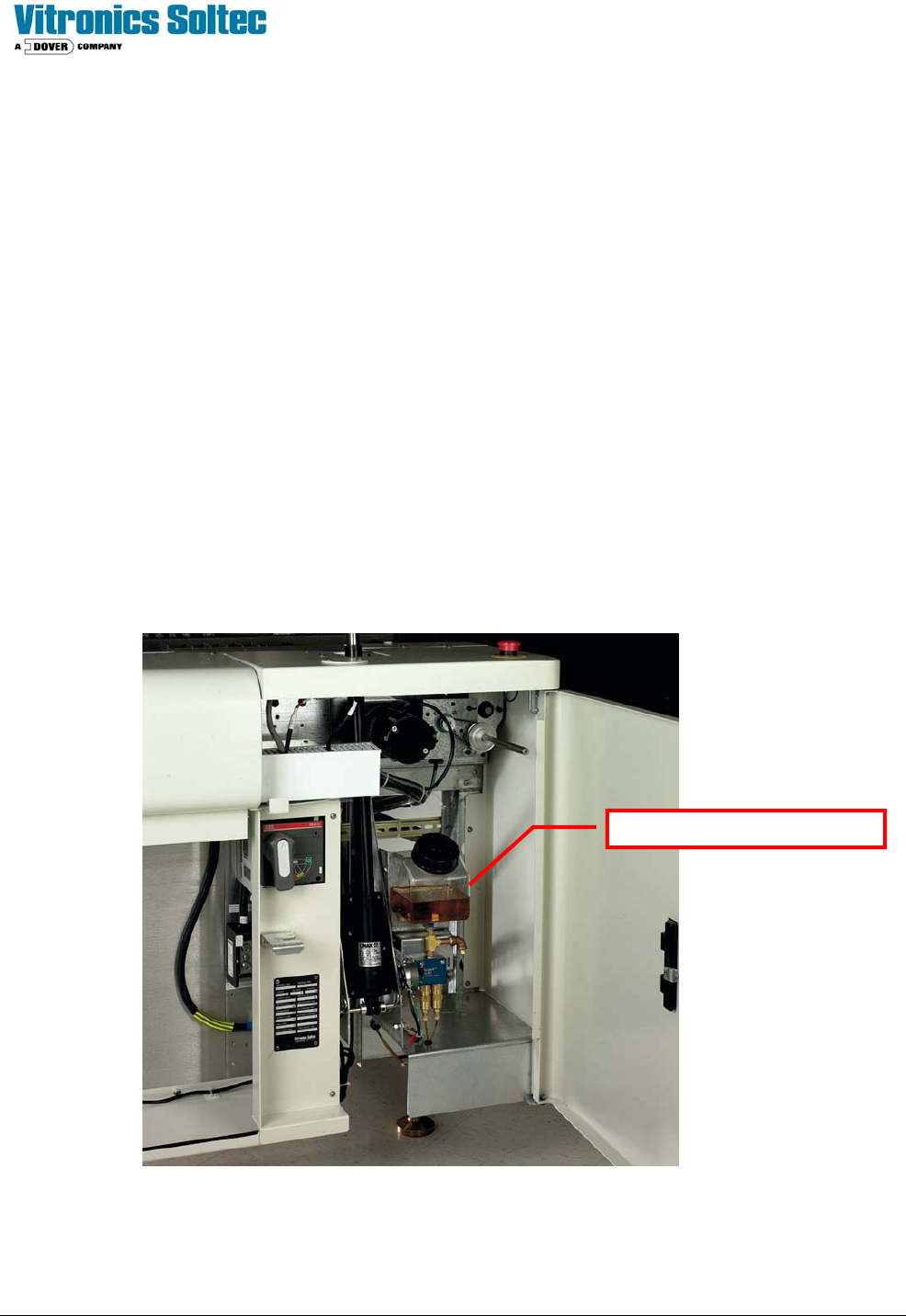
The Lubrication Tank-Pump Assembly is mounted to the frame at the front of the oven, inside the utility cabinet, at the
exit end of the oven. Opening the cabinet will expose the Lubrication Tank-Pump Assembly mounted on the Oven
Frame:
CHAIN LUBE RESERVOIR

Technical Service Manual 92 Revision Date: August 2004
INITIAL SETUP
The following process is done at the time the oven is built. It should be required only after repair or service of the
Autolube System.
1. Locate the lubrication reservoir. ( see illustration above )
2. Fill the reservoir with the lubricant, Darmex (Vitronics-Soltec P/N 1227204). (Remove the cap and pour the lubrication
into the top of the reservoir.
3. Prime the lube system. Refer to the User Manual (Chain lubrication system setup) for details on how to prime the
system.
4. Priming the autolube system can take as much 6 hours depending on the size of the oven. The priming operation will not
shut-off automatically, therefore it MUST be monitored to prevent excess oil from dripping on the floor.
(During normal “Manual” & “Auto” Lube operations, the system does stop automatically)
NORMAL OPERATION
First, refer to Rail Chain Lubrication in the User Manual.
To perform a single manual lubrication of the conveyor chain:
1. Select manual lubrication in the Oven Control Software by clicking on the Oil cans Icon. The conveyor chain will run, and
lube oil will be applied at the rate of 1 drop per 3 feet of chain, for two complete cycles of the chain(s).
For automatic lubrication of the conveyor chain on a regular basis:
1. Select automatic lubrication in the Oven Control Software. Enter the desired lube frequency. (The default is 275.) This is
the number of chain cycles between lubes.
2. Enter the lubrication alarm count. (The default is 50.) This is an estimate of the number of lubrications contained in the
oil reservoir. Observe the amount of oil used for 50 oiling cycles and then adjust the number up or down depending on
the amount of oil remaining in the reservoir only after refilling the reservoir
In automatic mode, the lubrication process does not interrupt oven processing.
The chain will be lubed while there is product in the oven.
Avoid “over oiling” and getting lubricant on the conveyor chain transport pins. Apply the lubricant sparingly, do not soak
the chain or apply so much that the lubricant drips off. Make sure the factory exhaust system is on and operating
properly because some fumes may be created once the heaters are turned on
ALARMS:
Þ When the alarm count for lubrications has been reached a “Low Oil Message” will be displayed at the bottom of the
Operating Screen. Automatic or manual lubrication will not be permitted until the reservoir has been filled, and the
alarm reset.
This is the best time to adjust the cycles between lubes and/or the number of lubes before “Low Oil Message alarm.