Technical_reference - 第96页
Technical Service Manual 96 Revision Dat e: August 2004 FLUX EVACUAT ION SYSTEM The Flux Evacuation System is : ! Standard, (installed on all ovens ) ) An option, (NOT installed on all ovens ) NOT E: The Flux Evac uation…

Technical Service Manual 95 Revision Date: August 2004
INTEGRATED EXHAUST STACK FILTER
The Integrated Exhaust Stack Filter is:
! Standard, (installed on all ovens) ) An option, (NOT installed on all ovens)
PURPOSE:
To capture and dispose of the byproducts of SMT reflow by condensing and filtering the oven exhaust.
APPLICATION
The Integrated Exhaust Stack Filter option is a simple filtering method for capturing and disposing of many of the by-
products of the Surface Mount Reflow Process. The Integrated Exhaust Stack filter consists of two filters in metal
enclosure. The enclosure has an inlet and a connection point for a factory exhaust duct. There is an access door for
changing the disposable filters.
The introduction ambient room air powered by the facility exhaust accomplishes condensation. The hot gas exhaust
stream from the FFC system is routed to the intake tube of the filter enclosure where it is mixed with several streams of
ambient air. The cooling effect of the room air streams causes flux and other outgassed contaminants to condense in
the exhaust stream as it enters the box, but prior to passing through the filter. Contaminants are trapped in the filter, and
the cleaned gas continues out the exhaust duct.
BENEFITS
• Flux and other out-gassed contaminants are captured in an easily changed, disposable filter.
• Provides increased protection of the facility exhaust system from contaminants.
• Totally within the overall footprint of the Reflow Oven.
• Inexpensive locally available filter
MAINTENANCE:
Filter change interval is approximately every 2 weeks, but is throughput and paste dependent.
Filter change requires 1 minute or less
Filter Enclosure cleaning interval is approximately every two months, but is throughput and paste dependent.
Note: The contaminants caught by the filters are hazardous waste. Proper disposal techniques should be
followed. The filter contaminants are paste and product dependent. Refer to the paste specification for more
information.
Wear latex gloves, eye protection and breathing protection when changing filter.
Filters:
1 – 1x10x20 Polyester Smith 5003, part number #1248601
1 – 1x10x20 SEP Pleated Smith Special, part number #1248701
Technical Service Manual 96 Revision Date: August 2004
FLUX EVACUATION SYSTEM
The Flux Evacuation System is:
! Standard, (installed on all ovens) ) An option, (NOT installed on all ovens)
NOTE: The Flux Evacuation System is STANDARD on all N
2
Ovens
PURPOSE
The Vitronics-Soltec Flux Evacuation System is designed to reduce the flow of flux fumes into the cool zones of the
tunnel, resulting in longer maintenance intervals.
APPLICATION
The Flux Evacuation System is the standard gas management system on Vitronics-Soltec ovens equipped with the
Nitrogen option. This configuration is best suited for applications running nearly exclusively nitrogen recipes. The oven is
setup to minimize tunnel maintenance, optimize nitrogen performance, minimize O2 levels, and minimize N2
consumption.
BENEFITS
The XPM
2
series Flux Evacuation System is designed to inhibit the flow of hot flux fumes into the cool zones of the tunnel
(where they can cause maintenance problems), while still optimizing nitrogen performance. This control of gas flow
insures a cleaner cooling zone with maintenance intervals significantly increased. Although widely varying process
parameters will cause individual maintenance intervals to differ, an average expectation should be up to 8 times less
frequent.
The Flux Evacuation System has secondary benefits. In all applications, there should be a noticeable reduction in cooling
zone temperatures. Actual reductions will, of course, be dependent on individual process parameters. The Flux
Evacuation System will not adversely effect nitrogen consumption or 02-PPM levels, as specified by Vitronics Soltec for
XPM
2
series ovens.
It is important to be aware that fan speed settings lower than 2500 RPM will disable the Flux Evacuation System
and will increase flux contamination in the oven
MAINTENANCE
The Flux Evacuation System is virtually maintenance free if operating properly. To ensure this, it is recommended that the
inlet tube from the Flux Flow Control manifold into zone 2 be checked periodically (every three months) for flux residue. If
a flux accumulation is noticed, the flux evacuation manifold may need to be cleaned.
Technical Service Manual 97 Revision Date: August 2004
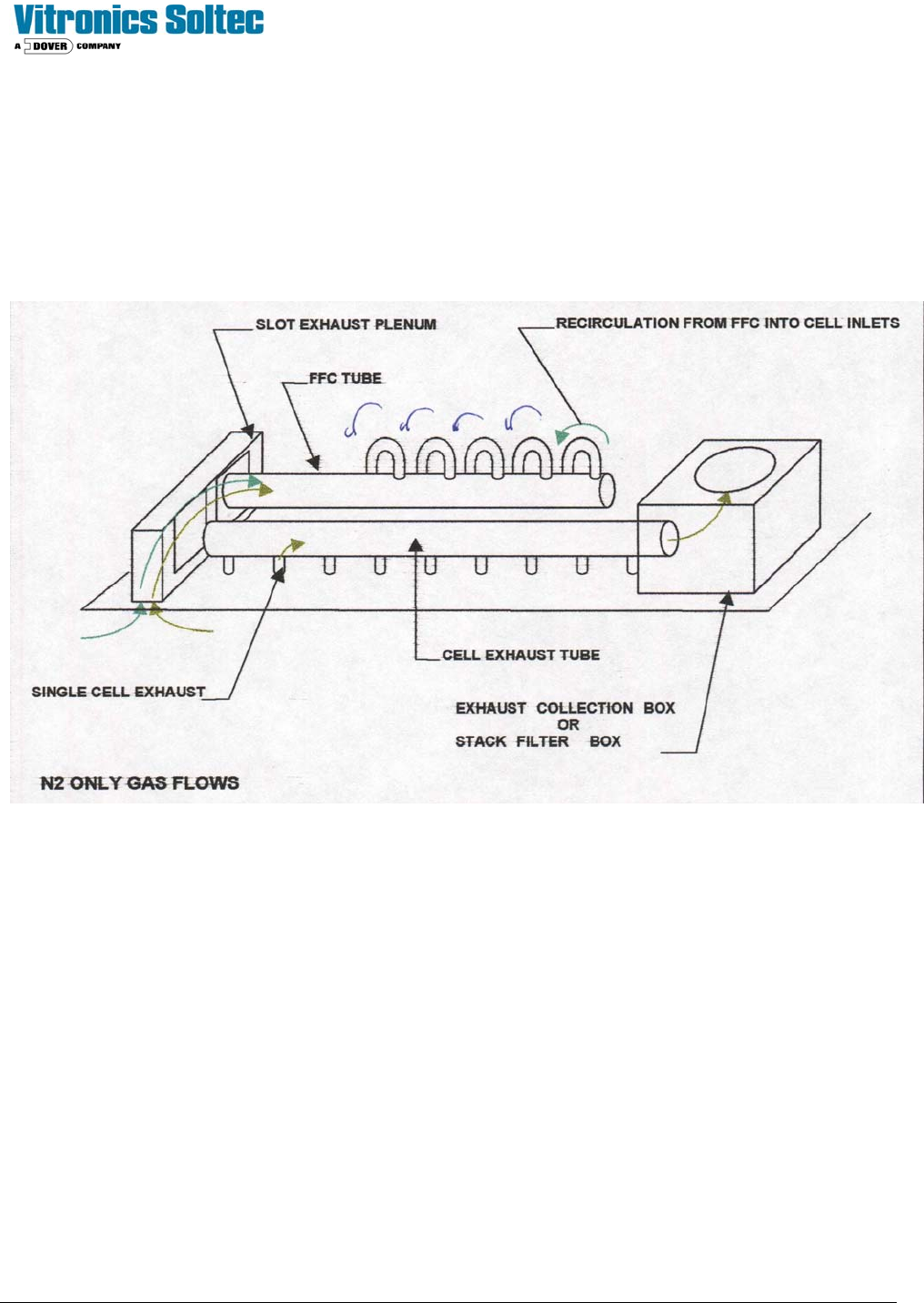
FUNCTION OF THE FLUX EVACUATION SYSTEM
N2 Mode -
The Flux Flow Control Manifold creates a recirculation loop by drawing gas from the tunnel into the controlled exhaust
plenum between the last heat and first cool zones, and returning it to the preheat and soak zones through several of the
patented individual cell inlets. The force powering this recirculation loop is low pressure at the cell inlet, created by the cell
fan. There are no moving parts to this system.
Flow into the controlled exhaust plenum is biased in favor of drawing from the cool zone side. This is accomplished by
raising the pressure in the cool zone (by inputting a high percentage of the total oven nitrogen consumption into that
area), and by reducing the pressure in the last heated zone (by fully opening the individual cell outlet.) The total oven
exhaust is taken from this one port.
The recirculation loop carries low O2 PPM gas from the first cool zone, into the preheat and soak sections of the heated
zone, maintaining low O2 PPMs throughout the tunnel. The recirculation loop carries out flux contaminants trying to enter
the cooling zones. The higher pressure in the cooling zones inhibits the migration of flux contaminants from the heated
zones. The amount of flow into the controlled exhaust from the last heated zone is at a rate that will maintain the total
recirculation loop gas temperature above 120°C, which prevents condensation.
Exhaust flow out of the oven is maximized in volume, and also positioned in the tunnel at the point of highest flux
concentration (the last heated zone), to maximize the amount of flux contaminant per cubic foot of exhaust.