E4000-90023+N67xx+dut+ps+installation.pdf.pdf - 第25页
N67xx DUT Power Supply Installation 1-21 What is Being Connected in ICT? • Faul t Ou tput • Inhibit Inpu t • Faul t/Inhibit System Protection • Clearing a System Pr otection Faul t Fault Output Pins 1 and 2 can be config…
1-20 N67xx DUT Power Supply Installation
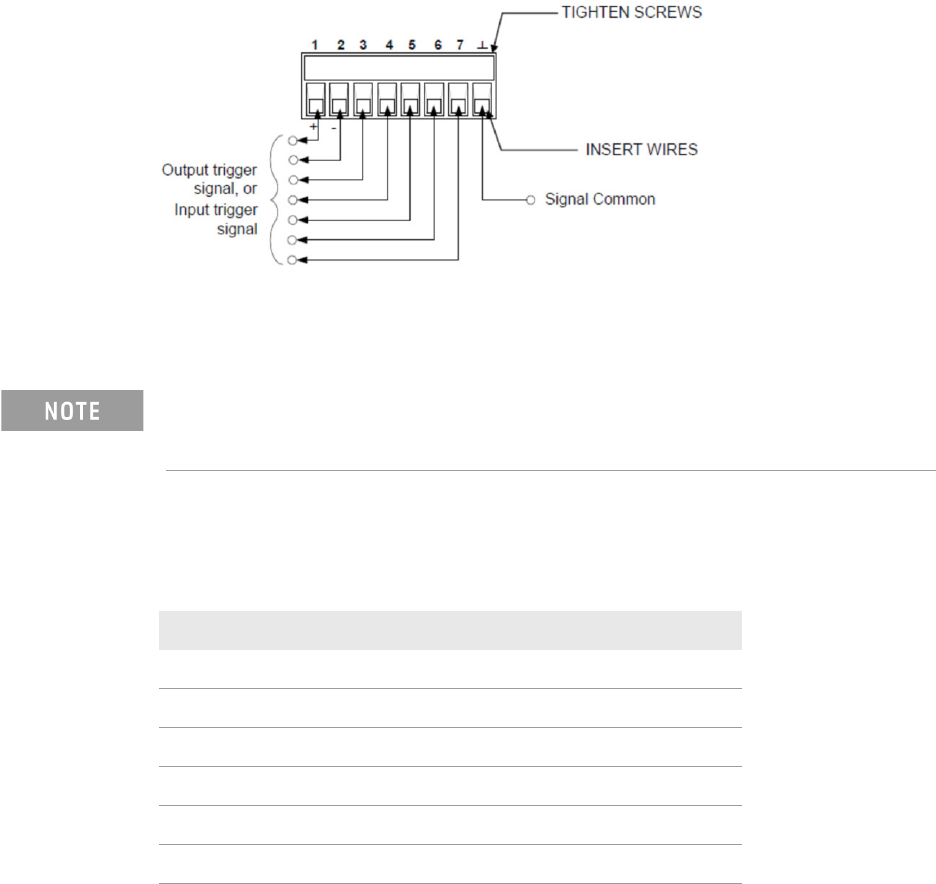
Digital Control Port
An 8-pin connector and a quick-disconnect connector plug are provided for
accessing the digital control port functions.
The digital control connector accepts wires sizes from AWG 14 to AWG 30. Note
that wire sizes smaller than AWG 24 are not recommended. Disconnect the
connector plug to make your wire connections.
The following chart describes the possible pin configuration for the digital port
functions.
In addition to the configurable pin functions, the active signal polarity for each pin
is also configurable. When Positive polarity is selected, a logical true signal is a
voltage high at the pin. When Negative polarity is selected, a logical true signal is
a voltage low at the pin.
It is good engineering practice to twist and shield all signal wires to and from the
digital connectors. If shielded wire is used, connect only one end of the shield to
chassis ground to prevent ground loops.
Table 1-6 Pin configuration
Pin function Availablel configurable pins
Digital I/O and Digital In Pins 1 through 7
External Trigger In/Out Pins 1 through 7
Fault Out Pins 1 and 2
Inhibit In Pin 3
Output State Pins 4 through 7
Common (⊥)Pin 8
N67xx DUT Power Supply Installation 1-21
What is Being Connected in ICT?
• Fault Output
• Inhibit Input
• Fault/Inhibit System Protection
• Clearing a System Protection Fault
Fault Output
Pins 1 and 2 can be configured as a fault-output pair. The polarity of pin 1 can also
be configured. Pin 1 is the Fault output; pin 2 is the common for pin 1. Note that
pin 2 must also be connected to pin 8.
The Fault output function enables a fault condition on any channel to generate a
fault signal on the digital control port. The following conditions will generate a fault
event: over-voltage, over-current, over-temperature, inhibit signal, power-fail
condition, or on some models, a power-limit condition.
Both pins 1 and 2 are dedicated to this function. This provides for an
optically-isolated output. Pin 2’s function is ignored.
Note that the Fault output signal remains latched until the fault condition is
cleared. You must also clear the protection circuit.
From the front panel:
1 Select System\IO\DigPort\Pins.
2 Select pin 1, then Function, then Fault Out.
3 In the Polarity field, select either Positive or Negative.
Using SCPI commands:
To configure the Fault function:
DIG:PIN1:FUNC FAUL
To select the fault output polarity:
DIG:PIN1:POL<pol>

1-22 N67xx DUT Power Supply Installation
Inhibit Input
Pin 3 can be configured as a remote inhibit input. The polarity of pin 3 can also be
configured. Pin 8 is the common for pin 3.
The Inhibit Input function lets an external input signal control the output state of all
the output channels in the DUT power supply. The signal latency is 5 microseconds.
Pin 3 can be programmed for the following Inhibit modes, which are stored in
non-volatile memory:
From the front panel:
1 Select System\IO\DigPort\Pins.
2 Select pin 3, then Function, then Inhibit In.
3 In the Polarity field, select either Positive or Negative.
4 Select Protect\Inhibit.
5 Select either Latching or Live.
6 To disable the Inhibit signal, select Off.
Using SCPI commands:
To configure the Inhibit function:
DIG:PIN3:FUNC INH
To select the inhibit input polarity:
DIG:PIN3:POL <pol>
To latch the Inhibit signal:
OUTP:INH:MODE LATC
To set the Inhibit signal live:
OUTP:INH:MODE LIVE
To disable the Inhibit signal:
OUTP:INH:MODE OFF
Table 1-7 Inhibit modes
Mode Description
LATChing Causes a logic-true transition on the Inhibit input to disable all outputs. The
outputs will remain disabled after the inhibit signal is received.
LIVE Allows the enabled outputs to follow the state of the Inhibit input. When the
Inhibit input is true, the outputs are disabled. When the Inhibit input is false, the
outputs are re-enabled.
OFF The Inhibit input is ignored.