SIPLACE Station Software 7xx to 714 介绍.pdf - 第208页
Station Software 7xx to 714.0 (R20-2) / Feature Description 11/2020 Edition 208 Nozzle scanning The dialog for configuring t he nozzle scanning under Settings – Machine options contains t wo new self-healing actions: Rep…
Station Software 7xx to 714.0 (R20-2) / Feature Description 11/2020 Edition
207
Nozzle setup for the placement head
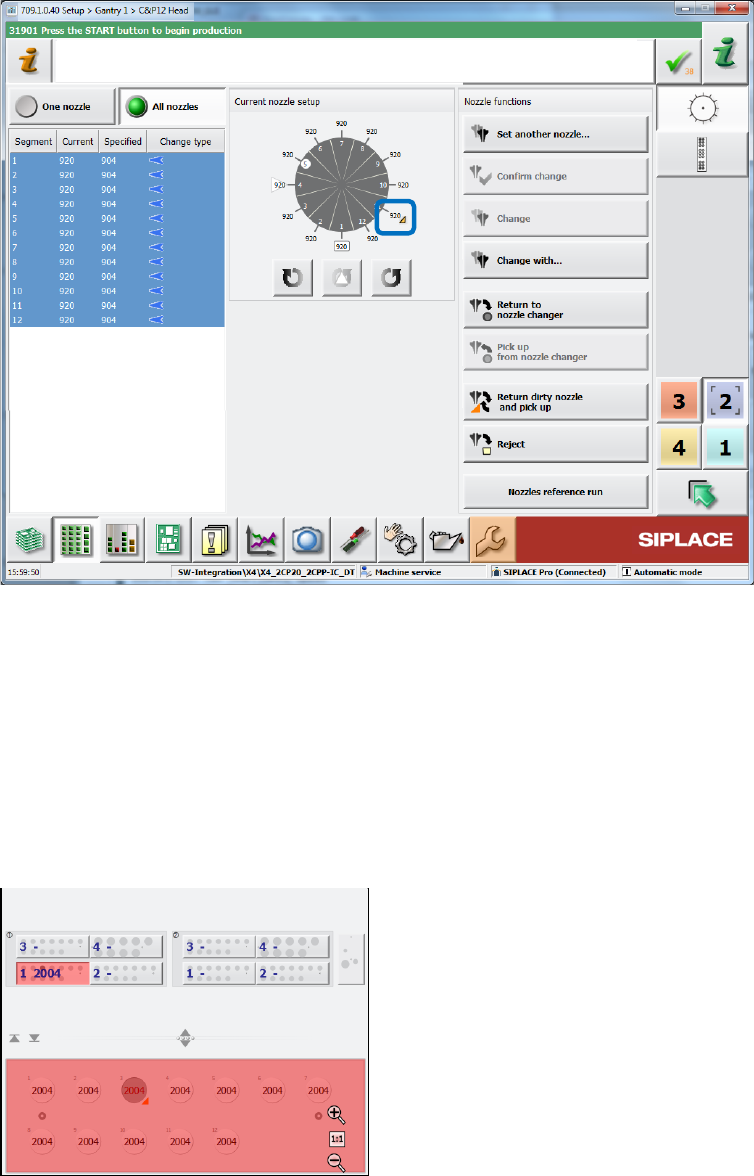
Figure 10-32: Dirty nozzle – Head view
Nozzle changer
In the Nozzle changer view, there are three new actions to change the nozzle state to "clean":
– Nozzle in garage n is clean (for selected nozzle)
– Nozzles in magazine n are clean (for all nozzles in the selected magazine)
– All nozzles in all magazines are clean (for all nozzles in all magazines at the displayed
location)
Example:
Figure 10-33: Dirty nozzle – Nozzle changer
Although there are twelve 2004 nozzles in the nozzle, the salience is red, and the nozzle setup is
incorrect, because one nozzle (in garage 3) is dirty and not allowed to pick up again. The operator
must clean the nozzle and inform the station software that the nozzle is clean. The operator can
also remove the dirty nozzle via the Empty garage action and set in a new, clean nozzle of the
same type. However, the Confirm nozzle in garage action will not set the nozzle to clean, the
nozzle setup remains incorrect!
Station Software 7xx to 714.0 (R20-2) / Feature Description 11/2020 Edition
208
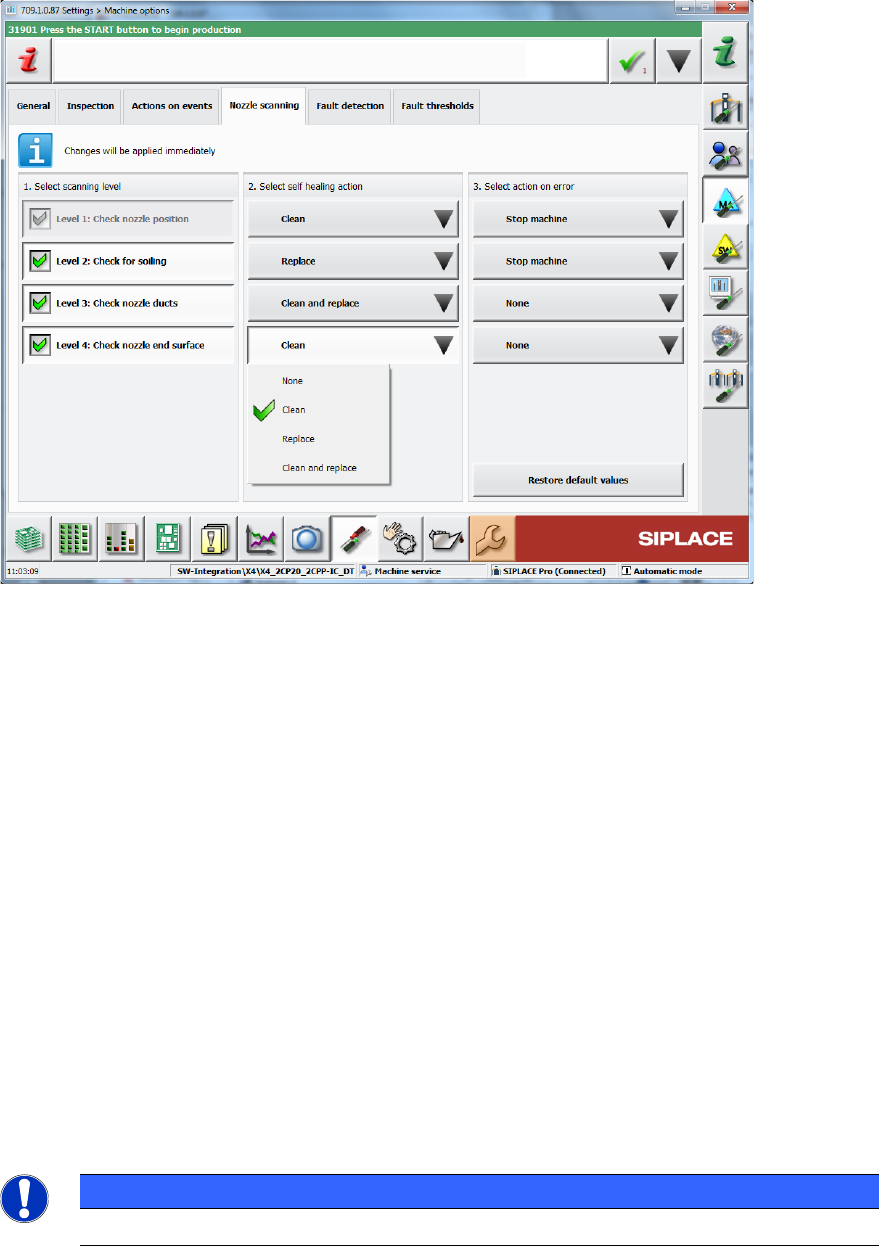
Nozzle scanning
The dialog for configuring the nozzle scanning under Settings – Machine options contains two
new self-healing actions: Replace and Clean and replace.
Figure 10-34: Dirty nozzle – Machine options
State overview of head segments
The State overview dialog for the head segments contains the new state disabled: nozzle dirty.
Preventive maintenance
Additionally to the above changes, the Preventive maintenance view has been extended. Please
refer to section 10.13.13.
10.15 Enhanced Automatic Feeder Pitch Detection
Compatible mode: Complete
The existing Automatic feeder pitch detection function has been enhanced in this station
software version.
The station software can now increase the pitch automatically to the measured value if the
expected pitch is undefined (value 0). The station software performs frequent measurements of the
pitch (every 700 placements) if the expected pitch is undefined, to continuously verify measured
pitch values and to minimize the impact of wrong automatic pitch increases.
NOTICE
This function has an impact on the placement performance.
Station Software 7xx to 714.0 (R20-2) / Feature Description 11/2020 Edition
209
10.16 Improved Face Down Recognition for Diodes
Compatible mode: Complete
Small SOT and SOD diodes sometimes are placed lying on their back on the boards what may
lead to problems and high reject rates. Therefore, the SIPLACE Vision functionality for the face
down recognition has been improved. As of station software version 709.1, this feature uses the
different appearance of the gullwing leads on the top and bottom of the component to detect which
side is facing the camera. In lower station software versions, this measurement will be ignored!
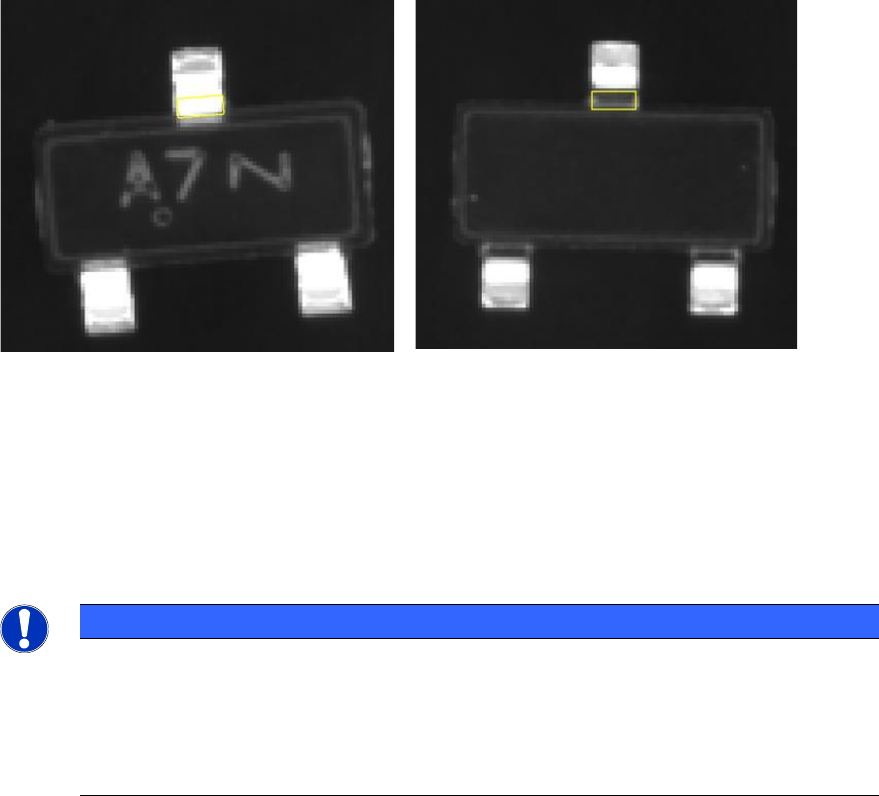
SIPLACE Vision performs a measurement in two steps, optionally with different illumination
settings. In the first step the position of the gullwing leads is determined; in the second step the
bend of the leads is recognized.
Component face down -> inner lead ends
are bright
Component correct -> inner lead ends are
dark
The face down recognition can be started from the Options list with the Recognition of flipped
components button. A wizard helps guiding the operator when entering the required data.
The feature can be combined with multiple field of view measurements and Pin1 detection but not
with pattern matching and glue inspection.
NOTICE
The face down recognition only works if the inner lead ends have a sufficiently constant
position to the middle of the component. If there are large tolerances for the component
body, it might happen that the component body or the contact area is evaluated instead
of the inner lead ends. This would then lead to faulty results (body to small -> area bright
-> a correct component is rejected; body to large -> area dark -> a face down component
is not recognized).