Specification_SIPLACE_F5_eng.pdf - 第42页
41 Description SIPLACE pl acement machin es are high- tech systems wh ose speed , placement accuracy and flexib ility are the result of the interaction of hardware and software. Duri ng the placement process a ll importa…
40
Description
S
SS
SI
II
IP
PP
PL
LL
LA
AA
AC
CC
CE
E E
E O
OO
On
nn
nli
lili
lin
nn
ne
ee
e
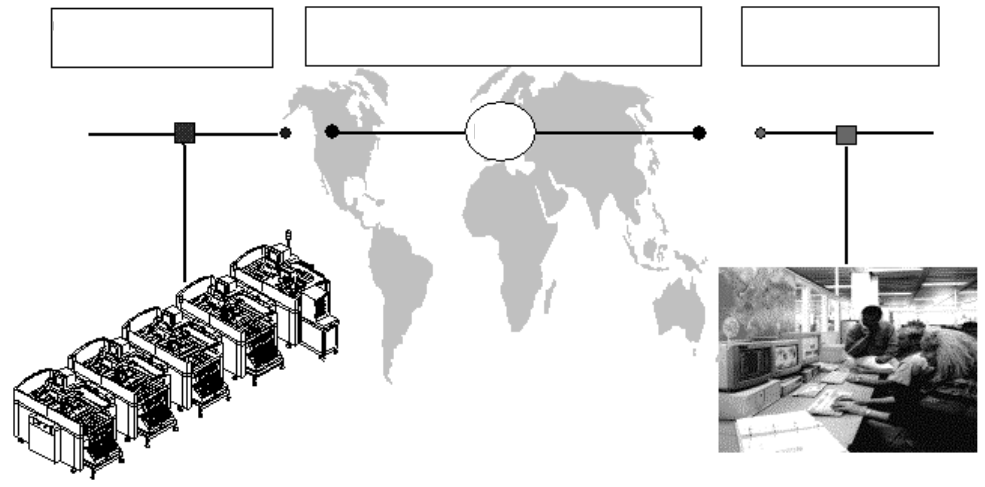
The product Remote Support en-
ables online access to the line
computer, station computer and
machine controller of SIPLACE
placement systems from the sup-
port centers in Munich, Norcross
and Singapore. The SIPLACE ex-
perts in the pertinent support cen-
ter can employ remote data and
the program files of the individual
SIPLACE lines in Production to an-
swer all questions about the
placement systems, immediately
and online.
S
SS
SI
II
IP
PP
PL
LL
LA
AA
AC
CC
CE
E E
E R
RR
Re
ee
em
mm
mo
oo
ot
tt
te
e e
e S
SS
Su
uu
up
pp
pp
pp
po
oo
or
rr
rt
t t
t i
ii
in
nn
n
A
AA
Ac
cc
ct
tt
tu
uu
ua
aa
al
l l
l P
PP
Pr
rr
ra
aa
ac
cc
ct
tt
ti
ii
ic
cc
ce
ee
e
Remote Support is offered on the
basis of communication via ISDN
(Integrated Services Digital Net-
work). Due to its high data trans-
mission speed (64,000 or 128,000
bits/s) ISDN is an ideal medium for
high-speed transfer of large quanti-
ties of data, the SIPLACE expert at
a “Remote Support Position”,
which consists of one line com-
puter, one station computer and a
communications router, can log
himself or herself into the corre-
sponding computers of the
SIPLACE line in the customer's
plant. Remote Support positions
are available in Munich, Norcross
and Singapore. An ISDN router is
also installed at the SIPLACE or
site LAN of the customer. There
need be only one such router per
production facility, however, if the
lines at the customer's site are in-
terconnected via a site LAN.
Basically, the same functionality is
available via Remote Support as is
possible at the local computers
(line computer, station computer
and machine controller).
To comply with the customer's
need for security where sensitive
production data are involved, many
mechanisms (automatic callback,
password protection, switch-off
mode, etc.) are integrated into the
system and can be applied specifi-
cally.
SIPLACE Software Architecture:
Remote Support (Option)
SIPLACE Expert Knowledge Immediately and Round the World
Customer’s production
bay
SIPLACE Support
Station
Public networks / Interfaces
Support LAN
Munich
Norcross
Singapore
Customer LAN
ISDN
41
Description
SIPLACE placement machines are
high-tech systems whose speed,
placement accuracy and flexibility
are the result of the interaction of
hardware and software. During the
placement process all important
components in the machines are
monitored via software, machine
status data are recorded and ap-
propriately displayed to the ma-
chine operator. The SIPLACE diag-
nostic system is available as an
option in addition to this standard
functionality of SIPLACE. This
software tool which can be run on
the SIPLACE station computers
contains everything required for
the more detailed diagnosis of
SIPLACE placement systems:
information about SIPLACE
components
structure and strategy of
SIPLACE diagnosis
and all required notes regarding
possible dynamic system con-
trol states of SIPLACE.
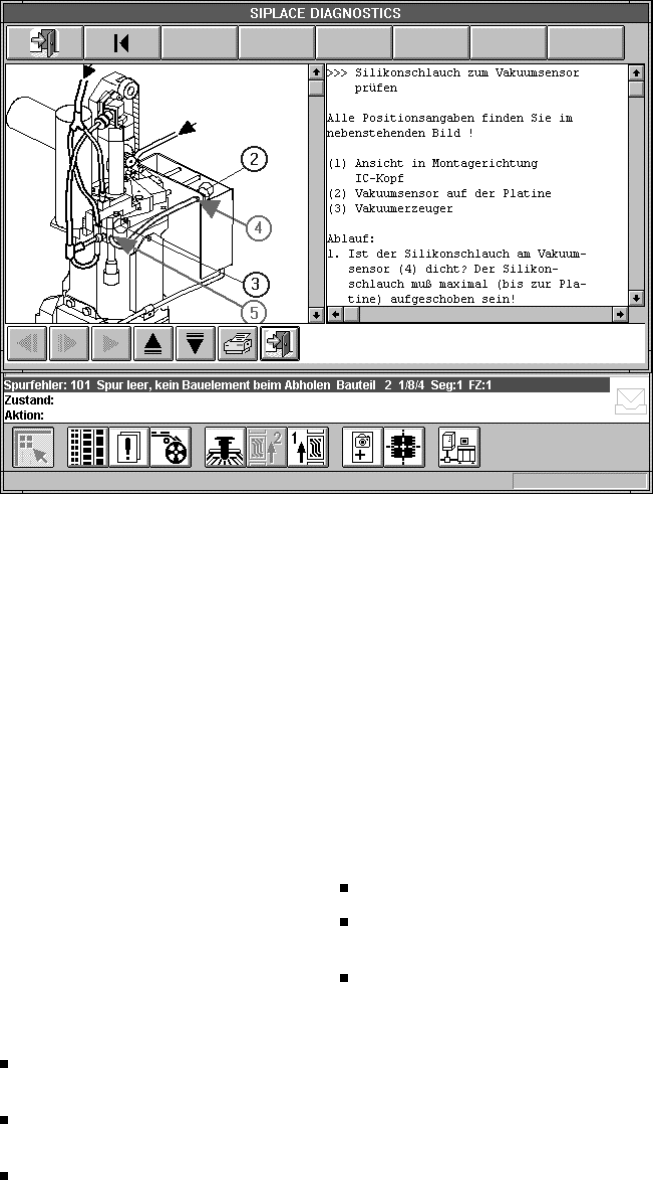
The SIPLACE diagnostic system
thus provides the machine opera-
tor with a convenient tool which
offers further support during day-
to-day work in Production in addi-
tion to the SIPLACE system re-
ports.
The diagnosis is performed online
at the station computer in dialog
mode. The dialog is organized into
three main steps:
analysis of the machine event
location and derivation of the
cause
resolution of the problem
The queries to locate the cause are
made on the basis of a menu, i.e.,
the operator is privy to all possible
answers. At any time during the
dialog the machine operator can
access additional data such as
graphics or texts which furnish him
or her directions, hints and aids in
answering the questions posed by
the diagnostic system.
The procedure followed during this
dialog is specified by the system.
This ensures that the strategy of
minimum diagnostic effort imple-
mented in the diagnostic system is
followed. “Minimum diagnostic ef-
fort” means that causes which can
be ascertained easily or eliminated
quickly are examined first in order
to organize the search for causes
efficiently. This strategy is based
on the “SIEMENS Information
Bank” developed by SIPLACE ex-
perts.
The cause discovered is presented
in the form of clearly phrased text.
The possible solutions for each
cause are displayed at the same
time as the cause. To facilitate un-
derstanding, the solutions are out-
put in the form of graphics with a
detailed description of the steps to
be taken. All required information
is stored in the diagnostic system
in the form of texts, scanned im-
ages or CAD graphics.
SIPLACE Software Architecture:
Diagnostic Tools (Option)
Analysis and On-Line-Support of SIPLACE Placement Systems
42
1. After switching-on the station
Technical Data:
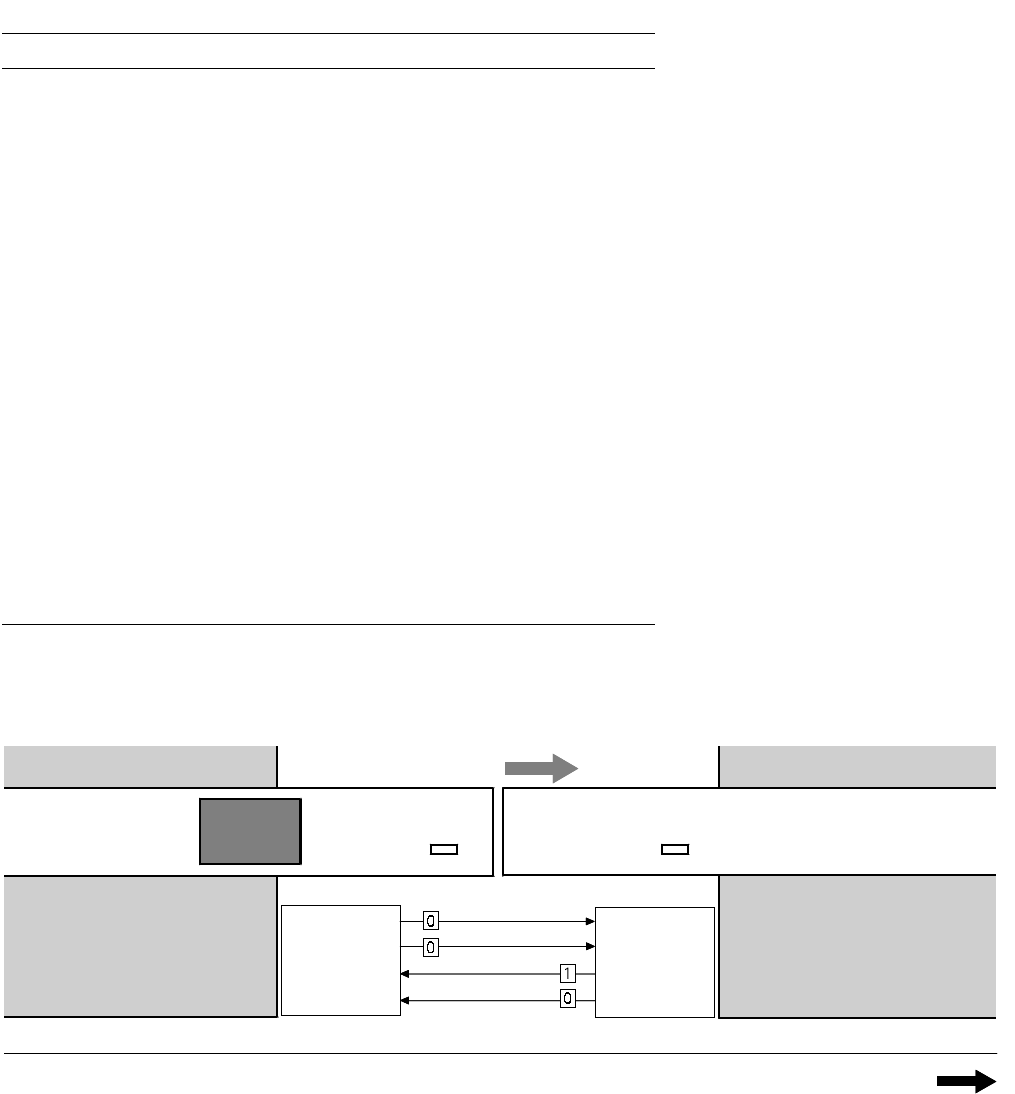
Signal Interfaces
Signal Interface (20-Pin Ribbon Cable Connector)
to upstream station x3 to downstream station x4
Pin 13 GND 24 V Pin 10 Reserved
Pin 14 Arrived Pin 9 Reserved
Pin 15 Permission Pin 8 Reserved
Pin 19 Request Pin 4
+30 V DC
unsaturated
Pin 20
GND 24 V for request / re-
leased (contact separation)
Pin 5 GND 24 V
Pin 18 Released Pin 6 +24 V DC
Pin 12 Trouble signal loop Pin 11 Trouble signal loop
Pin 11 Pin 12
Pin 3 +24 V DC Pin 15 Permission
Pin 2 GND 24 V Pin 13
GND 24 V for per-
mission / arrived
(contact separation)
Pin 1 +30 V DC unsaturated Pin 14 Arrived
Pin 8 Reserved Pin 18 Released
Pin 9 Reserved Pin 19 Released
Pin 10 Reserved Pin 20 GND 24 V
Requirement
Delivery
Permission
Receival
Requirement
Delivery
Permission
Receival
Transport Direction
Conveyor Section 1
PCB
Sensor
PCB
Sensor
Conveyor Section 2
Station n
transports
PCB
to delivery
Station n+1
is ready to
receive PCBs
Conveyor 1 is On Conveyor 2 is Off