4OM-1011-002.pdf - 第203页
0305-001 Tg0860-PM-MM 7.2 COMPONENT RECOG. TEST Display 3-152 Case: An error was found in the recognition. (16) Press the [COMP . RECOG. (MANUAL)] key . The “COMP . RECOG. (MANUAL)” display appears on the screen. • When …
0305-001 Tg0860-PM-MM
7.2 COMPONENT RECOG. TEST Display
3-151
(14) Select the [MOVE TO RECOG. STATION & RECOG. [MOVE]] key
and press the [MOVE] button.
The component recognition test is implemented.
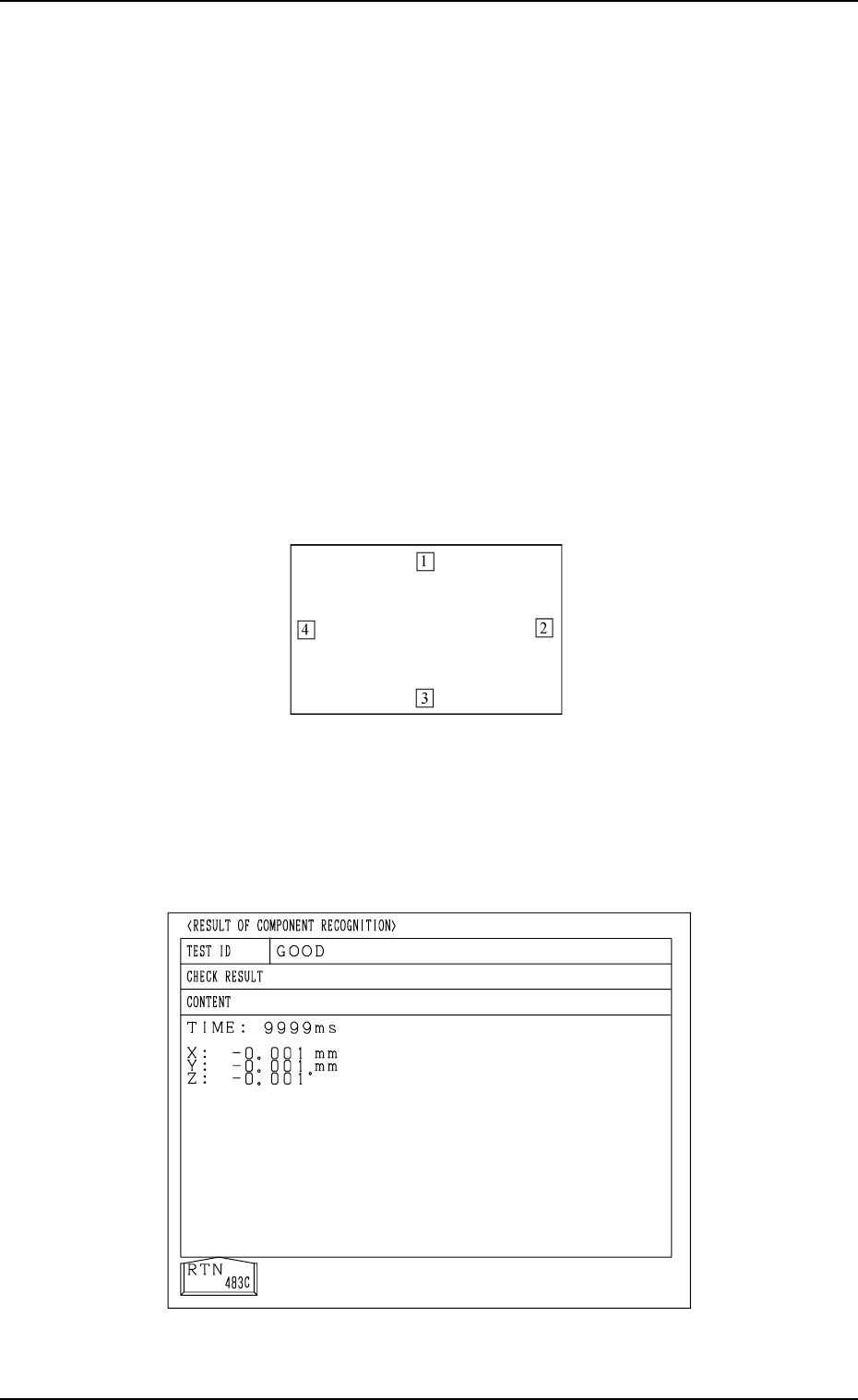
Note: In the component recognition test, the captured image on the rec-
ognition monitor will be oriented such that it faces the directions
defined in the test library data, basically regardless of which beam
(Beam A or B) the component is picked up from. In the test li-
brary data, the upward direction of the monitor is regarded as
Direction 1, the rightward direction as Direction 2, the downward
direction as Direction 3, and the leftward direction as Direction
4. A component picked up from Beam B is rotated by 180° such
that it faces the directions defined in the test library data before
recognized.
(In the automatic operation, no component is rotated by 180°.
Therefore, the captured image of the component appears differ-
ently on the recognition monitor, depending on which side (A or
B) the component is picked up from.)
1, 2, 3, and 4 appear on the recognition monitor, indicating the
directions in which the picked component is facing.
(15) Press the [RESULT OF RECOG.] key to check the result of the recogni-
tion.
Case: The recognition is completed normally.
Normal Completion of Recognition
Fig. 4C320
Recognition Monitor
Fig. 4C319
0305-001 Tg0860-PM-MM
7.2 COMPONENT RECOG. TEST Display
3-152
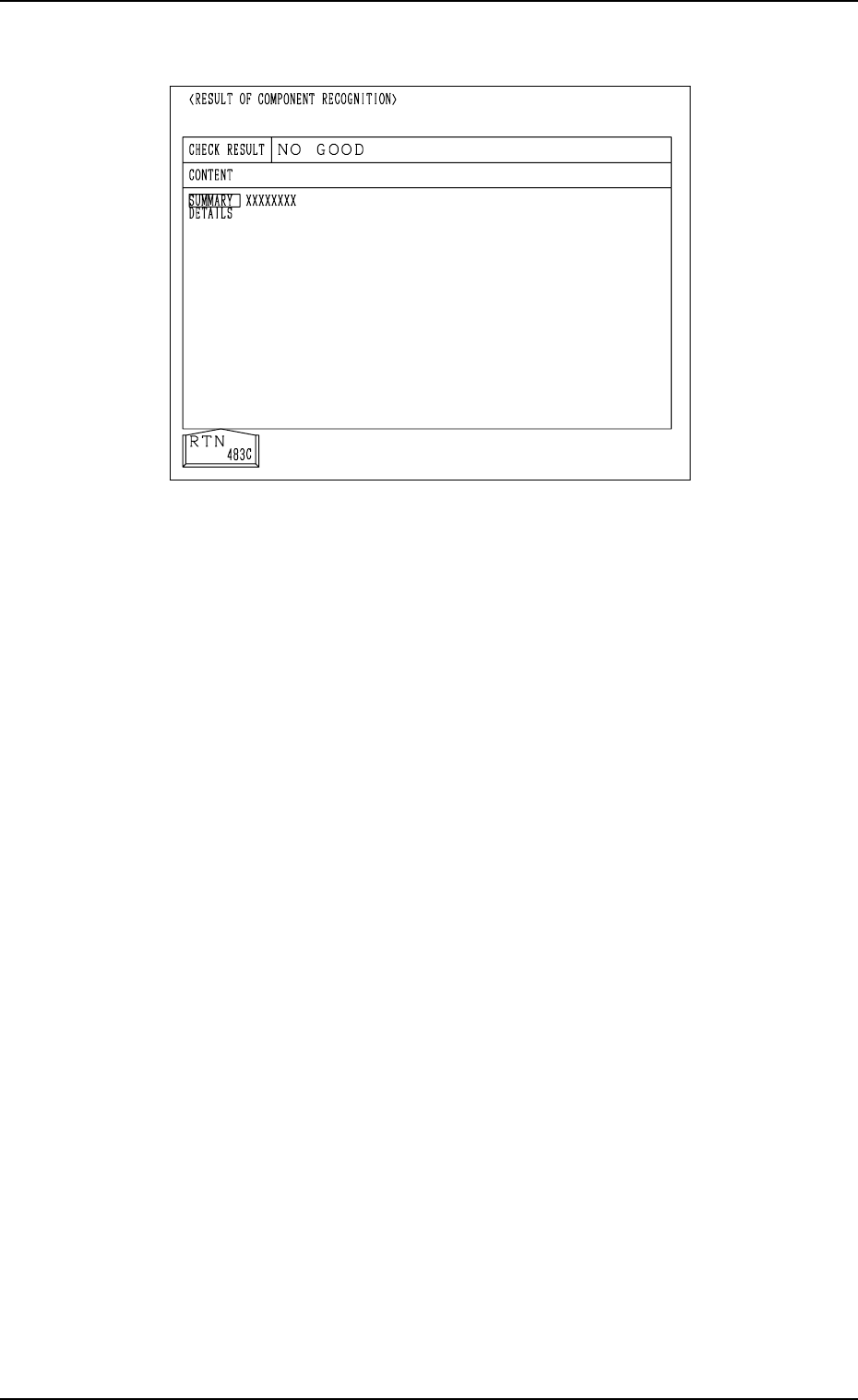
Case: An error was found in the recognition.
(16) Press the [COMP. RECOG. (MANUAL)] key. The “COMP. RECOG.
(MANUAL)” display appears on the screen.
• When the result of the recognition is “OK”, proceed to Step (18).
• When the result of the recognition is “NG (No Good)”, proceed to Step
(17).
(17) Use the “CAMERA”, “CORRECT PICKED POSITION [MOVE]”, and
“RECOGNITION LIGHTING SET” menus at the “COMP. RECOG.
(MANUAL)” display and re-perform the component recognition test.
(18) Perform a hysteresis test at the “HYSTERESIS TEST” display.
Refer to “7.2.4 HYSTERESIS TEST Display of Section 3” for details.
(19) Select the [COMP. COLLECTION [MOVE]] key and press the [MOVE]
button.
Components are collected (discharged) and the X/Y beam is zeroed.
The components are discharged to the component discharge box near the
X/Y beam or the component discharge conveyor (option).
To collect a component by hand, select the [PICK FROM FEEDER
(MANUAL) [MOVE]] key to move the component to the pick-up posi-
tion and collect it there.
After that, press the [COMP. COLLECTION [MOVE]] key to implement
the component collection operation and then zero the X/Y beam.
Note: The display cannot be resumed when the vacuum valve is kept
“ON” (a component is picked up).
Abnormal Completion of Recognition
Fig. 4C321

0305-001 Tg0860-PM-MM
7.2 COMPONENT RECOG. TEST Display
3-153
To draw out a pallet manually, pick up a component automatically
from the tray, and perform a component recognition test
(1) Press the [SET TEST ID] key at the display (Fig. 4C265). The “SET
TEST ID” display appears on the screen.
Register the component ID to be tested as a test ID.
Refer to “7.2.1 SET TEST ID Display of Section 3” for details.
(2) Check “NOZZLE TYPE” at the display (Fig. 4C265) and press the
[MANUAL NOZZLE CHANGE OPE] key. The “MANUAL NOZZLE
CHANGE OPERATION” display appears on the screen.
Attach the nozzle specified for “NOZZLE TYPE”.
When the pertinent nozzle is not found, open the “NOZZLE TYPE DATA”
and “NOZZLE DATA” displays and register parameters. Then, attach the
nozzle. (Hierarchical Sequence: “DATA EDIT” Display → “NOZZLE
TYPE DATA” Display or “NOZZLE DATA” Display).
(3) Open the “COMPONENT REPLENISHMENT” display for the multi-
layer tray feeder (option) and check whether or not any component short-
age error has occurred in the steps for the production model.
If a component shortage error has occurred in a step, replenish the step
with components.
Refer to the instruction manual of the multi-layer tray feeders for details.
(4) Press the [SET FEEDER] key at the display (Fig. 4C265). The “SET
FEEDER” display appears on the screen.
Use the “CURRENT PRGM. (COMP. DATA) REF.” function to select
the [TRAY-L 301-] or the [TRAY-R 601-] key to specify the same com-
ponent ID (feeder No.) as the set test ID.
Refer to “7.2.2 COMP. RECOG. TEST - SET FEEDER Display of Sec-
tion 3” for details.
(5) Select the head where the nozzle on the operation side is attached, using
the related keys in the “SELECT HEAD/CAMERA” group box.
(6) Select the camera to be used to capture an image, using the related keys in
the “SELECT HEAD/CAMERA” group box.
(7) Set “OFF” in the “VACUUM VALVE” data box.
(The vacuum valve turns ON automatically.)
(8) Open the “COMPONENT RECOG. TEST - TRAY COMPONENT SUP-
PLY/STORAGE” display. Select the [DRAWING CARRIAGE [MOVE]]
key and press the [MOVE] button.
The pallet is drawn out.
(9) Select the [PICK FROM FEEDER (AUTO) [MOVE]] key and press the
[MOVE] button.
A component is picked up from the tray which was drawn out.
(10) Select the [MOVE TO RECOG. STATION & RECOG. [MOVE]] key
and press the [MOVE] button.
The component recognition test is implemented.
(11) To manually attach the component, refer to Steps (15) through (19).
(12) Select the [STORING CARRIAGE [MOVE]] key and press the [MOVE]
button.
The tray that was drawn out is stored back in the magazine.