4OM-1011-002.pdf - 第273页
0305-001 Tg0860-PM-MM 3.3 Setting of Passwords (1) Perform the touch screen calibration operation before setting a password. (Refer to “Section 5 T ouch Screen” for details.) When the touch screen is not calibrated corre…

0305-001 Tg0860-PM-MM
• All operations set as available at the “PASSWORD AVLBL. AREA
SET” display can be performed.
Note: When you open the data edit display corresponding to the item
whose editing is prohibited at the “PASSWORD AVLBL.
AREA SET” display, the parameters can be checked but can-
not be edited. A message “CANNOT INPUT THE DATA” ap-
pears in place of “PLEASE INPUT THE DATA AND PRESS
THE [SET] KEY.”.
When a prohibited operation item is selected, a message “OP-
ERATION DENIED BY LOGIN TYPE.” appears in the dis-
play.
• After you finish machine operations, be sure to select the [LOGOUT]
key located at the bottom left of the “MAIN MENU” display. The dis-
play for “Log In” type selection appears on the screen.
Note: If you keep the “MAIN MENU” open for a long period of time
without opening the display for “Log In” type selection, the
password’s security function becomes meaningless.
Especially when the system is logged on to by a highly autho-
rized personnel such as the supervisor, be sure to return to the
display for “Log In” type selection.
4-7
3.2 Flow of Operation
0305-001 Tg0860-PM-MM
3.3 Setting of Passwords
(1) Perform the touch screen calibration operation before setting a password.
(Refer to “Section 5 Touch Screen” for details.)
When the touch screen is not calibrated correctly, the entered password
may not be stored correctly in memory of the machine.
(2) Enter the password specified as one for the supervisor to issue the “Log
In” command.
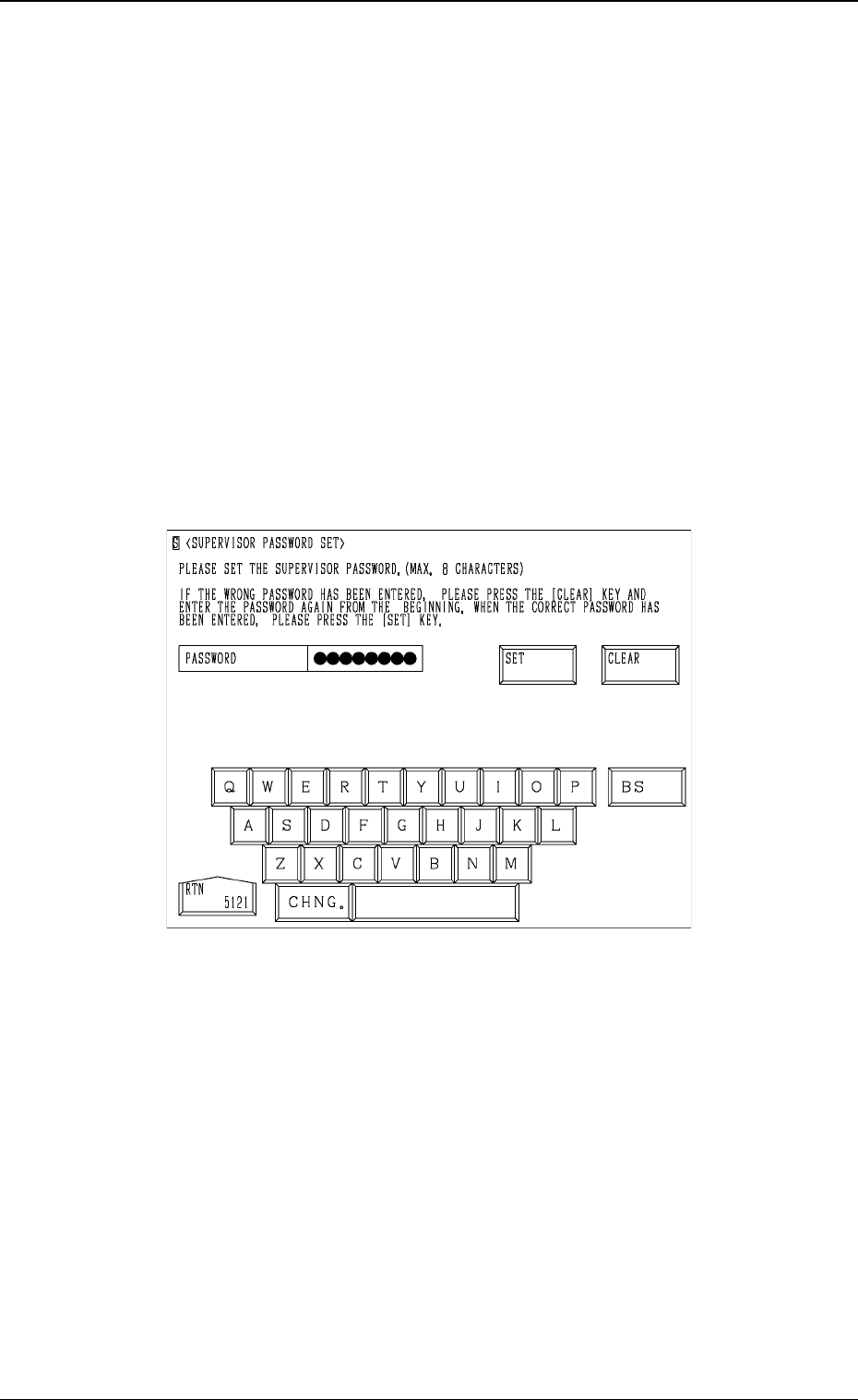
(3) When the [SUPERVISOR PASSWORD SET] key is pressed at the “PASS-
WORD” display, the following display (Fig. 4D9) appears on the screen.
(Hierarchical Sequence: “MAIN MENU” Display → “MACHINE SET-
UP” Display → “PASSWORD” Display → “SUPERVISOR PASSWORD
SET” Display)
Ref.: The “OPERATOR #1 PASSWORD SET” and “OPERATOR #2
PASSWORD SET” displays also look similar to the “SUPERVI-
SOR PASSWORD SET” display.
(4) Enter a password with the keyboard. (Max. 8 characters)
As you type, the system will display z marks instead of characters to
maintain password security.
When you accidentally press the wrong key in the middle of password
entry, use the [CLEAR] key to delete all entries and enter your password
from the beginning or press the [BS] key to delete a character to the left
of the cursor.
(5) After all the entries are correct, press the [SET] key.
• When the password is set for the first time, proceed to Step (7).
• When a password is already set, proceed to Step (6).
Note: If the [SET] or [RTN] key is pressed without entering any pass-
word, the “PASSWORD” display appears on the screen, indicat-
ing that no password is set and the operator can successfully log
on to the system without a password.
4-8
3.3 Setting of Passwords
Fig. 4D9
0305-001 Tg0860-PM-MM
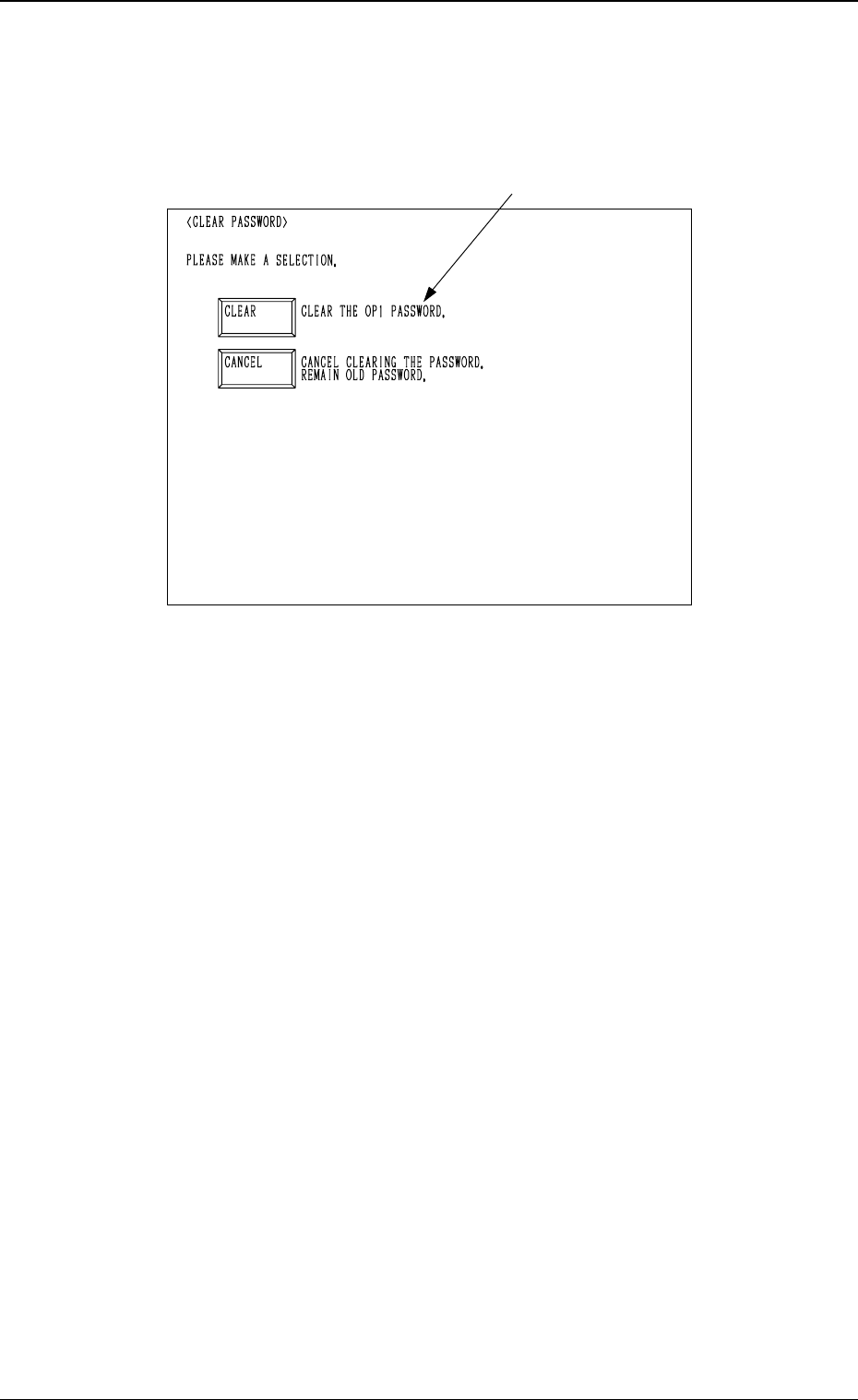
(6) When a password is already set, the following display appears on the
screen, prompting the handling of the password.
Follow the instructions on the screen and select the [CLEAR] or [CAN-
CEL] key.
[CLEAR] Key : The old password is cleared and a new password can be
set again.
[CANCEL] Key : The password entered last is used.
Ref.: Fig. 4D10 shows the “CLEAR PASSWORD” display opened from the
“OPERATOR #1 PASSWORD SET” display.
When the “CLEAR PASSWORD” display is opened from the “SU-
PERVISOR PASSWORD” display, “CLEAR SUPERVISOR PASS-
WORD” appears in the area indicated by A at the “CLEAR PASS-
WORD” display (Fig. 4D10).
When the “CLEAR PASSWORD” display is opened from the “OP-
ERATOR #2 PASSWORD SET” display, “CLEAR THE OP2 PASS-
WORD” appears in the area indicated by A at the “CLEAR PASS-
WORD” display (Fig. 4D10).
(7) After a password is set and the [SET] key is pressed, “REENTER PASS-
WORD” appears in the display, enabling you to re-enter your password.
Re-enter your password and press the [SET] key. The system checks
whether or not the re-entered password matches the password entered
last.
• If the password is not identical, “PASSWORD” appears in the display,
enabling you to enter a password from the beginning.
• If the password is identical, the “PASSWORD” display appears on the
screen, indicating that your password is correctly set.
A
4-9
3.3 Setting of Passwords
Fig. 4D10