Oxford-100-Manual.pdf - 第109页
System Manual Oxford Instruments Plasma Technology PlasmalabSystem 1 00 LOW PRESSURE STRIKE panel The low pressure strike feature allows plasma processing at low pressures. When the gas pressure is too low, it is not pos…
PiasmaiabSystem100
Oxford
Instruments
Plasma
Technology
System Manual
RF
Generator
panel
ICP
GENERATOR
panel
CRYO panel
HELIUM
BACKING panel
Enter
the
required
forward
power.
The
forward
power, reflected
power,
power
ON/OFF status and
DC
bias are displayed.
Clicking
the
Set
Fwd
Power
button
toggles
the
demand
between
a
forward
power
set
point
and a
DC
bias set
point.
If
a
DC
bias demand
is
set,
the
RF
power
will
be varied
to
try
to
achieve
the
required
bias.
Use
this
facility
with
care:
if
the
plasma does
not
strike
or
if
the
DC
bias
cannot
be
read (by covering
the
table
with
insulator),
then
the
RF
power
will
increase
to
maximum.
Enter
the
required
forward
power.
The
forward
power, reflected
power,
ON/OFF status are displayed.
Enter
the
required
table
temperature.
The
current
table
temperature
is
displayed.
Enter
the
required
backing pressure. The
current
pressure (Torr) and
flow
rate
(sccm) are displayed. The open/closed status
of
the
control
valve
is
displayed.
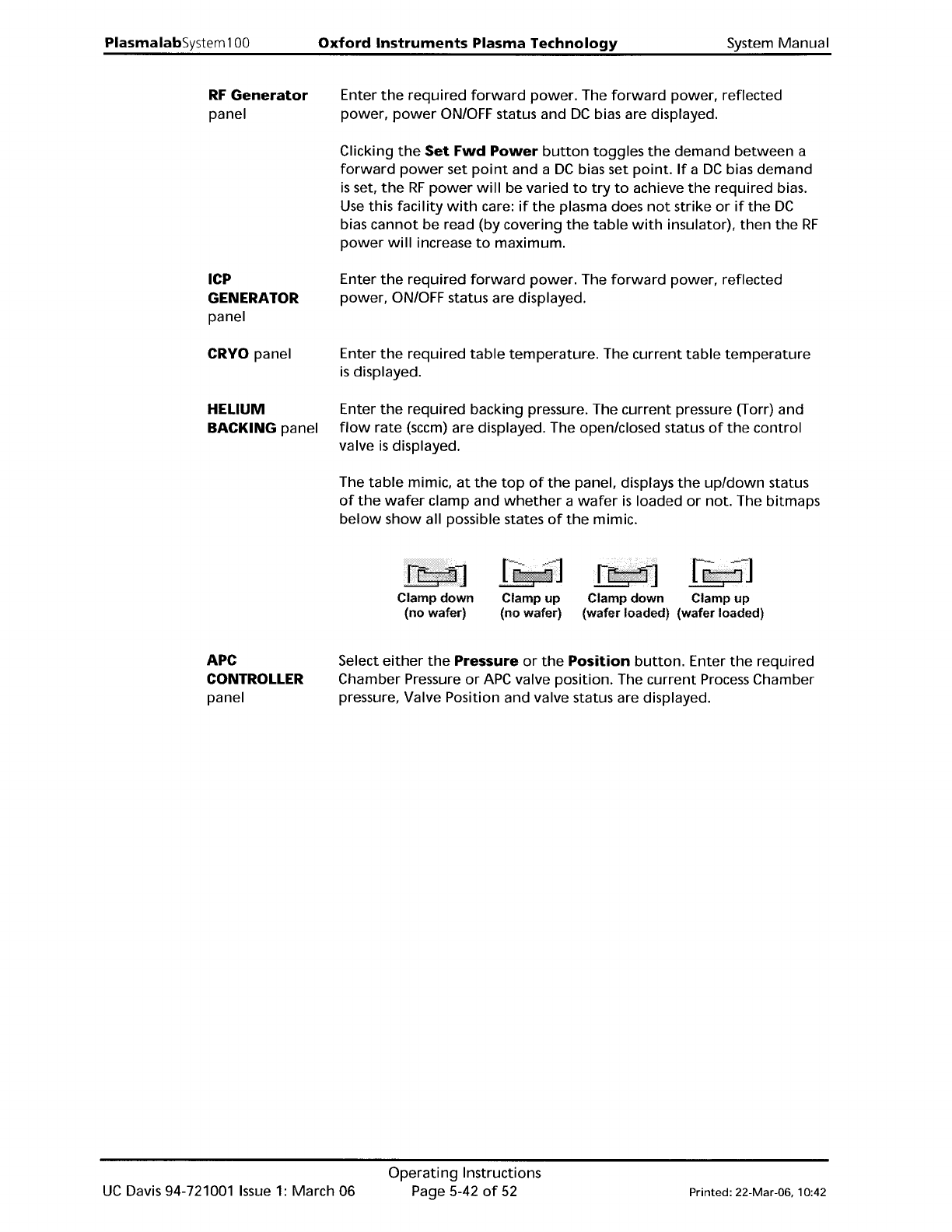
The
table
mimic,
at
the
top
of
the
panel, displays
the
up/down
status
of
the
wafer
clamp and
whether
a
wafer
is
loaded
or
not. The bitmaps
below
show
all possible states
of
the
mimic.
Clamp
down
(no wafer)
Fij!pdTI
Clamp
up
(no wafer)
Clamp
down
Clamp
up
(wafer loaded) (wafer loaded)
APC
CONTROLLER
panel
Select
either
the
Pressure
or
the
Position
button.
Enter
the
required
Chamber Pressure
or
APC
valve position. The
current
Process
Chamber
pressure, Valve Position and valve status are displayed.
UC
Davis 94-721001
Issue
1:
March 06
Operating
Instructions
Page 5-42
of
52
Printed: 22-Mar-06. 10:42
System
Manual
Oxford
Instruments
Plasma
Technology
PlasmalabSystem
100
LOW
PRESSURE
STRIKE panel
The
low
pressure strike
feature
allows plasma processing
at
low
pressures.
When
the
gas pressure
is
too
low,
it
is
not
possible
to
strike
a plasma;
however
it
is
possible
to
sustain a plasma
to
very
low
pressures once
it
has been
ignited.
This
software
feature
enables
the
user
to
raise
the
pressure
temporarily,
strike a plasma, and
automatically
reduce
the
pressure
to
the
desired
value
for
processing.
The
three
data fields and
their
effects are:
Strike
Pressure
field
DC bias
Minimum
field
Ramp
Rate
field
Enter
the
value in
mTorr
at
which
the
RF
should
turn
on and strike
the
plasma.
If
a zero
is
entered,
the
feature
is
disabled and
the
RF
will
turn
on once
the
pressure has stabilised
at
the
requested process
pressure.
Enter a positive
number
for
the
minimum
DC
bias
value expected once
the
plasma has struck. Enter
zero
if
DC
bias
cannot
be read because
the
substrate (and any
wafer
clamp)
completely
cover
the
electrode,
or
if
the
electrode has an insulating
coating. A
non-zero
value
is
used by
the
software
to
detect
if
the
plasma has been
properly
established.
If
a
zero
is
entered,
then
the
software
assumes
the
plasma has struck once
the
RF
reflected
power
goes
low.
Enter a
number
to
set
the
rate
at
which
the
pressure
is
reduced
from
the
strike
value
to
the
set
point.
The
higher
the
number
entered,
the
faster
the
transition
to
process conditions
will
be.
Note
that
too
high
a value can cause
the
plasma
to
go
out
if
the
plasma impedance changes faster
than
the
RF
matching
unit
can track.
Printed: 22-Mar-06, 10:42
Operating
Instructions
Page 5-43
of
52
UC
Davis 94-721001
Issue
1:
March 06
PiasmaiabSystem100
Process gas
pod
mimic
Oxford
Instruments
Plasma
Technology
Displays a
mimic
of
the
gas lines installed
in
the
gas pod.
System
Manual
Enter
the
required
gas
flow
in
sccm
for
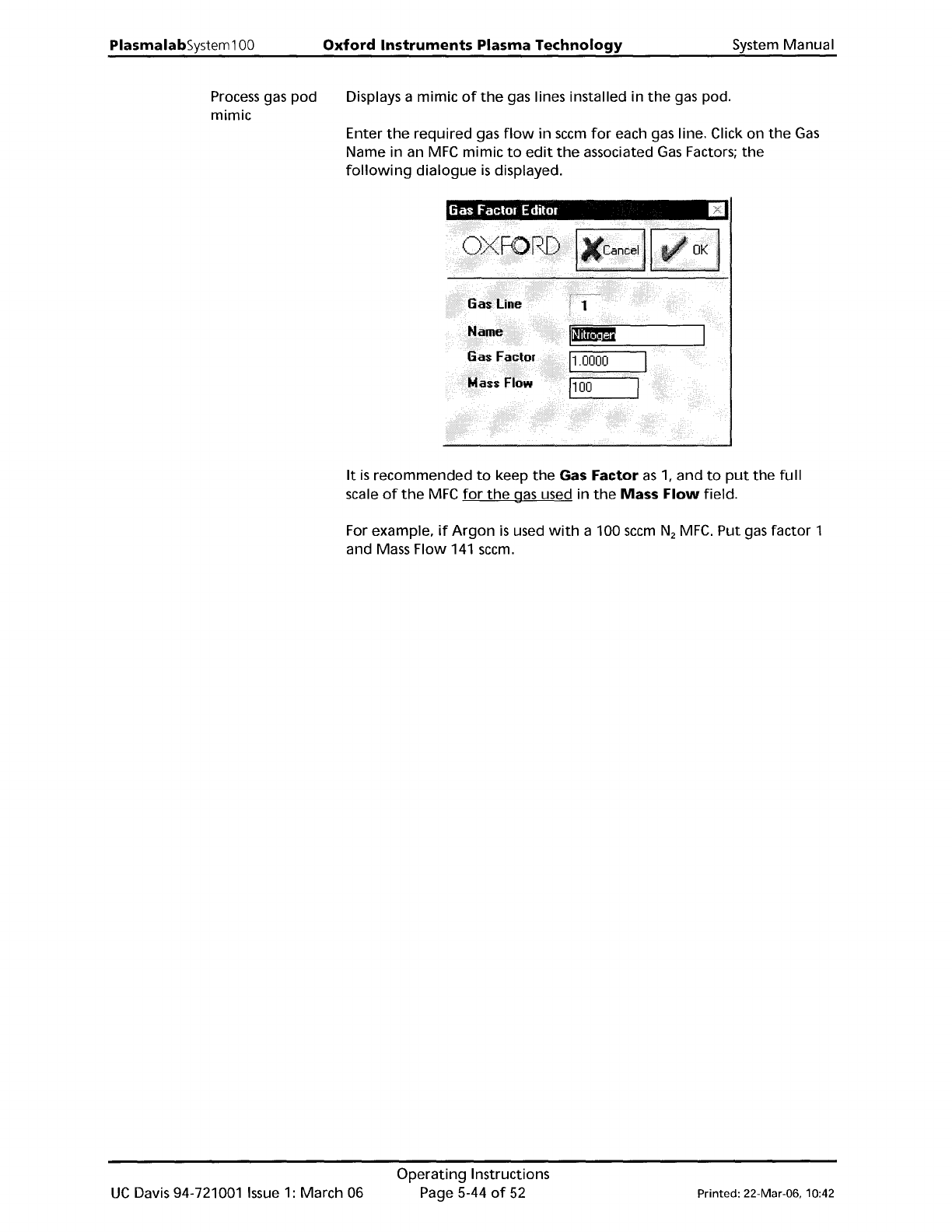
each gas line. Click
on
the
Gas
Name in an MFC
mimic
to
edit
the
associated
Gas
Factors;
the
following
dialogue
is
displayed.
Gas Factor Editor •
It
is
recommended
to
keep
the
Gas Factor
as
1,
and
to
put
the
full
scale
of
the
MFC
for
the
gas used in
the
Mass
Flow
field.
For example,
if
Argon
is
used
with
a 100
seem
N
2
MFC.
Put
gas
factor
1
and Mass
Flow
141
seem.
UC
Davis 94-721001 Issue
1:
March
06
Operating
Instructions
Page 5-44
of
52
Printed: 22-Mar-06. 10:42