Oxford-100-Manual.pdf - 第123页
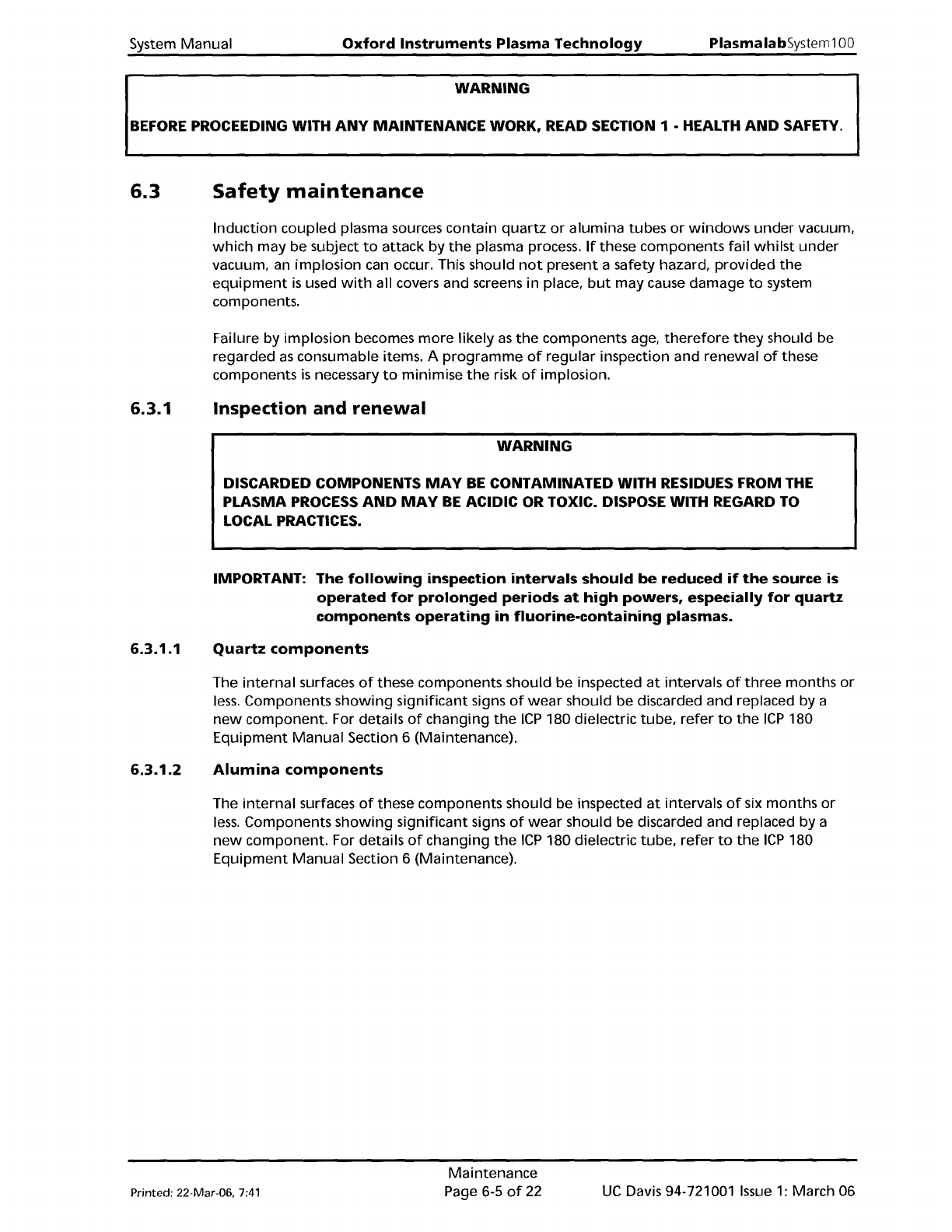
System Manual Oxford Instruments Plasma Technology WARNING Plasma labSystem 1 00 BEFORE PROCEEDING WITH ANY MAINTENANCE WORK, READ SECTION 1 - HEALTH AND SAFETY. 6.3 Safety maintenance Induction coupled plasma sources co…
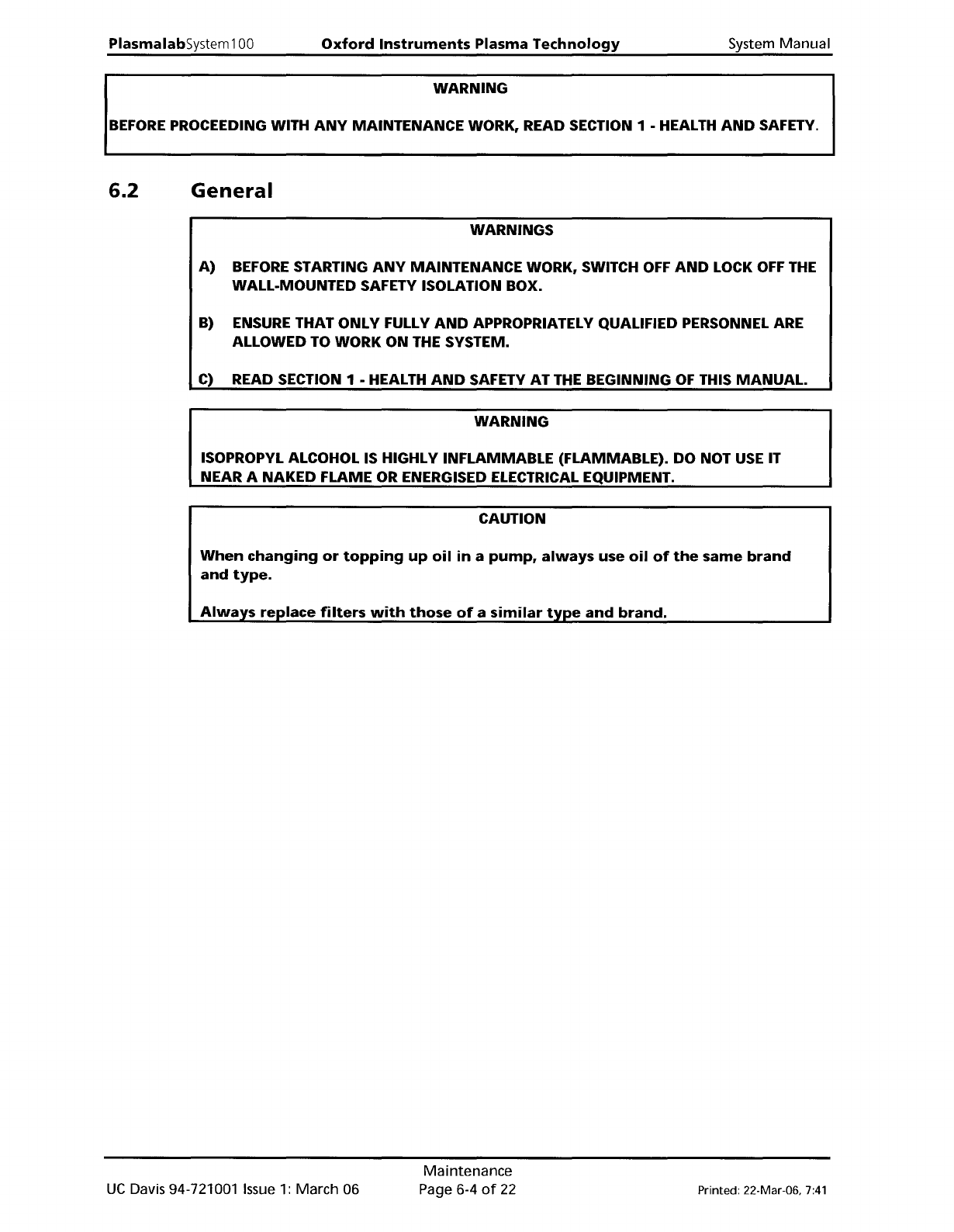
PlasmalabSystem100
Oxford
Instruments
Plasma
Technology
WARNING
System Manual
BEFORE PROCEEDING WITH
ANY
MAINTENANCE
WORK, READ SECTION 1 - HEALTH
AND
SAFETY.
6.2
General
WARNINGS
A)
BEFORE STARTING
ANY
MAINTENANCE
WORK, SWITCH
OFF
AND
LOCK
OFF
THE
WALL·MOUNTED
SAFETY ISOLATION BOX.
B) ENSURE THAT
ONLY
FULLY
AND
APPROPRIATELY QUALIFIED PERSONNEL ARE
ALLOWED
TO
WORK
ON
THE SYSTEM.
C)
READ SECTION 1 • HEALTH
AND
SAFETY
AT
THE BEGINNING
OF
THIS
MANUAL.
WARNING
ISOPROPYL ALCOHOL IS
HIGHLY
INFLAMMABLE
(FLAMMABLE).
DO NOT
USE
IT
NEAR A
NAKED
FLAME
OR ENERGISED ELECTRICAL EQUIPMENT.
CAUTION
When
changing
or
topping
up
oil
in
a
pump,
always
use
oil
of
the
same
brand
and
type.
Always
replace
filters
with
those
of
a
similar
type
and
brand.
UC
Davis 94-721001
Issue
1:
March 06
Maintenance
Page 6-4
of
22
Printed: 22-Mar-06.
7:41
System
Manual
Oxford
Instruments
Plasma
Technology
WARNING
PlasmalabSystem100
BEFORE
PROCEEDING WITH
ANY
MAINTENANCE WORK, READ SECTION 1 - HEALTH
AND
SAFETY.
6.3
Safety
maintenance
Induction
coupled
plasma sources contain
quartz
or
alumina
tubes
or
windows
under
vacuum,
which
may be subject
to
attack
by
the
plasma process.
If
these components fail
whilst
under
vacuum, an implosion can occur. This should
not
present a safety hazard,
provided
the
equipment
is
used
with
all covers and screens in place,
but
may
cause damage
to
system
components.
Failure by
implosion
becomes
more
likely
as
the
components age,
therefore
they
should be
regarded
as
consumable items. A
programme
of
regular
inspection and renewal
of
these
components
is
necessary
to
minimise
the
risk
of
implosion.
6.3.1
6.3.1.1
6.3.1.2
Inspection
and
renewal
WARNING
DISCARDED COMPONENTS
MAY
BE
CONTAMINATED WITH RESIDUES FROM
THE
PLASMA
PROCESS
AND
MAY
BE
ACIDIC
OR
TOXIC. DISPOSE WITH REGARD
TO
LOCAL PRACTICES.
IMPORTANT:
The
following
inspection
intervals
should
be
reduced
if
the
source is
operated
for
prolonged
periods
at
high
powers,
especially
for
quaru
components
operating
in
fluorine-containing
plasmas.
Quartz
components
The
internal
surfaces
of
these components should
be
inspected
at
intervals
of
three
months
or
less.
Components
showing
significant
signs
of
wear
should
be
discarded and replaced by a
new
component.
For details
of
changing
the
ICP
180 dielectric
tube,
refer
to
the
ICP
180
Equipment
Manual
Section 6 (Maintenance).
Alumina
components
The
internal
surfaces
of
these components should be inspected
at
intervals
of
six
months
or
less.
Components
showing
significant
signs
of
wear
should
be
discarded and replaced by a
new
component.
For details
of
changing
the
ICP
180 dielectric
tube,
refer
to
the
ICP
180
Equipment
Manual
Section 6 (Maintenance).
Printed: 22-Mar-06,
7:41
Maintenance
Page 6-5
of
22
UC
Davis 94-721001 Issue
1:
March 06
PlasmalabSystem100
Oxford
Instruments
Plasma Technology
WARNING
System Manual
BEFORE
PROCEEDING WITH
ANY
MAINTENANCE WORK, READ SECTION
1·
HEALTH
AND
SAFETY.
6.4
6.4.1
6.4.2
94-100-BW-2F
Base
wired
2-frame
kit
Weekly
Examine
the
exterior
of
the
machine
for
damage
or
signs
of
overheating and
for
failed
indicator
lamps.
Closed
loop
(recirculating)
cooling
systems:
Top
up
with
Hexid A40
coolant
(Oxford Plasma Technology Part No. GIWTRlSUN/007
for
15 litres). This
product
is
propylene
glycol based and
is
pre-diluted
ready
for
use.
Refer
to
Appendix
S(Services Specifications
for
Plasmalab and
lonfab
systems) sub-
section
2.1
for
the
warranty
impact
of
not
using this product.
Monthly
1)
Monitor
the
vacuum
integrity
of
the
system
by
pumping
thoroughly,
isolating
the
process chamber and
noting
the
rate
of
pressure rise.
An
abnormally
high
value (Le.
>
2mTorr/minute)
may indicate a leak
or
heavy
contamination
of
the
process
chamber. (The chamber can be isolated by clicking
the
Stop
button
on
the
corresponding Pump
Control
page.)
2)
Monitor
the
backing pump(s)'
condition
by
timing
how
long
it
takes
to
pump
from
atmosphere
to
0.1
Torr
(without
a
turbomolecular
pump
turned
on). An increase in
time
may
indicate
deteriorating
pump
performance.
3)
Check
the
zero
setting
of
the
Capacitance
Manometer
(CM gauge).
Note
that
the
CM
gauge
output
does
not
stabilise
until
it
has been switched on and
under
vacuum
for
15 minutes. A
turbo
pumped
system
will
have a base pressure
well
below
0.1
mTorr,
so
the
zero
point
can be adjusted readily in this
case
(see
manufacturer's
data). A Roots
I
rotary
combination
should give a base pressure
below
1 mTorr, and
can be used
to
set
the
zero
point
of
a 10
Torr
gauge. A
rotary
pump
should give a
base pressure
below
10 mTorr,
so
a
true
zero pressure
cannot
be set in this
case.
Either
the
gauge
should be set
to
the
same
arbitrary
reference level (e.g. 10 mTorr),
or
it
should be set
to
zero on
another
vacuum system
with
a
known
base pressure,
and
carefully
re-installed
in
the
System 100.
4)
Monitor
the
performance
of
each
mass
flow
controller,
by
noting
the
system
pressure
with
10%,
50%
and 100%
flow
setpoints and
the
throttle
fully
open. A
change may indicate a
deterioration
in
MFC
performance,
or
a change in
pumping
speed.
UC
Davis 94-721001
Issue
1:
March 06
Maintenance
Page 6-6
of
22
Printed: 22-Mar-06,
7:41