Oxford-100-Manual.pdf - 第125页
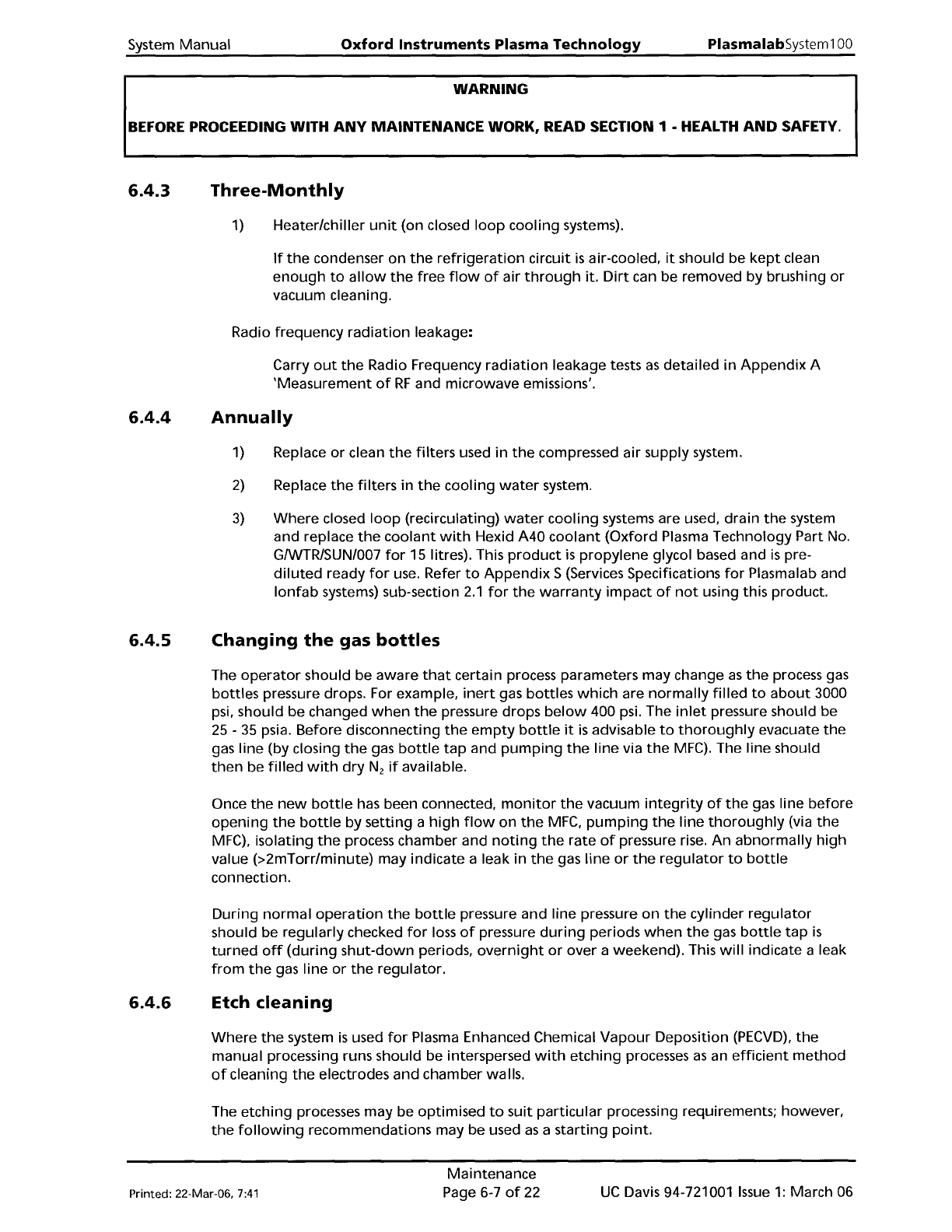
System Manual Oxford Instruments Plasma Technology WARNING PiasmaiabSystem100 BEFORE PROCEEDING WITH ANY MAINTENANCE WORK, READ SECTION 1 - HEALTH AND SAFETY. 6.4.3 6.4.4 6.4.5 6.4.6 Three-Monthly 1) Heater/chiller unit …
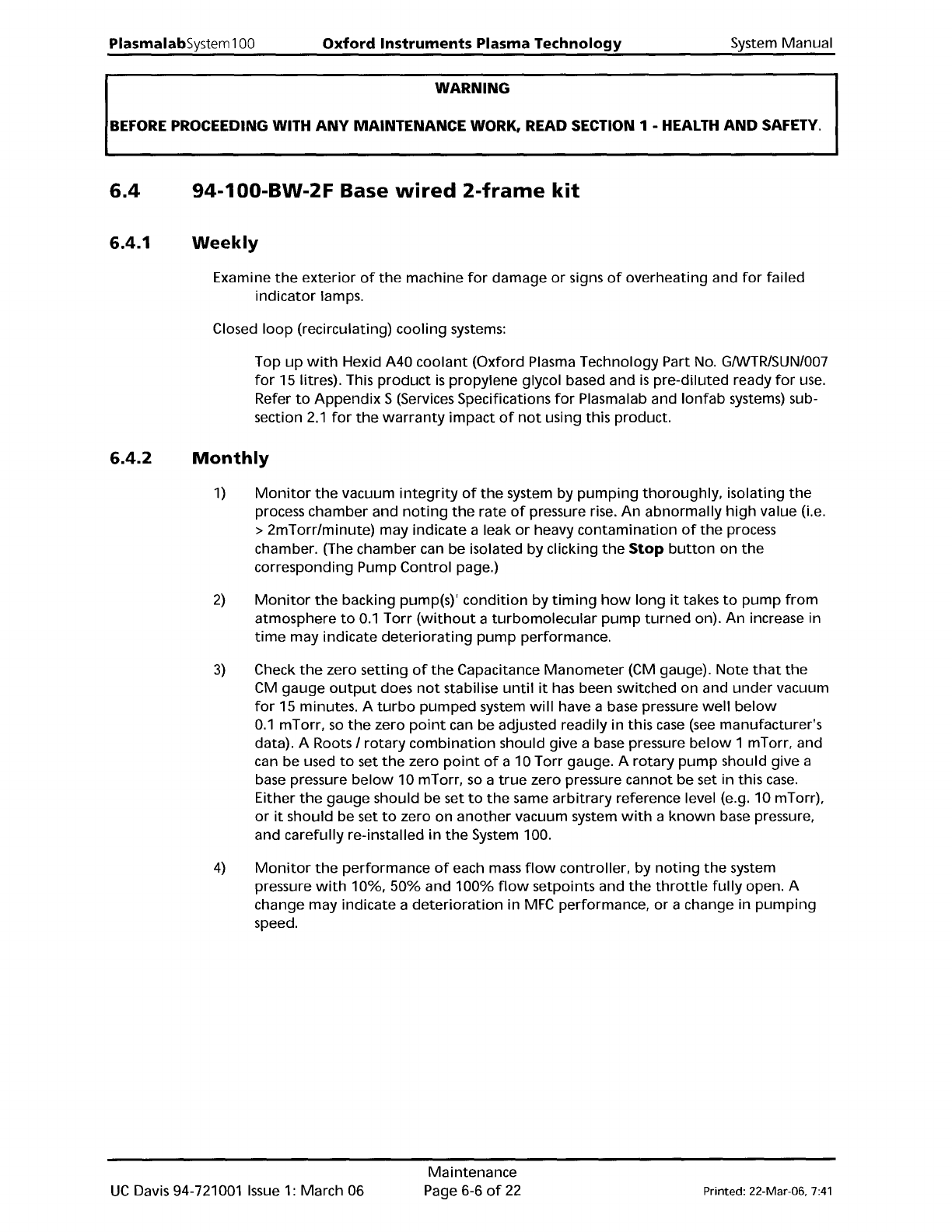
PlasmalabSystem100
Oxford
Instruments
Plasma Technology
WARNING
System Manual
BEFORE
PROCEEDING WITH
ANY
MAINTENANCE WORK, READ SECTION
1·
HEALTH
AND
SAFETY.
6.4
6.4.1
6.4.2
94-100-BW-2F
Base
wired
2-frame
kit
Weekly
Examine
the
exterior
of
the
machine
for
damage
or
signs
of
overheating and
for
failed
indicator
lamps.
Closed
loop
(recirculating)
cooling
systems:
Top
up
with
Hexid A40
coolant
(Oxford Plasma Technology Part No. GIWTRlSUN/007
for
15 litres). This
product
is
propylene
glycol based and
is
pre-diluted
ready
for
use.
Refer
to
Appendix
S(Services Specifications
for
Plasmalab and
lonfab
systems) sub-
section
2.1
for
the
warranty
impact
of
not
using this product.
Monthly
1)
Monitor
the
vacuum
integrity
of
the
system
by
pumping
thoroughly,
isolating
the
process chamber and
noting
the
rate
of
pressure rise.
An
abnormally
high
value (Le.
>
2mTorr/minute)
may indicate a leak
or
heavy
contamination
of
the
process
chamber. (The chamber can be isolated by clicking
the
Stop
button
on
the
corresponding Pump
Control
page.)
2)
Monitor
the
backing pump(s)'
condition
by
timing
how
long
it
takes
to
pump
from
atmosphere
to
0.1
Torr
(without
a
turbomolecular
pump
turned
on). An increase in
time
may
indicate
deteriorating
pump
performance.
3)
Check
the
zero
setting
of
the
Capacitance
Manometer
(CM gauge).
Note
that
the
CM
gauge
output
does
not
stabilise
until
it
has been switched on and
under
vacuum
for
15 minutes. A
turbo
pumped
system
will
have a base pressure
well
below
0.1
mTorr,
so
the
zero
point
can be adjusted readily in this
case
(see
manufacturer's
data). A Roots
I
rotary
combination
should give a base pressure
below
1 mTorr, and
can be used
to
set
the
zero
point
of
a 10
Torr
gauge. A
rotary
pump
should give a
base pressure
below
10 mTorr,
so
a
true
zero pressure
cannot
be set in this
case.
Either
the
gauge
should be set
to
the
same
arbitrary
reference level (e.g. 10 mTorr),
or
it
should be set
to
zero on
another
vacuum system
with
a
known
base pressure,
and
carefully
re-installed
in
the
System 100.
4)
Monitor
the
performance
of
each
mass
flow
controller,
by
noting
the
system
pressure
with
10%,
50%
and 100%
flow
setpoints and
the
throttle
fully
open. A
change may indicate a
deterioration
in
MFC
performance,
or
a change in
pumping
speed.
UC
Davis 94-721001
Issue
1:
March 06
Maintenance
Page 6-6
of
22
Printed: 22-Mar-06,
7:41
System
Manual
Oxford
Instruments
Plasma
Technology
WARNING
PiasmaiabSystem100
BEFORE
PROCEEDING WITH
ANY
MAINTENANCE WORK, READ SECTION 1 - HEALTH
AND
SAFETY.
6.4.3
6.4.4
6.4.5
6.4.6
Three-Monthly
1)
Heater/chiller
unit
(on closed
loop
cooling
systems).
If
the
condenser
on
the
refrigeration
circuit
is
air-cooled,
it
should be
kept
clean
enough
to
allow
the
free
flow
of
air
through
it.
Dirt
can be removed by brushing
or
vacuum cleaning.
Radio
frequency
radiation
leakage:
Carry
out
the
Radio Frequency
radiation
leakage tests
as
detailed
in
Appendix
A
'Measurement
of
RF
and microwave emissions'.
Annually
1)
Replace
or
clean
the
filters
used
in
the
compressed air supply system.
2)
Replace
the
filters in
the
cooling
water
system.
3)
Where
closed
loop
(recirculating)
water
cooling
systems are used, drain
the
system
and replace
the
coolant
with
Hexid A40
coolant
(Oxford
Plasma Technology Part No.
GIWTRlSUN/007
for
15 litres). This
product
is
propylene
glycol based and
is
pre-
diluted
ready
for
use.
Refer
to
Appendix
S(Services Specifications
for
Plasmalab and
lonfab
systems) sub-section
2.1
for
the
warranty
impact
of
not
using this product.
Changing
the
gas
bottles
The
operator
should be
aware
that
certain process parameters may change
as
the
process gas
bottles
pressure drops. For example,
inert
gas
bottles
which
are
normally
filled
to
about
3000
psi, should
be
changed
when
the
pressure drops
below
400 psi. The
inlet
pressure should be
25
-
35
psia. Before disconnecting
the
empty
bottle
it
is
advisable
to
thoroughly
evacuate
the
gas line (by closing
the
gas
bottle
tap
and
pumping
the
line via
the
MFC).
The line should
then
be
filled
with
dry
N
2
if
available.
Once
the
new
bottle
has been connected,
monitor
the
vacuum
integrity
of
the
gas line
before
opening
the
bottle
by
setting
a
high
flow
on
the
MFC,
pumping
the
line
thoroughly
(via
the
MFC),
isolating
the
process chamber and
noting
the
rate
of
pressure rise.
An
abnormally
high
value (>2mTorr/minute) may indicate a leak
in
the
gas
line
or
the
regulator
to
bottle
connection.
During
normal
operation
the
bottle
pressure and line pressure
on
the
cylinder
regulator
should be
regularly
checked
for
loss
of
pressure
during
periods
when
the
gas
bottle
tap
is
turned
off
(during
shut-down
periods,
overnight
or
over a weekend). This
will
indicate a leak
from
the
gas line
or
the
regulator.
Etch
cleaning
Where
the
system
is
used
for
Plasma Enhanced Chemical
Vapour
Deposition
(PECVD),
the
manual processing runs should be interspersed
with
etching
processes
as
an
efficient
method
of
cleaning
the
electrodes
and
chamber walls.
The
etching
processes
may
be
optimised
to
suit
particular
processing requirements; however,
the
following
recommendations may
be
used
as
a
starting
point.
Printed: 22-Mar-06,
7:41
Maintenance
Page
6-7
of
22
UC
Davis 94-721001
Issue
1:
March 06
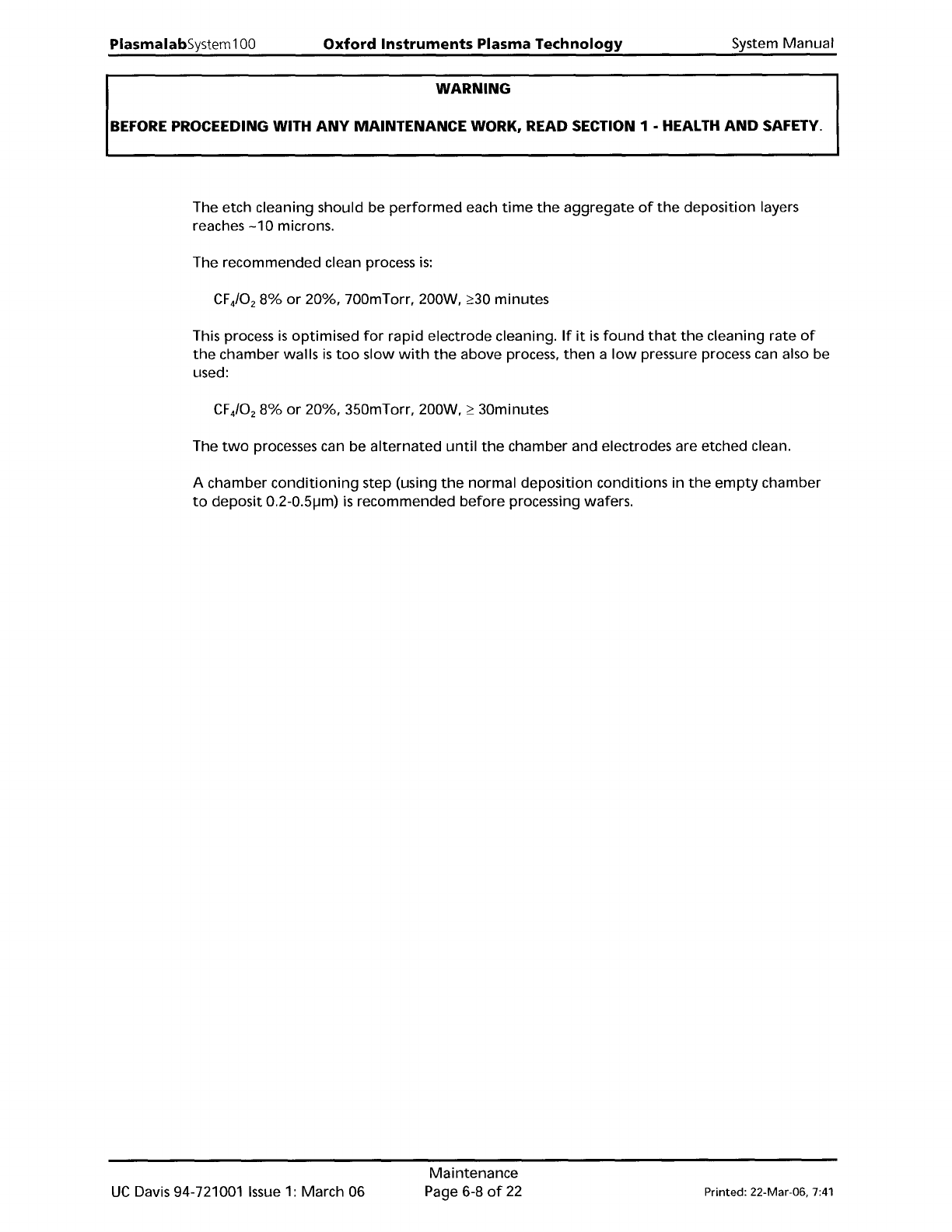
PlasmalabSystem100
Oxford
Instruments Plasma Technology
WARNING
System
Manual
BEFORE
PROCEEDING WITH
ANY
MAINTENANCE WORK, READ SECTION
1·
HEALTH
AND
SAFETY.
The etch cleaning should be
performed
each
time
the
aggregate
of
the
deposition
layers
reaches
-10
microns.
The recommended clean process
is:
CFi02
8%
or
20%, 700mTorr, 200W,
;:::30
minutes
This process
is
optimised
for
rapid electrode cleaning.
If
it
is
found
that
the
cleaning rate
of
the
chamber walls
is
too
slow
with
the
above process,
then
a
low
pressure process can also be
used:
CF
4
/0
2
8%
or
20%, 350mTorr, 200W,
;:::
30minutes
The
two
processes can be
alternated
until
the
chamber and electrodes are etched clean.
A chamber
conditioning
step (using
the
normal
deposition
conditions in
the
empty
chamber
to
deposit
0.2-0.5IJm)
is
recommended
before
processing wafers.
UC
Davis 94-721001
Issue
1:
March 06
Maintenance
Page 6-8
of
22
Printed: 22-Mar-06,
7:41