Oxford-100-Manual.pdf - 第135页
System Manual Oxford Instruments Plasma Technology WARNING PlasmalabSystem 1 00 BEFORE PROCEEDING WITH ANY MAINTENANCE WORK, READ SECTION 1 • HEALTH AND SAFETY. 6.10 Gas handling system WARNING BEFORE ATTEMPTING ANY MAIN…
PiasmaiabSystem100
Oxford
Instruments Plasma Technology
WARNING
System
Manual
BEFORE
PROCEEDING WITH
ANY
MAINTENANCE WORK, READ SECTION 1 • HEALTH
AND
SAFETY.
fitted
to
load locks and
transfer
chambers
is
not
so critical.
therefore
the
manufacturer's
recommendations can be used.
The
ATP
turbo
pumps are supplied
with
series
ACT
intelligent
controllers
which
are menu-
driven. The 'SET-UP' menu allows
the
re-greasing interval
to
be set
so
that
a visual
warning
with
an
optional
audible
alarm
is
displayed
at
the
relevant
time.
Note
that
this visual
warning
does
not
require
any action immediately;
it
only
indicates
that
the
bearing should be re-
greased
at
the
next
available
opportunity.
If
required,
the
visual
warning
and
audible
alarm
can be disabled via
the
'SET-UP' menu.
When
the
pumps are supplied,
the
ACT
controller
is
pre-set
with
a 5,000
hour
re-grease
interval.
If
the
pumps are
running
continuously,
the
visual re-grease
warning
will
be
automatically
triggered
after
approximately
seven months.
The customer
is
advised
to
use
the
'SET-UP' menu
to
set
the
re-greasing interval
for
the
pump
fitted
to
his system. Refer
to
the
pump
manufacturer's manual.
Note
that
this change takes
approximately
five
minutes.
When
the
re-greasing
time
is
reached,
lubrication
is
carried
out
using a pre-loaded syringe
to
apply
a
metered
quantity
of
a specific grease
to
one
point
on
the
bearing. Refer
to
the
pump
manufacturer's
manual. The Alcatel
part
numbers
of
the
syringes are:
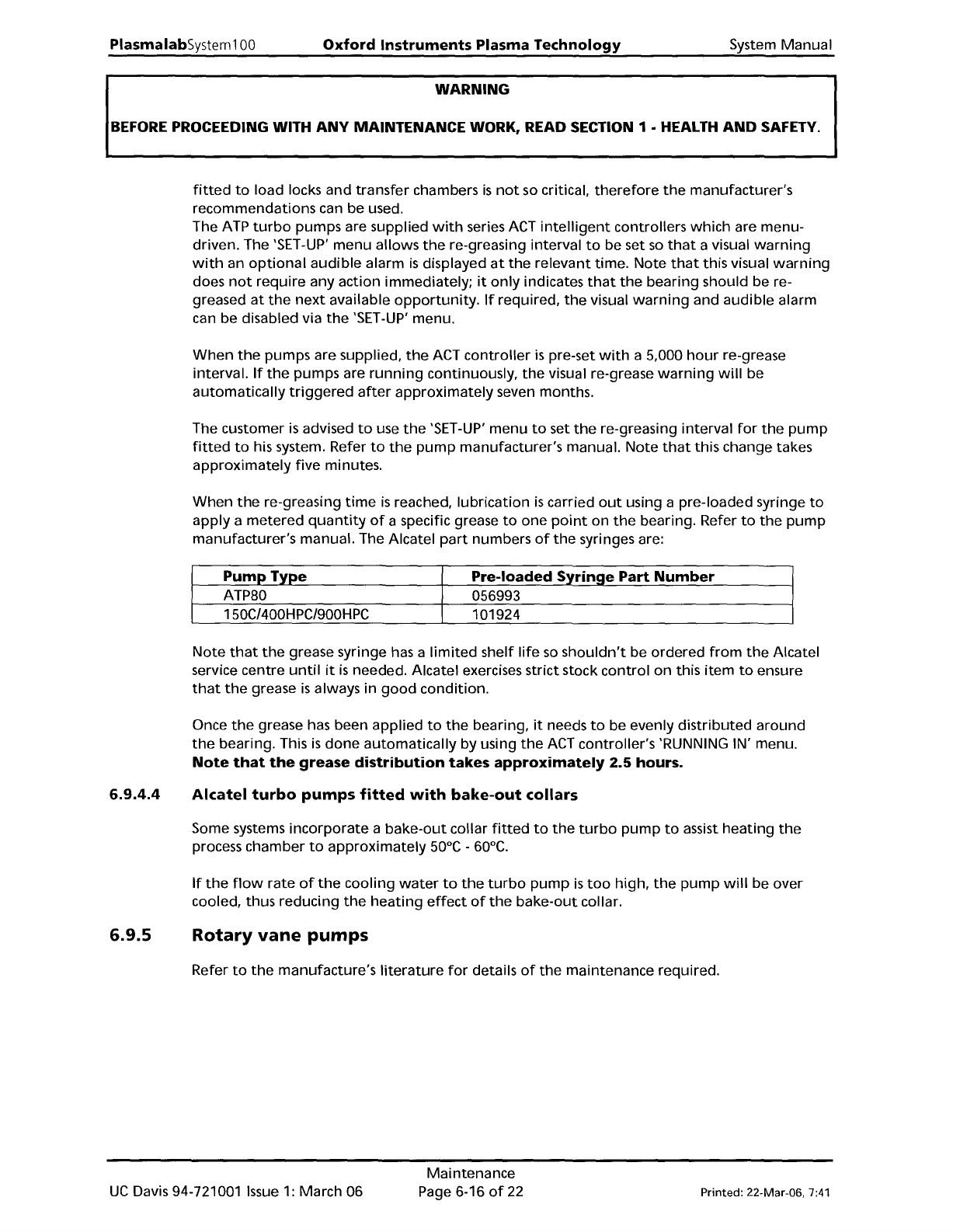
Pump
Type
Pre-loaded Syringe
Part
Number
ATP80
056993
150C/400HPC/900HPC
101924
Note
that
the
grease syringe has a
limited
shelf
life
so
shouldn't
be ordered
from
the
Alcatel
service centre
until
it
is
needed. Alcatel exercises
strict
stock
control
on
this
item
to
ensure
that
the
grease
is
always
in
good
condition.
Once
the
grease has been
applied
to
the
bearing,
it
needs
to
be evenly
distributed
around
the
bearing. This
is
done
automatically
by using
the
ACT
controller's 'RUNNING IN' menu.
Note
that
the
grease
distribution
takes
approximately
2.5 hours.
6.9.4.4
6.9.5
Alcatel
turbo
pumps
fitted
with
bake-out
collars
Some systems
incorporate
a
bake-out
collar
fitted
to
the
turbo
pump
to
assist
heating
the
process chamber
to
approximately
50°C
- 60°C.
If
the
flow
rate
of
the
cooling
water
to
the
turbo
pump
is
too
high,
the
pump
will
be over
cooled, thus reducing
the
heating
effect
of
the
bake-out
collar.
Rotary
vane
pumps
Refer
to
the
manufacture's
literature
for
details
of
the
maintenance required.
UC
Davis 94-721001 Issue
1:
March 06
Maintenance
Page 6-16
of
22
Printed: 22-Mar-06,
7:41
System
Manual
Oxford
Instruments
Plasma
Technology
WARNING
PlasmalabSystem100
BEFORE
PROCEEDING WITH
ANY
MAINTENANCE WORK, READ SECTION 1 • HEALTH
AND
SAFETY.
6.10
Gas
handling
system
WARNING
BEFORE
ATTEMPTING
ANY
MAINTENANCE WORK ON THE GAS HANDLING SYSTEM,
ELECTRICALLY ISOLATE
THE
SYSTEM BY SWITCHING
OFF
AND
LOCKING
OFF
THE
WALL-MOUNTED SAFETY ISOLATION BOX.
PROCESS
GASES USED
MAY
BE
TOXIC
OR
FLAMMABLE. ADOPT THE
CORRECT
PROCEDURES WITH REGARD
TO
PURGING
BEFORE
REMOVING
OR
LOOSENING COMPONENTS CARRYING
THESE
GASES. WEAR
PROTECTIVE CLOTHING.
6.10.1
Wall-mounted
gas
pod
6.10.1.1
Annually
Ensure
the
gas
pod
and its fixings are secure.
IMPORTANT: OIPT gas pods
typically
weigh
>40kg.
Ensure
the
wall
and
gas
pod
fixings
are
sturdy
enough
to
bear
at
least
four
times
the
weight
of
the
gas
pod.
6.10.2
Mass
flow
controllers
6.10.2.1
Annually
(or
as
necessary)
If
valves need cleaning,
repair
or
re-calibration:
1)
Make
sure valve has been
thoroughly
purged
before
removal.
2)
Discuss
with
the
vendor
the
return
of
the
Mass Flow Controllers
for
service
work.
Inform
the
vendor
if
hazardous gases have been used.
6.10.3
Filters
6.10.3.1
Annually
(or
as
necessary)
The process gas
filter
elements
will
need replacing
at
a frequency
that
depends
on
both
the
nature
and
purity
of
the
process gases, and
of
other
materials
that
come
into
contact
with
them.
The filters could need
changing
more
or
less
often
than
annually.
1)
Make
sure
line
has been
thoroughly
purged
before
removal.
2)
Unscrew
union
nut
and remove assembly.
3)
Tap
filter
element
lightly
on side
with
a
fibre
mallet
to
loosen and remove element.
4)
Fit
new
element.
5)
Re-assemble.
Printed: 22-Mar-06, 7:41
Maintenance
Page 6-17
of
22
UC
Davis 94-721001
Issue
1:
March 06
PlasmalabSystem
100
Oxford
Instruments
Plasma
Technology
WARNING
System
Manual
BEFORE
PROCEEDING WITH
ANY
MAINTENANCE WORK, READ SECTION 1 - HEALTH
AND
SAFETY.
6.11
6.11.1
6.11.2
Pump
lubricants
CAUTION
When
changing
or
topping-up
the
lUbricating
oil
in
a
pump,
always
use
oil
of
the
same
brand
and
type.
If
a
change
of
brand
or
type
is
contemplated,
refer
to
Oxford
Instruments
Plasma
Technology
for
advice.
General
The
lubricating
oils used
for
pumps
where
the
oil
comes
into
contact
with
the
pumped
gases,
Le. oil-sealed pumps such
as
rotary
vane types, should be chosen
to
meet
the
specific
characteristics necessary
for
the
process involved.
The
vapour
pressure must be
low
at
the
temperatures
reached
at
the
rubbing
surfaces.
Viscosity should
not
vary significantly over
the
temperature
range involved, and
the
water
absorption
rate and
content
must
be
low.
Lubricating oils generally fall
into
one
of
two
categories: mineral (hydrocarbon) based oil
or
synthetic
oil
such
as
perfluorinated
polyether. The synthetic oils are
normally
used
where
they
come
into
contact
with
strong oxidants such
as
nitrogen
dioxide, oxygen,
or
one
of
the
halogens.
Perfluorised
polyethers
Perfluorised
polyether
(PFPE)
lubricants have
the
following
properties:
a)
They are stable
up
to
350
0
C,
Le.
they
do
not
decompose
below
this
temperature.
b)
They are chemically inert. They
will,
however, react
with
Lewis acids
(BCI
3
,
AICI
3
etc.)
at
temperatures
over 100
0
C.
c)
They
do
not
polymerise
under
the
impact
of
high-energy
radiation.
d) Since
they
tend
not
to
keep contaminants suspended, pumps using these lubricants
must always be
fitted
with
suitable oil filters.
e)
They
do
not
'age' and
therefore,
if
used correctly, need
not
be replaced
during
the
lifetime
of
the
pump.
f)
Any
contaminants
in
the
lubricant
may be removed by
fitting
clean
filters
and
letting
the
pump
run
for
several hours
with
inert
gas ballast,
the
intake
port
having
been closed.
g) They
do
not
protect
metal surfaces against corrosion. Pumps should
therefore
always
be flushed
with
inert
gas. Pumps using
PFPE
should be
allowed
to
run continuously.
h)
PFPE
is
incompatible
with
hydrocarbon oils, i.e. mineral oils, conventional greases
and cleaning agents.
i)
If
a
pump
uses
PFPE
lubricant
only
Freon 113
or
Frigen 113 may be used
as
a cleaning
agent, and
only
PFPE
grease may be employed.
UC
Davis 94-721001
Issue
1: March 06
Maintenance
Page 6-18
of
22
Printed: 22-Mar-06,
7:41