Oxford-100-Manual.pdf - 第137页
System Manual Oxford Instruments Plasma Technology WARNING PiasmaiabSystem100 BEFORE PROCEEDING WITH ANY MAINTENANCE WORK, READ SECTION 1· HEALTH AND SAFETY. j) If it should become necessary to change from PFPE to minera…
PlasmalabSystem
100
Oxford
Instruments
Plasma
Technology
WARNING
System
Manual
BEFORE
PROCEEDING WITH
ANY
MAINTENANCE WORK, READ SECTION 1 - HEALTH
AND
SAFETY.
6.11
6.11.1
6.11.2
Pump
lubricants
CAUTION
When
changing
or
topping-up
the
lUbricating
oil
in
a
pump,
always
use
oil
of
the
same
brand
and
type.
If
a
change
of
brand
or
type
is
contemplated,
refer
to
Oxford
Instruments
Plasma
Technology
for
advice.
General
The
lubricating
oils used
for
pumps
where
the
oil
comes
into
contact
with
the
pumped
gases,
Le. oil-sealed pumps such
as
rotary
vane types, should be chosen
to
meet
the
specific
characteristics necessary
for
the
process involved.
The
vapour
pressure must be
low
at
the
temperatures
reached
at
the
rubbing
surfaces.
Viscosity should
not
vary significantly over
the
temperature
range involved, and
the
water
absorption
rate and
content
must
be
low.
Lubricating oils generally fall
into
one
of
two
categories: mineral (hydrocarbon) based oil
or
synthetic
oil
such
as
perfluorinated
polyether. The synthetic oils are
normally
used
where
they
come
into
contact
with
strong oxidants such
as
nitrogen
dioxide, oxygen,
or
one
of
the
halogens.
Perfluorised
polyethers
Perfluorised
polyether
(PFPE)
lubricants have
the
following
properties:
a)
They are stable
up
to
350
0
C,
Le.
they
do
not
decompose
below
this
temperature.
b)
They are chemically inert. They
will,
however, react
with
Lewis acids
(BCI
3
,
AICI
3
etc.)
at
temperatures
over 100
0
C.
c)
They
do
not
polymerise
under
the
impact
of
high-energy
radiation.
d) Since
they
tend
not
to
keep contaminants suspended, pumps using these lubricants
must always be
fitted
with
suitable oil filters.
e)
They
do
not
'age' and
therefore,
if
used correctly, need
not
be replaced
during
the
lifetime
of
the
pump.
f)
Any
contaminants
in
the
lubricant
may be removed by
fitting
clean
filters
and
letting
the
pump
run
for
several hours
with
inert
gas ballast,
the
intake
port
having
been closed.
g) They
do
not
protect
metal surfaces against corrosion. Pumps should
therefore
always
be flushed
with
inert
gas. Pumps using
PFPE
should be
allowed
to
run continuously.
h)
PFPE
is
incompatible
with
hydrocarbon oils, i.e. mineral oils, conventional greases
and cleaning agents.
i)
If
a
pump
uses
PFPE
lubricant
only
Freon 113
or
Frigen 113 may be used
as
a cleaning
agent, and
only
PFPE
grease may be employed.
UC
Davis 94-721001
Issue
1: March 06
Maintenance
Page 6-18
of
22
Printed: 22-Mar-06,
7:41
System
Manual
Oxford
Instruments
Plasma Technology
WARNING
PiasmaiabSystem100
BEFORE
PROCEEDING WITH
ANY
MAINTENANCE WORK, READ SECTION
1·
HEALTH
AND
SAFETY.
j)
If
it
should become necessary
to
change
from
PFPE
to
mineral oil
lubrication
or
vice
versa,
the
pump
must
be
completely
disassembled, freed
of
lubricant
and
fitted
with
new
gaskets and vanes.
k)
At
temperatures
over 350
0
C,
hazardous gaseous
decomposition
products are
formed.
Therefore
do
not
smoke
in
rooms
where
PFPE
is
used, and make sure
that
no
tobacco comes
into
contact
with
PFPE.
I)
When
handling
PFPE,
protective
clothing
must
be
used.
m) Do
not
mix
PFPE
with
used oil. Dispose
of
them
separately.
n)
PFPE
is
normally
odourless and colourless. Cloudiness
or
odour
is
a sign
of
contamination.
6.11.3
6.12
Hydrocarbon
lubricants
Where
mineral oils are used,
the
rate
of
oil
deterioration
for
a
particular
pump
and process
should
be
established
at
an early stage, and oil changes based
upon
this
information.
94-100-5-12A
Cryo
I
heated
-150
1400C
He
lower
electrode
wafer
clamping
plate
changeover
procedure
Before carrying
out
a process, in
the
process chamber
on
a
wafer
which
is
a
different
size
to
that
last processed,
it
is
necessary
to
fit
the
correct
type
of
clamping plate. Clamping plates
are available
for
various sized wafers.
To change
the
clamping plate, use
the
following
procedure
(refer
to
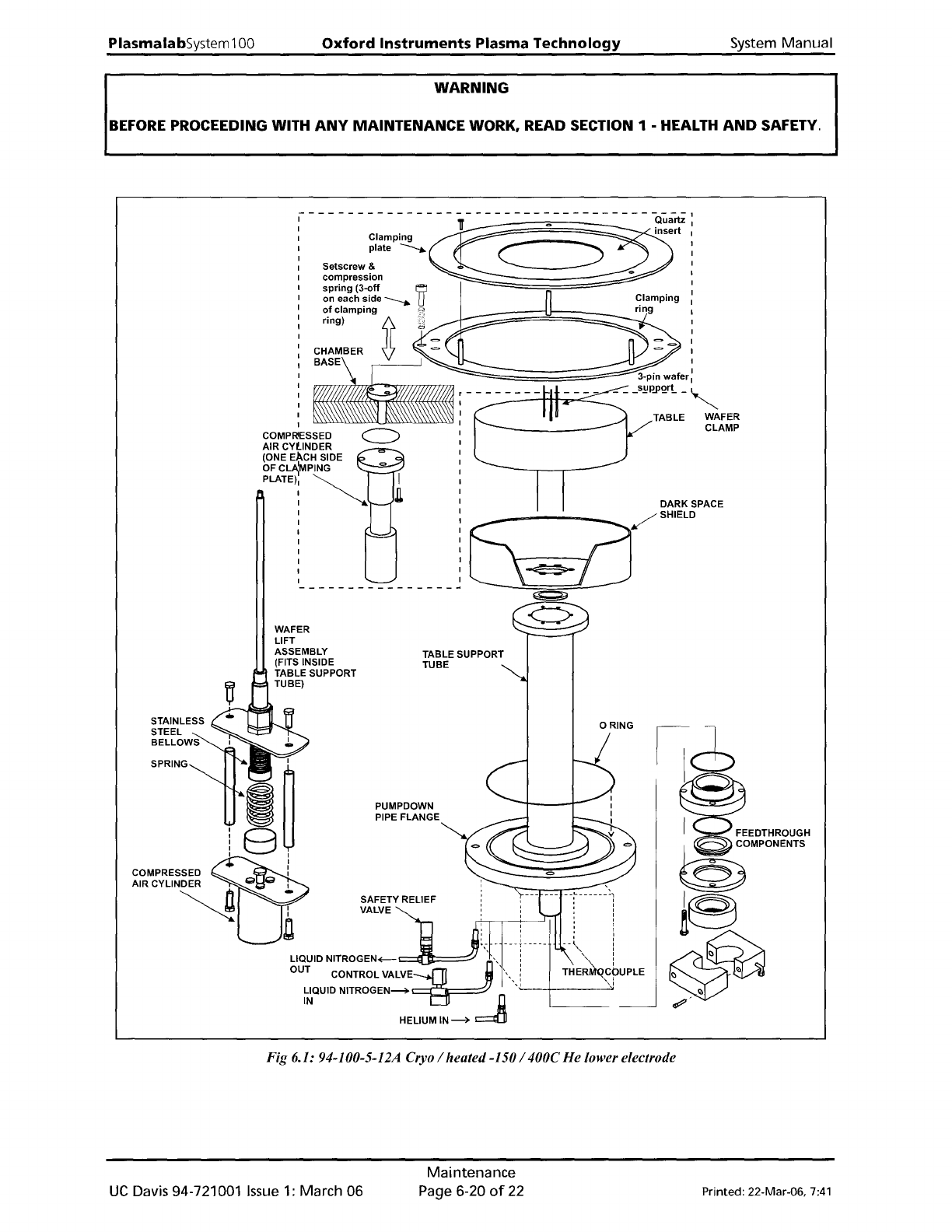
Fig 6.1, page 6-20):
6)
If
necessary,
vent
the
process chamber.
7)
Open
the
process chamber lid.
8)
Wearing
powder-free
gloves, unscrew
the
three
clamping
plate
securing screws
then
remove
the
clamping
plate
from
the
process chamber and place on a clean surface.
9)
Take
the
replacement
clamping
plate
and
mount
it
on
the
three
supporting
pillars
then
insert and
tighten
the
three
securing screws.
10) Close
the
process chamber lid.
Printed: 22-Mar-06,
7:41
Maintenance
Page 6-19
of
22
UC
Davis 94-721001
Issue
1:
March 06
PlasmalabSystem
100
Oxford
Instruments Plasma Technology
System Manual
WARNING
BEFORE
PROCEEDING WITH
ANY
MAINTENANCE WORK, READ SECTION 1 - HEALTH
AND
SAFETY.
ORING
Quartz
-=$25"
TABLE SUPPORT
TUBE
==;;;;;;;;;;;;;;:;;;;;;==
3-pin
wafer
'TTTTTT7T77TTn
_ _ _ s!'
p.PQrL
_ ,
TABLE WAFER
CLAMP
PUMPDOWN
PIPE FLANGE
WAFER
LIFT
ASSEMBLY
(FITS INSIDE
TABLE SUPPORT
TUBE)
---
-
--
-
-:-
---- - -
~~
, , '
I I , I
I I , I
LIQUID
NITROGEN+--r--l'I"1'l-=--~
,i
....
~-<
I
OUT CONTROL
VALVE~
~
\",1
THER~~PUPLE
~~QUID
NITROGEN~~
D
~--
---->
HELIUMIN~
c::::::elIi
COMP ESSED
AIR CYLINDER
(ONE
EACH SIDE
OFC~MPING
PLATE)
~
Fig 6.1: 94-100-5-12A Cryo I heated-150
1400C
He lower electrode
UC
Davis 94-721001 Issue
1:
March 06
Maintenance
Page
6-20
of
22
Printed: 22-Mar-06,
7:41