Oxford-100-Manual.pdf - 第144页
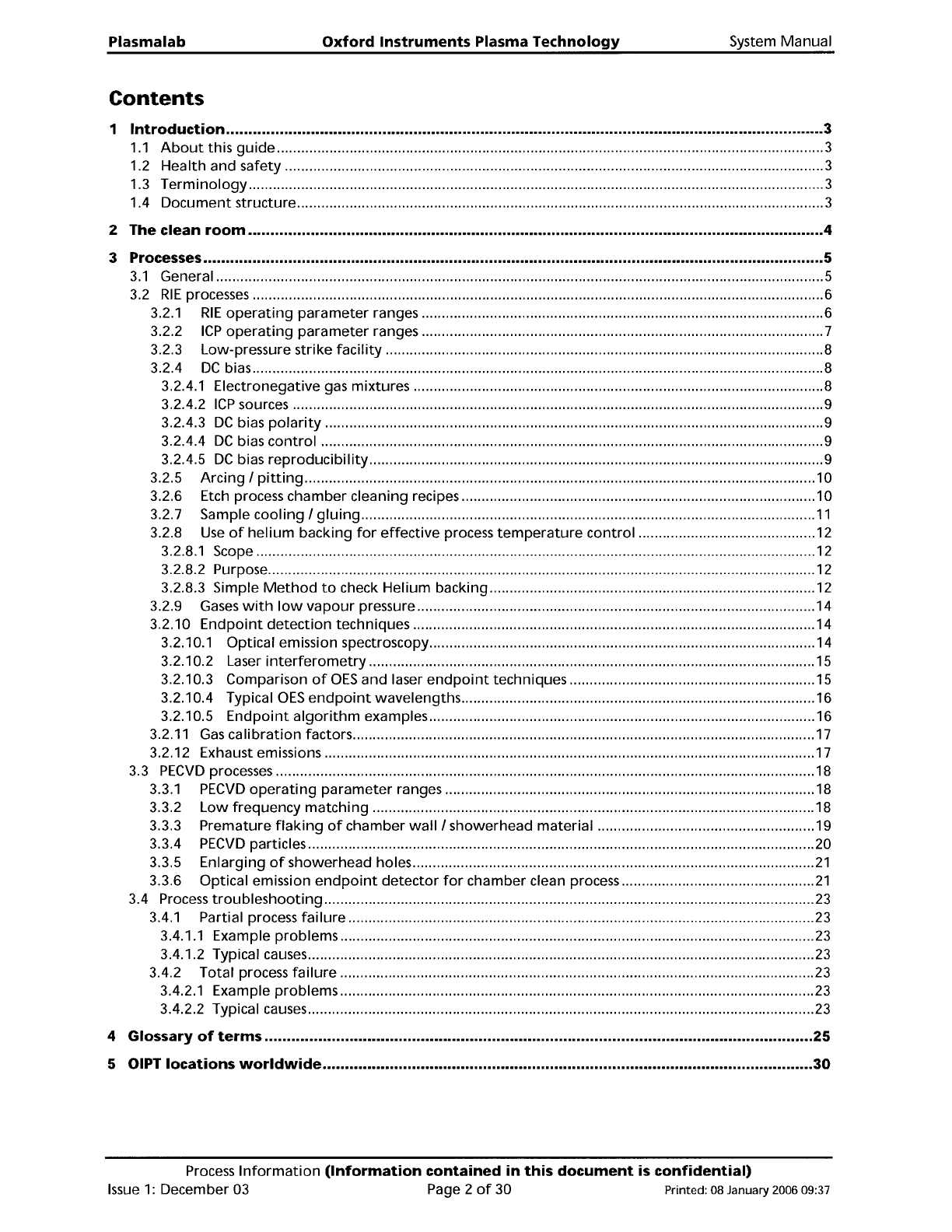
Plasma lab Contents Oxford Instruments Plasma Technology System Manual 1 Introduction 3 1.1 About this guide 3 1.2 Health and safety 3 1.3 Terminology 3 1.4 Document structure 3 2 The clean room 4 3 Processes 5 3.1 Gener…
System
Manual
Oxford
Instruments
Plasma Technology
Plasma
lab
Process
Guide
Plasma
lab
Process
Information
(Information
contained
in
this
document
is
confidential)
Printed: 08 January 2006 09:37 Page 1
of
30
Issue
1:
December
03
Plasma
lab
Contents
Oxford
Instruments
Plasma
Technology
System
Manual
1
Introduction
3
1.1
About
this
guide
3
1.2 Health and safety 3
1.3
Terminology
3
1.4
Document
structure 3
2 The
clean
room
4
3 Processes 5
3.1
General 5
3.2
RIE
processes 6
3.2.1
RIE
operating
parameter
ranges 6
3.2.2
ICP
operating
parameter
ranges 7
3.2.3 Low-pressure strike
facility
8
3.2.4
DC
bias 8
3.2.4.1 Electronegative gas mixtures 8
3.2.4.2
ICP
sources 9
3.2.4.3
DC
bias
polarity
9
3.2.4.4
DC
bias
control
9
3.2.4.5
DC
bias
reproducibility
9
3.2.5
Arcing!
pitting
10
3.2.6 Etch process chamber cleaning recipes 10
3.2.7 Sample
cooling!
gluing
11
3.2.8
Use
of
helium
backing
for
effective
process
temperature
control
12
3.2.8.1 Scope 12
3.2.8.2 Purpose 12
3.2.8.3 Simple
Method
to
check Helium backing
12
3.2.9
Gases
with
low
vapour
pressure 14
3.2.10
Endpoint
detection
techniques 14
3.2.10.1 Optical emission spectroscopy 14
3.2.10.2 Laser
interferometry
15
3.2.10.3 Comparison
of
OES
and laser
endpoint
techniques
15
3.2.10.4 Typical
OES
endpoint
wavelengths 16
3.2.10.5
Endpoint
algorithm
examples 16
3.2.11
Gas
calibration
factors
17
3.2.12 Exhaust emissions
17
3.3
PECVD
processes 18
3.3.1
PECVD
operating
parameter
ranges 18
3.3.2
Low
frequency
matching
18
3.3.3 Premature
flaking
of
chamber
wall!
showerhead material 19
3.3.4
PECVD
particles 20
3.3.5 Enlarging
of
showerhead holes
21
3.3.6 Optical emission
endpoint
detector
for
chamber clean process
21
3.4 Process
troubleshooting
23
3.4.1
Partial process
failure
23
3.4.1.1 Example problems
23
3.4.1.2 Typical causes
23
3.4.2 Total process
failure
23
3.4.2.1 Example problems
23
3.4.2.2 Typical causes
23
4 Glossary
of
terms
25
5 OIPT
locations
worldwide
30
Process
Information
(Information
contained
in
this
document
is
confidential)
Issue
1:
December 03 Page 2
of
30 Printed: 08 January 2006 09:37
System
Manual
1
Introduction
Oxford
Instruments
Plasma
Technology
Plasma
lab
1.1
About
this
guide
This
guide
gives
information
about
plasma processes based on
Oxford
Instruments Plasma Technology's
(OIPT)
long
experience in
the
semiconductor industry.
The scope
of
the
guide
is
to
provide
a general
introduction
to
process strategies and
common
process
problems, and has
not
been prepared
for
a
particular
version
of
hardware. The
information
is
presented
to
help
users
obtain
optimum
results
from
their
specific process applications using Plasmalab systems.
To ensure
that
the
information
is
as
comprehensive and
up-to-date
as
possible,
it
has been collated
from
the
following
sources
within
OIPT:
In-house
Applications
Laboratory'
(Process Lab reports, manager's notes, customer feedback etc.).
Service
Department
(customer feedback, on-site experience etc.)
Technology
Department
(external
information
sources, design reviews, customer liaison, etc.)
1.2
Health
and
safety
For
health
and safety
information,
see
Section 1 (Health and Safety)
of
your
Plasmalab system manual.
The customer
is
always responsible
for:
(A) Delivery
of
process gases
to
the
tool.
(B)
Removal
of
exhaust gases
from
the
tool.
(C)
Maintaining
a safe system
of
work
in using and
maintaining
the
tool.
1.3
Terminology
Material
presented
within
this
guide
is
aimed
at
users
who
have
knowledge
of
plasma processes and
the
terms used. However,
if
you
come across an
unfamiliar
term, please
refer
to
Section 4 (Glossary
of
Terms).
1.4
Document
structure
The
text
in
this
document
is
logically
divided
into
general
information
and specific
information
relevant
to
the
main
process types
(RIE
and
PECVD)
and
is
generally
applicable
to
all Plasmalab systems.
Where
information
is
only
applicable
to
a specific system, e.g.
the
Plasmalab 80
Plus
RIE.
this
is
stated.
1 The
Application
Laboratory
is
a
purpose-built
clean
room
facility
housing examples
of
all
of
our
Plasmalab systems
for
research and
development
purposes.
Each
of
these systems
is
installed in
accordance
with
our
standard
installation
data documents supplied
to
customers
for
each system type.
Process
Information
(Information
contained
in
this
document
is
confidential)
Printed: 08 January 2006 09:37 Page 3
of
30
Issue
1:
December
03