Oxford-100-Manual.pdf - 第167页
System Manual Oxford Instruments Plasma Technology Plasma lab 4 Glossary of terms AMU APC Backing pump Backing valve Baratron Base pressure Bayard-Alpert gauge Clean gas Cluster CM gauge (Baratron) Cryo pump (Meissner co…
Plasma
lab
Oxford
Instruments
Plasma
Technology
System Manual
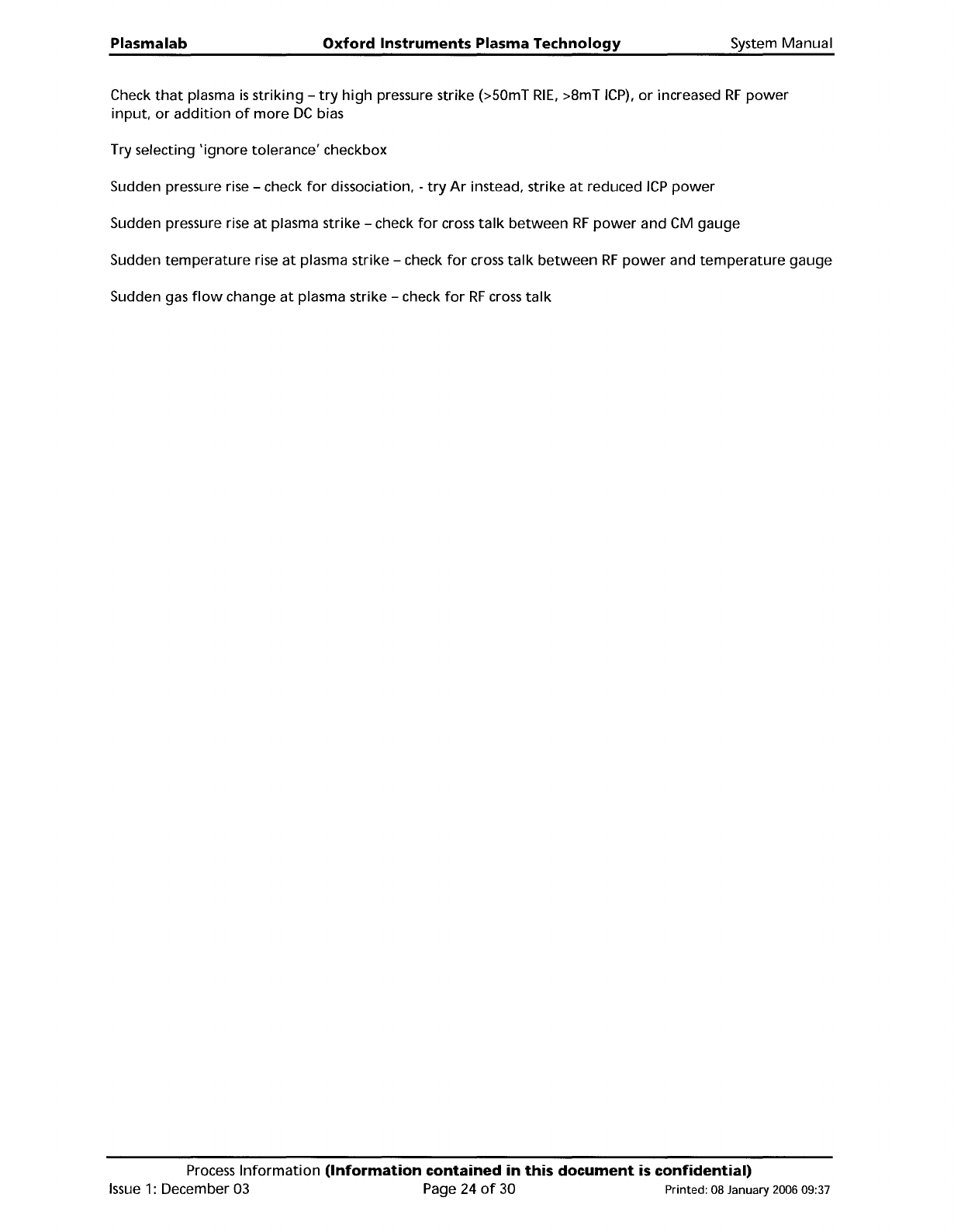
Check
that
plasma
is
striking
-
try
high
pressure strike
(>SOmT
RIE,
>8mT
ICP),
or
increased
RF
power
input,
or
addition
of
more
DC
bias
Try selecting
'ignore
tolerance'
checkbox
Sudden pressure rise - check
for
dissociation, -
try
Ar
instead, strike
at
reduced
ICP
power
Sudden pressure rise
at
plasma strike - check
for
cross
talk
between
RF
power
and CM
gauge
Sudden
temperature
rise
at
plasma strike - check
for
cross
talk
between
RF
power
and
temperature
gauge
Sudden gas
flow
change
at
plasma strike - check
for
RF
cross
talk
Process
Information
(Information
contained
in
this
document
is
confidential)
Issue
1:
December 03 Page 24
of
30 Printed: 08 January 2006 09:37
System
Manual
Oxford
Instruments
Plasma Technology
Plasma
lab
4 Glossary
of
terms
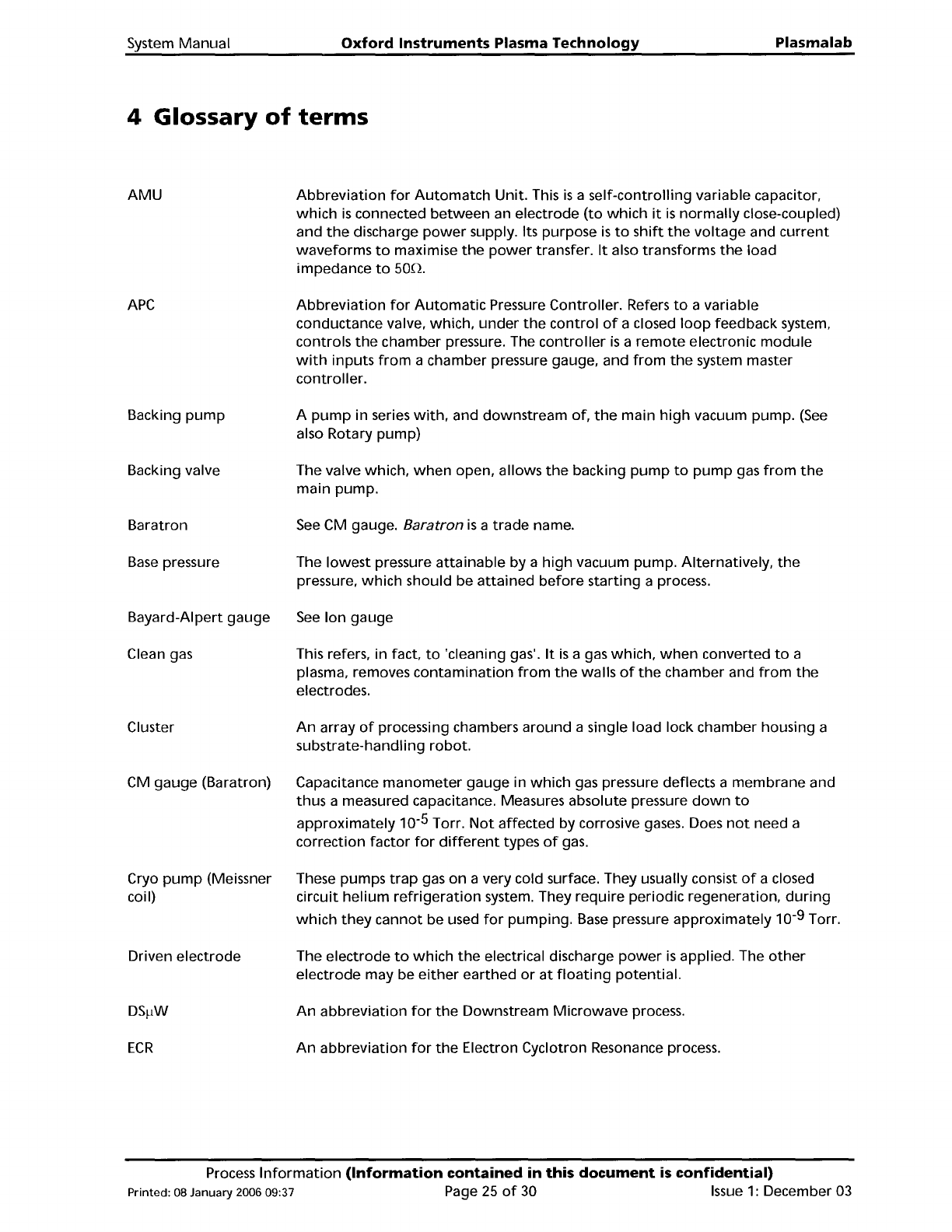
AMU
APC
Backing
pump
Backing valve
Baratron
Base
pressure
Bayard-Alpert
gauge
Clean gas
Cluster
CM
gauge
(Baratron)
Cryo
pump
(Meissner
coil)
Driven
electrode
DSflW
ECR
Abbreviation
for
Automatch
Unit. This
is
a
self-controlling
variable capacitor,
which
is
connected
between
an electrode
(to
which
it
is
normally
close-coupled)
and
the
discharge
power
supply. Its purpose
is
to
shift
the
voltage
and
current
waveforms
to
maximise
the
power
transfer.
It
also transforms
the
load
impedance
to
son.
Abbreviation
for
Automatic
Pressure Controller. Refers
to
a variable
conductance valve, which,
under
the
control
of
a closed
loop
feedback system,
controls
the
chamber pressure. The
controller
is
a
remote
electronic
module
with
inputs
from
a chamber pressure gauge, and
from
the
system master
controller.
A
pump
in series
with,
and
downstream
of,
the
main
high
vacuum
pump.
(See
also Rotary
pump)
The valve which,
when
open, allows
the
backing
pump
to
pump
gas
from
the
main
pump.
See
CM gauge. Baratron
is
a
trade
name.
The
lowest
pressure
attainable
by a
high
vacuum pump.
Alternatively,
the
pressure,
which
should be
attained
before
starting
a process.
See
Ion
gauge
This refers, in fact,
to
'cleaning gas'.
It
is
a gas which,
when
converted
to
a
plasma, removes
contamination
from
the
walls
of
the
chamber and
from
the
electrodes.
An
array
of
processing chambers
around
a single load lock chamber housing a
substrate-handling
robot.
Capacitance
manometer
gauge
in
which
gas pressure deflects a
membrane
and
thus a measured capacitance. Measures absolute pressure
down
to
approximately
10-
5
Torr.
Not
affected by corrosive gases. Does
not
need a
correction
factor
for
different
types
of
gas.
These pumps
trap
gas
on
a very cold surface. They usually consist
of
a closed
circuit
helium
refrigeration
system. They
require
periodic regeneration,
during
which
they
cannot
be used
for
pumping.
Base
pressure
approximately
10-
9
Torr.
The electrode
to
which
the
electrical discharge
power
is
applied. The
other
electrode may be
either
earthed
or
at
floating
potential.
An
abbreviation
for
the
Downstream
Microwave
process.
An
abbreviation
for
the
Electron Cyclotron Resonance process.
Process
Information
(Information
contained
in
this
document
is
confidential)
Printed: 08 January 2006 09:37 Page
25
of
30
Issue
1:
December 03
Plasma
lab
Oxford
Instruments
Plasma
Technology
System Manual
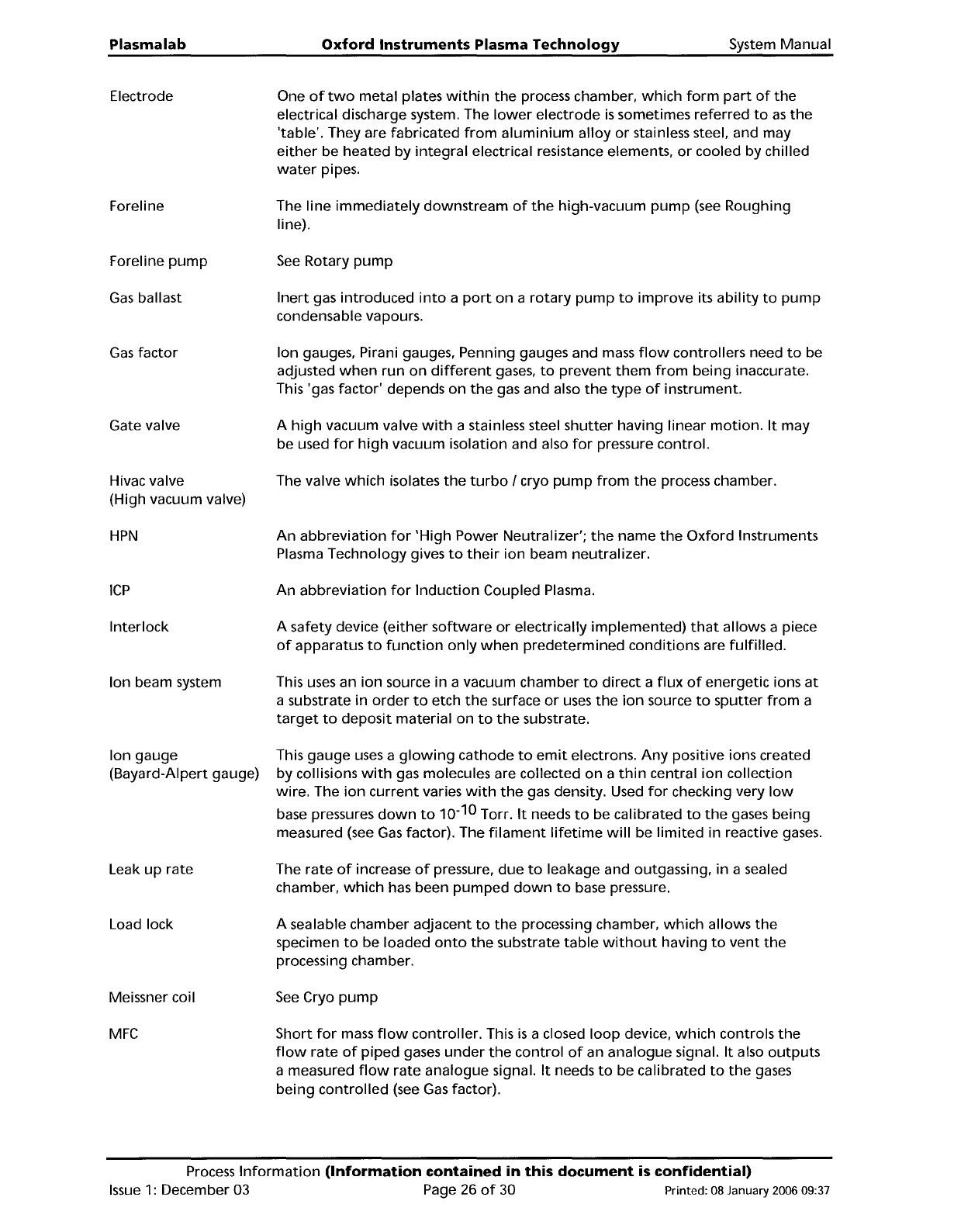
Electrode
Foreline
Foreline
pump
Gas
ballast
Gas
factor
Gate valve
Hivac valve
(High vacuum valve)
HPN
ICP
Interlock
Ion beam system
Ion
gauge
(Bayard-Alpert gauge)
Leak
up
rate
Load lock
Meissner coil
MFC
One
of
two
metal
plates
within
the
process chamber,
which
form
part
of
the
electrical discharge system. The
lower
electrode
is
sometimes referred
to
as
the
'table'.
They are fabricated
from
aluminium
alloy
or
stainless steel, and may
either
be
heated
by
integral
electrical resistance elements,
or
cooled by chilled
water
pipes.
The
line
immediately
downstream
of
the
high-vacuum
pump
(see
Roughing
line).
See
Rotary
pump
Inert
gas
introduced
into
a
port
on
a
rotary
pump
to
improve
its
ability
to
pump
condensable vapours.
Ion gauges, Pirani gauges, Penning gauges and
mass
flow
controllers need
to
be
adjusted
when
run
on
different
gases,
to
prevent
them
from
being inaccurate.
This 'gas
factor'
depends on
the
gas and also
the
type
of
instrument.
A
high
vacuum valve
with
a stainless steel
shutter
having linear
motion.
It
may
be used
for
high
vacuum isolation and also
for
pressure
control.
The valve
which
isolates
the
turbo
I cryo
pump
from
the
process chamber.
An
abbreviation
for
'High
Power Neutralizer';
the
name
the
Oxford
Instruments
Plasma Technology gives
to
their
ion
beam neutralizer.
An
abbreviation
for
Induction
Coupled Plasma.
A safety device
(either
software
or
electrically
implemented)
that
allows a piece
of
apparatus
to
function
only
when
predetermined
conditions are
fulfilled.
This
uses
an
ion
source in a vacuum chamber
to
direct
a
flux
of
energetic ions
at
a substrate in
order
to
etch
the
surface
or
uses
the
ion
source
to
sputter
from
a
target
to
deposit
material
on
to
the
substrate.
This
gauge
uses
a
glowing
cathode
to
emit
electrons.
Any
positive ions created
by collisions
with
gas molecules are collected
on
a
thin
central
ion
collection
wire. The
ion
current
varies
with
the
gas density. Used
for
checking very
low
base pressures
down
to
10-
10
Torr.
It
needs
to
be calibrated
to
the
gases being
measured
(see
Gas
factor). The
filament
lifetime
will
be
limited
in reactive
gases.
The
rate
of
increase
of
pressure,
due
to
leakage and outgassing, in a sealed
chamber,
which
has been
pumped
down
to
base pressure.
A sealable chamber adjacent
to
the
processing chamber,
which
allows
the
specimen
to
be loaded
onto
the
substrate
table
without
having
to
vent
the
processing chamber.
See
Cryo
pump
Short
for
mass
flow
controller. This
is
a closed
loop
device,
which
controls
the
flow
rate
of
piped
gases
under
the
control
of
an
analogue
signal.
It
also
outputs
a measured
flow
rate
analogue signal.
It
needs
to
be calibrated
to
the
gases
being
controlled
(see
Gas
factor).
Process
Information
(Information
contained
in
this
document
is
confidential)
Issue
1:
December 03 Page
26
of
30 Printed: 08 January 2006 09:37