Oxford-100-Manual.pdf - 第180页
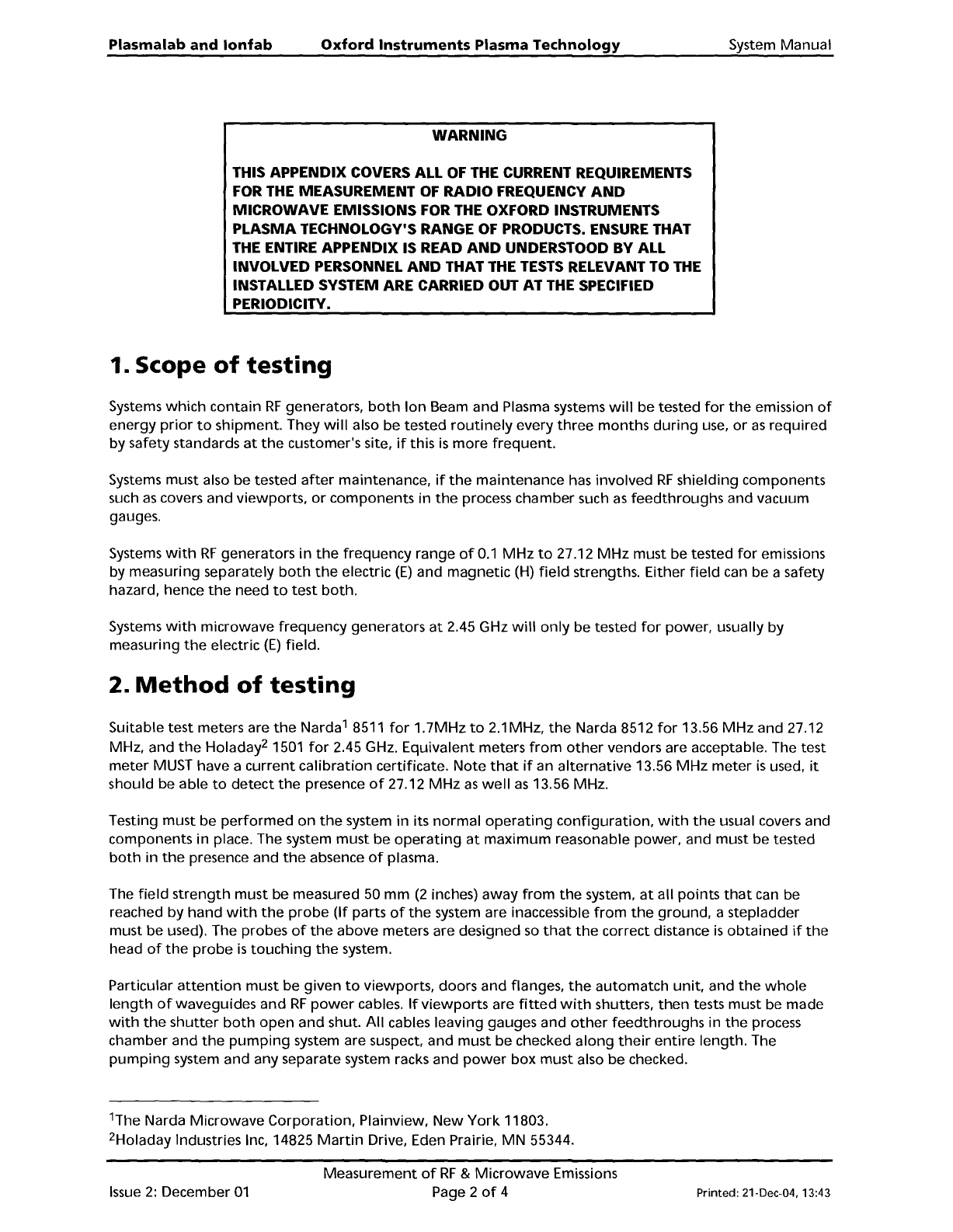
Plasma lab and lonfab Oxford Instruments Plasma Technology WARNING System Manual THIS APPENDIX COVERS ALL OF THE CURRENT REQUIREMENTS FOR THE MEASUREMENT OF RADIO FREQUENCY AND MICROWAVE EMISSIONS FOR THE OXFORD INSTRUME…
System Manual
Oxford
Instruments
Plasma
Technology
Plasma
lab
and
lonfab
Appendix
A
Measurement
of
radio
frequency
and
microwave
emissions
1.
Scope
of
testing
2
2.
Method
of
testing
2
3.
Acceptable
exposure
standards
3
4.
System
design
3
Printed: 21-Dec-04, 13:43
Measurement
of
RF
& Microwave Emissions
Page
1
of
4
Issue
2:
December
01
Plasma
lab
and
lonfab
Oxford
Instruments
Plasma
Technology
WARNING
System
Manual
THIS APPENDIX COVERS ALL
OF
THE CURRENT REQUIREMENTS
FOR THE MEASUREMENT
OF
RADIO
FREQUENCY
AND
MICROWAVE
EMISSIONS FOR THE OXFORD INSTRUMENTS
PLASMA
TECHNOLOGY'S RANGE
OF
PRODUCTS. ENSURE THAT
THE ENTIRE APPENDIX IS READ
AND
UNDERSTOOD BY ALL
INVOLVED PERSONNEL
AND
THAT THE
TESTS
RELEVANT TO THE
INSTALLED SYSTEM ARE CARRIED OUT AT THE SPECIFIED
PERIODICITY.
1. Scope
of
testing
Systems
which
contain
RF
generators,
both
Ion Beam and Plasma systems
will
be tested
for
the
emission
of
energy
prior
to
shipment. They
will
also
be
tested
routinely
every
three
months
during
use,
or
as
required
by
safety standards
at
the
customer's site,
if
this
is
more
frequent.
Systems must also
be
tested
after
maintenance,
if
the
maintenance has involved
RF
shielding components
such
as
covers and viewports,
or
components in
the
process chamber such
as
feedthroughs
and vacuum
gauges.
Systems
with
RF
generators
in
the
frequency range
of
0.1
MHz
to
27
.12
MHz
must be tested
for
emissions
by measuring separately
both
the
electric
(E)
and
magnetic
(H)
field
strengths. Either
field
can be a safety
hazard, hence
the
need
to
test
both.
Systems
with
microwave frequency generators
at
2.45 GHz
will
only
be
tested
for
power, usually by
measuring
the
electric
(E)
field.
2.
Method
of
testing
Suitable
test
meters are
the
Narda
1
8511
for
1.7MHz
to
2.1MHz,
the
Narda 8512
for
13.56
MHz
and 27.12
MHz, and
the
Holad
ay
21501
for
2.45 GHz. Equivalent meters
from
other
vendors are acceptable. The test
meter
MUST have a
current
calibration
certificate.
Note
that
if
an
alternative
13.56
MHz
meter
is
used,
it
should be able
to
detect
the
presence
of
27.12
MHz
as
well
as
13.56 MHz.
Testing
must
be
performed
on
the
system in its
normal
operating
configuration,
with
the
usual covers and
components
in
place. The system
must
be
operating
at
maximum
reasonable power, and must be tested
both
in
the
presence and
the
absence
of
plasma.
The
field
strength
must
be measured 50
mm
(2
inches)
away
from
the
system,
at
all points
that
can be
reached by
hand
with
the
probe
(If
parts
of
the
system are inaccessible
from
the
ground,
a stepladder
must be used). The probes
of
the
above meters are designed
so
that
the
correct distance
is
obtained
if
the
head
of
the
probe
is
touching
the
system.
Particular
attention
must
be
given
to
viewports, doors and flanges,
the
automatch
unit,
and
the
whole
length
of
waveguides and
RF
power
cables.
If
viewports
are
fitted
with
shutters,
then
tests must be made
with
the
shutter
both
open
and shut.
All
cables leaving gauges and
other
feedthroughs
in
the
process
chamber and
the
pumping
system are suspect, and must be checked
along
their
entire
length. The
pumping
system and any separate system racks and
power
box
must
also
be
checked.
1The Narda
Microwave
Corporation,
Plainview,
New
York
11803.
2Holaday Industries Inc, 14825
Martin
Drive, Eden Prairie,
MN
55344.
Issue
2:
December
01
Measurement
of
RF
&
Microwave
Emissions
Page 2
of
4
Printed: 21-Dec-04, 13:43
System
Manual
Oxford
Instruments
Plasma
Technology
Plasma
lab
and
lonfab
It
is
strongly
recommended
that
the
operation
of
all safety interlocks should be tested
at
the
same time,
whenever
an
RF
or
Microwave
leakage test
is
performed.
3. Acceptable exposure standards
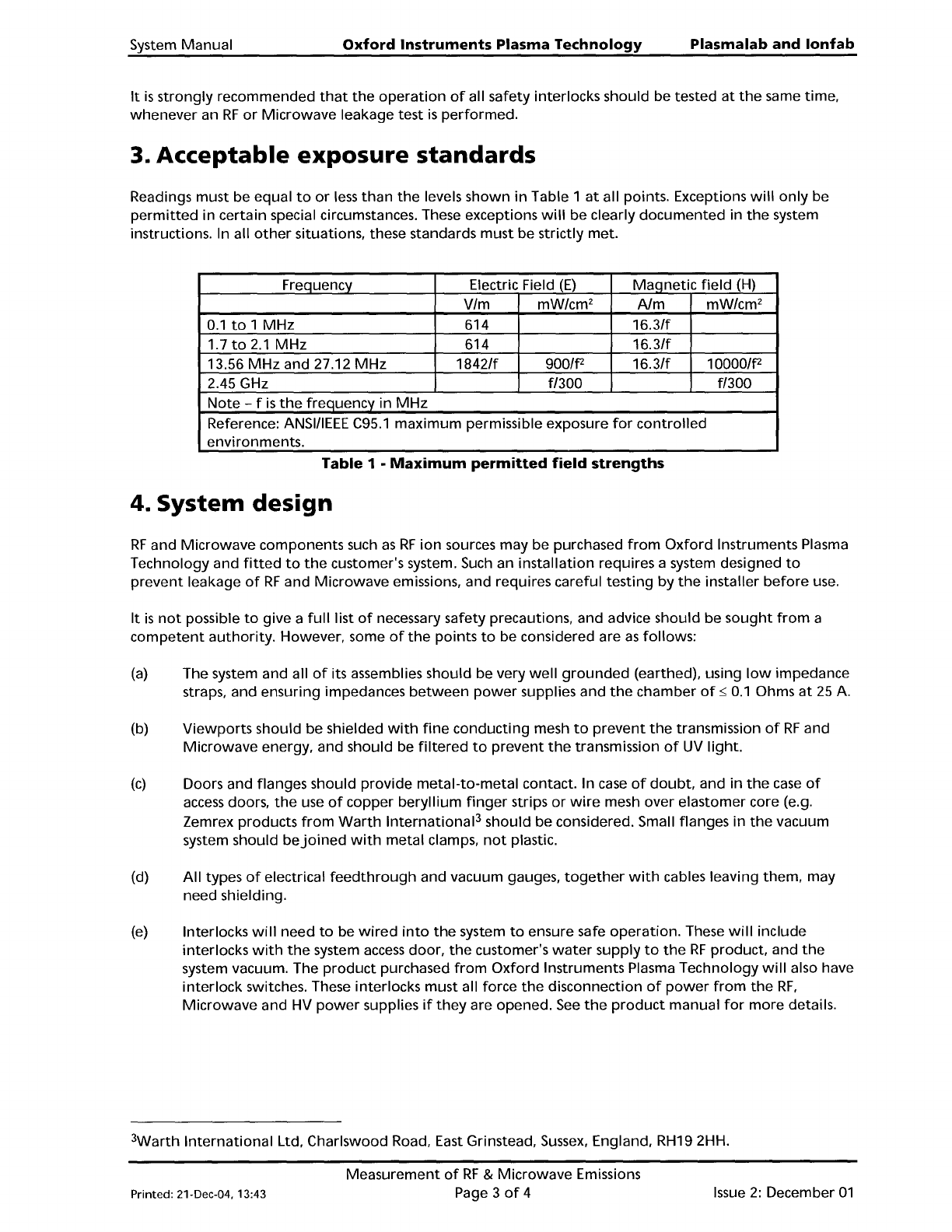
Readings must be equal
to
or
less
than
the
levels shown
in
Table 1
at
all points. Exceptions
will
only
be
permitted
in certain special circumstances. These exceptions
will
be
clearly
documented
in
the
system
instructions. In all
other
situations, these standards
must
be strictly met.
Frequency Electric Field
(E)
Ma!=jnetic
field
(H)
VIm mWlcm
2
AIm mW/cm
2
0.1
to
1
MHz
614
16.3/f
1.7to2.1
MHz
614
16.3/f
13.56
MHz
and 27.12
MHz
1842/f
900/f2
16.3/f
10000/f2
2.45 GHz
fl300
fl300
Note
- f
is
the
frequency
in
MHz
Reference:
ANSI/lEEE
C95.1
maximum
permissible exposure
for
controlled
environments.
Table
1 •
Maximum
permitted
field
strengths
4. System design
RF
and
Microwave
components such
as
RF
ion
sources may be purchased
from
Oxford
Instruments Plasma
Technology and
fitted
to
the
customer's system.
Such
an
installation
requires a system designed
to
prevent
leakage
of
RF
and
Microwave
emissions, and requires careful
testing
by
the
installer
before
use.
It
is
not
possible
to
give a
full
list
of
necessary safety precautions, and advice should be
sought
from
a
competent
authority.
However, some
of
the
points
to
be considered are
as
follows:
(a)
The system and all
of
its assemblies should be very
well
grounded
(earthed), using
low
impedance
straps, and ensuring impedances
between
power
supplies and
the
chamber
of
~
0.1
Ohms
at
25
A.
(b)
Viewports
should be shielded
with
fine
conducting
mesh
to
prevent
the
transmission
of
RF
and
Microwave
energy, and should be
filtered
to
prevent
the
transmission
of
UV
light.
(c)
Doors and flanges should
provide
metal-to-metal
contact. In
case
of
doubt,
and
in
the
case
of
access
doors,
the
use
of
copper
beryllium
finger
strips
or
wire
mesh over elastomer core (e.g.
Zemrex products
from
Warth
International
3
should be considered. Small flanges in
the
vacuum
system should
bejoined
with
metal
clamps,
not
plastic.
(d)
All
types
of
electrical
feedthrough
and vacuum gauges,
together
with
cables leaving them, may
need shielding.
(e)
Interlocks
will
need
to
be
wired
into
the
system
to
ensure safe
operation.
These
will
include
interlocks
with
the
system
access
door,
the
customer's
water
supply
to
the
RF
product,
and
the
system vacuum. The
product
purchased
from
Oxford
Instruments Plasma Technology
will
also have
interlock
switches. These interlocks
must
all force
the
disconnection
of
power
from
the
RF,
Microwave
and HV
power
supplies
if
they
are opened.
See
the
product
manual
for
more
details.
3Warth
International
Ltd, Charlswood Road, East Grinstead,
Sussex,
England, RH19 2HH.
Printed: 21-Dec-04, 13:43
Measurement
of
RF
&
Microwave
Emissions
Page 3
of
4
Issue
2:
December
01