Oxford-100-Manual.pdf - 第21页
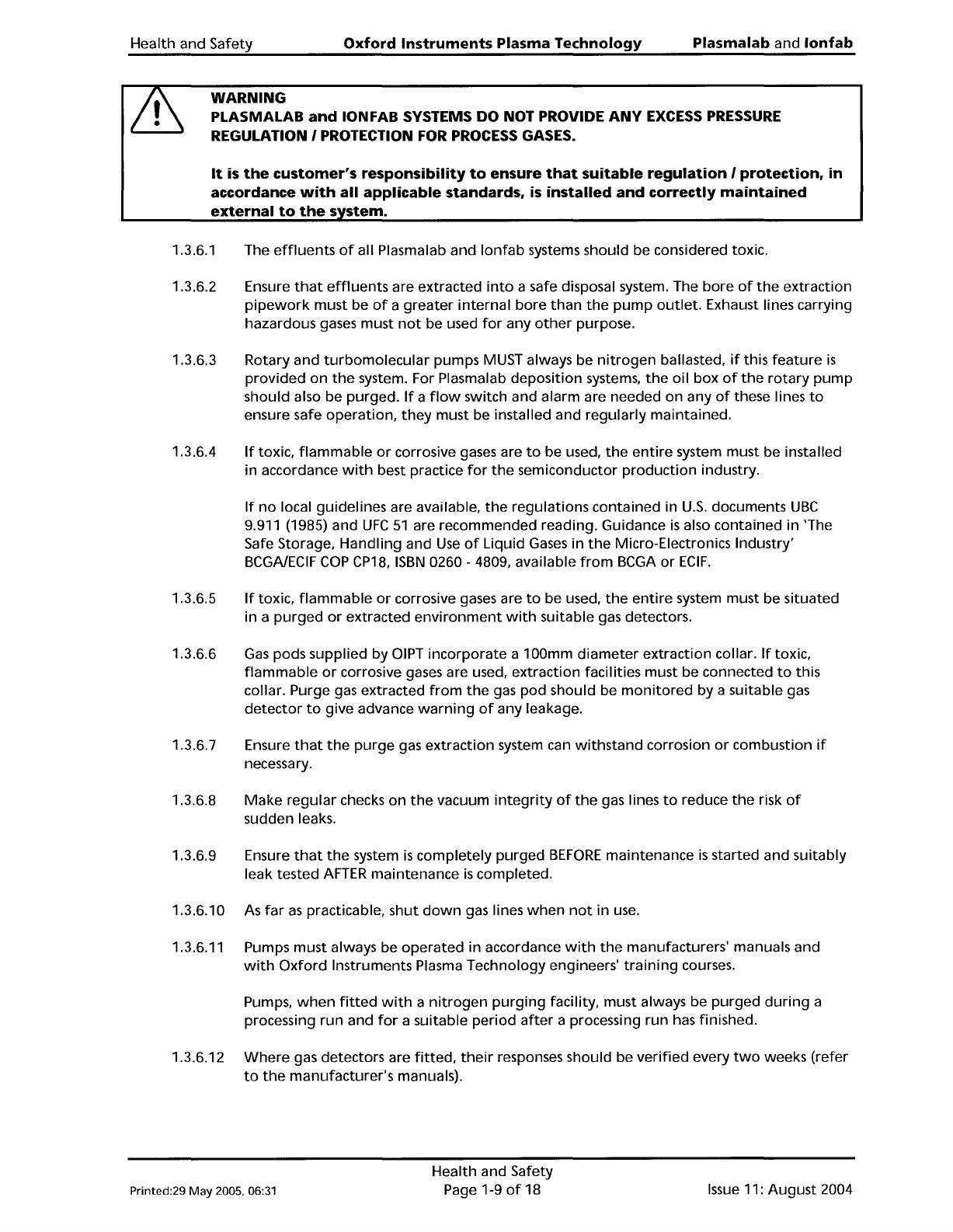
Health and Safety Oxford Instruments Plasma Technology Plasma lab and lonfab WARNING PLASMALAB and 10NFAB SYSTEMS DO NOT PROVIDE ANY EXCESS PRESSURE REGULATION I PROTECTION FOR PROCESS GASES. It is the customer's re…
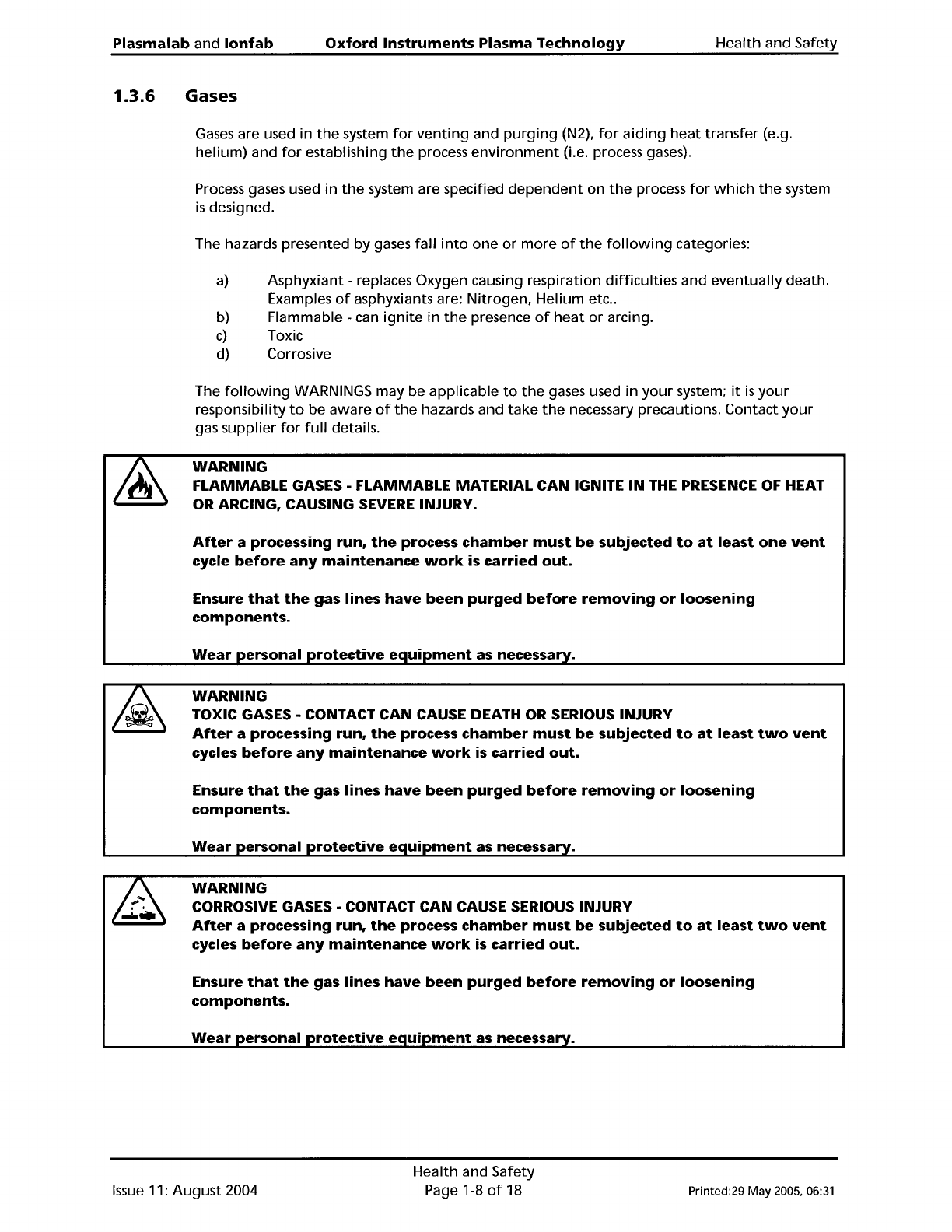
Plasma
lab
and
lonfab
Oxford
Instruments
Plasma
Technology
Health and Safety
1.3.6
Gases
Gases
are used in
the
system
for
venting
and
purging
(N2),
for
aiding
heat
transfer (e.g.
helium) and
for
establishing
the
process
environment
(i.e. process gases).
Process
gases
used in
the
system are specified
dependent
on
the
process
for
which
the
system
is
designed.
The hazards presented by gases fall
into
one
or
more
of
the
following
categories:
a)
Asphyxiant - replaces Oxygen causing respiration
difficulties
and eventually death.
Examples
of
asphyxiants are: Nitrogen, Helium etc
..
b) Flammable - can
ignite
in
the
presence
of
heat
or
arcing.
c)
Toxic
d) Corrosive
The
following
WARNINGS may be applicable
to
the
gases used in
your
system;
it
is
your
responsibility
to
be aware
of
the
hazards and
take
the
necessary precautions. Contact
your
gas supplier
for
full
details.
WARNING
FLAMMABLE
GASES·
FLAMMABLE MATERIAL CAN IGNITE
IN
THE PRESENCE
OF
HEAT
OR
ARCING, CAUSING SEVERE INJURY.
After
a processing
run,
the
process
chamber
must
be
subjected
to
at
least
one
vent
cycle
before
any
maintenance
work
is
carried
out.
Ensure
that
the
gas
lines
have
been
purged
before
removing
or
loosening
components.
Wear
personal
protective
equipment
as necessary.
WARNING
TOXIC
GASES·
CONTACT CAN CAUSE DEATH OR SERIOUS INJURY
After
a processing
run,
the
process
chamber
must
be
subjected
to
at
least
two
vent
cycles
before
any
maintenance
work
is
carried
out.
Ensure
that
the
gas lines
have
been
purged
before
removing
or
loosening
components.
Wear
personal
protective
equipment
as necessary.
WARNING
CORROSIVE
GASES·
CONTACT CAN CAUSE SERIOUS INJURY
After
a processing
run,
the
process
chamber
must
be
subjected
to
at
least
two
vent
cycles
before
any
maintenance
work
is
carried
out.
Ensure
that
the
gas
lines
have
been
purged
before
removing
or
loosening
components.
Wear
personal
protective
equipment
as necessary.
Issue
11:
August
2004
Health and Safety
Page 1-8
of
18
Printed:29
May
2005, 06:31
Health and Safety
Oxford
Instruments
Plasma
Technology
Plasma
lab
and
lonfab
WARNING
PLASMALAB
and
10NFAB SYSTEMS
DO
NOT PROVIDE
ANY
EXCESS
PRESSURE
REGULATION I PROTECTION
FOR
PROCESS
GASES.
It
is
the
customer's
responsibility
to
ensure
that
suitable
regulation
I
protection,
in
accordance
with
all
applicable
standards, is
installed
and
correctly
maintained
external
to
the
system.
1.3.6.1
1.3.6.2
1.3.6.3
1.3.6.4
The
effluents
of
all Plasmalab and
lonfab
systems should be considered toxic.
Ensure
that
effluents
are extracted
into
a safe disposal system. The
bore
of
the
extraction
pipework
must
be
of
a
greater
internal
bore
than
the
pump
outlet.
Exhaust lines carrying
hazardous gases must
not
be
used
for
any
other
purpose.
Rotary and
turbomolecular
pumps MUST always be
nitrogen
ballasted,
if
this
feature
is
provided
on
the
system. For Plasmalab
deposition
systems,
the
oil box
of
the
rotary
pump
should also be purged.
If
a
flow
switch and alarm are needed on any
of
these lines
to
ensure safe
operation,
they
must be installed and
regularly
maintained.
If
toxic,
flammable
or
corrosive gases are
to
be used,
the
entire
system must be installed
in accordance
with
best practice
for
the
semiconductor
production
industry.
If
no
local guidelines are available,
the
regulations
contained
in
U.S.
documents
UBC
9.911 (1985) and
UFC
51
are recommended reading. Guidance
is
also contained in 'The
Safe Storage,
Handling
and
Use
of
Liquid
Gases
in
the
Micro-Electronics Industry'
BCGAlECIF
COP
CP18,
ISBN
0260 - 4809, available
from
BCGA
or
ECIF.
1.3.6.5
If
toxic,
flammable
or
corrosive gases are
to
be used,
the
entire
system must be situated
in a
purged
or
extracted
environment
with
suitable gas detectors.
1.3.6.6
Gas
pods supplied by
OIPT
incorporate
a 100mm
diameter
extraction
collar.
If
toxic,
flammable
or
corrosive gases are used, extraction facilities must be connected
to
this
collar. Purge gas extracted
from
the
gas
pod
should be
monitored
by a suitable gas
detector
to
give advance
warning
of
any leakage.
1.3.6.7 Ensure
that
the
purge
gas
extraction
system can
withstand
corrosion
or
combustion
if
necessary.
1.3.6.8
Make
regular
checks
on
the
vacuum
integrity
of
the
gas lines
to
reduce
the
risk
of
sudden leaks.
1.3.6.9 Ensure
that
the
system
is
completely
purged
BEFORE
maintenance
is
started and suitably
leak tested
AFTER
maintenance
is
completed.
1.3.6.10
As
far
as
practicable,
shut
down
gas lines
when
not
in
use.
1.3.6.11 Pumps
must
always be
operated
in
accordance
with
the
manufacturers' manuals and
with
Oxford
Instruments Plasma Technology engineers'
training
courses.
Pumps,
when
fitted
with
a
nitrogen
purging
facility, must always be
purged
during
a
processing run and
for
a suitable
period
after
a processing run has finished.
1.3.6.12
Where
gas detectors are
fitted.
their
responses should be
verified
every
two
weeks (refer
to
the
manufacturer's
manuals).
Printed:29 May 2005, 06:31
Health and Safety
Page 1-9
of
18
Issue
11:
August
2004
Plasma
lab
and
lonfab
Oxford
Instruments
Plasma
Technology
Health and Safety
1.3.7
Materials
1.3.7.1
1.3.7.2
1.3.7.3
Materials used in
the
construction
of
the
system are
in
a safe state
when
installed.
However,
fluorine-containing
materials may be used
as
a-rings
(e.g.
Viton™
materials),
as
electrical insulation
or
as
electrical isolation block (e.g. Teflon ™
or
other
tfe
or
ptfe
material)
or
as
lubricating
grease
or
fluid
(e.g. Fomblin™,
Krytox™
or
the
NCFM
range
from
Leybold)
If
any
of
these materials are over-
heated, hazardous materials are created
that
can result in
the
loss
of
a
limb
or
death.
Very
great
care must be
taken
to
ensure
that
Perfluoro-elastomer (Viton™)
a-rings
are
not
exposed
to
high
temperatures.
If
overheated,
decomposition
takes place,
producing
a
highly
acidic residue
containing
hydrofluoric
acid
(HF).
If
there
is
any evidence
that
a
Viton™
a-ring
could have been subjected
to
temperatures
in
excess
of
300°C
the
following
actions must be carried
out:
(a)
Consult a
competent
authority
regarding
the
following
items (b)
to
(e).
(b)
Wearing
suitable
protective
clothing,
remove
the
a-ring
and
dispose
of
it
in
accordance
with
local Health and Safety
regulations.
(c)
Wearing
suitable
protective
clothing,
thoroughly
clean
the
contaminated
area, disposing
of
any residue
in
accordance
with
local Health and Safety regulations.
(d) Fit a
new
a-ring.
(e) Investigate
the
cause
of
the
overheating
and
review
operating
procedures and
control
systems
to
prevent
a recurrence.
Teflon™
and
other
tfe
materials. Very
great
care
must
be
taken
to
ensure
that
Teflon™
and
other
tfe
or
ptfe
materials are
not
exposed
to
high
temperatures.
If
overheated, decomposition takes place,
producing
volatile
fluorine
containing
components.
If
there
is
any evidence
that
any
Teflon™
or
other
tfe
or
ptfe
material could have
been subjected
to
temperatures
in
excess
of
300°C
the
following
actions must be
carried out:
(a) Consult a
competent
authority
regarding
the
following
items (b)
to
(e).
(b)
Wearing
suitable
protective
clothing,
remove
the
decomposed
material
and dispose
of
it
in accordance
with
local Health and
Safety regulations.
(c)
Wearing
suitable
protective
clothing,
thoroughly
clean
the
contaminated
area, disposing
of
any residue in accordance
with
local Health and Safety regulations.
(d) Fit a
new
component.
(e) Investigate
the
cause
of
the
overheating
and
review
operating
procedures and
control
systems
to
prevent
a recurrence.
Issue
11:
August
2004
Health and Safety
Page 1-10
of
18 Printed:29
May
2005, 06:31