Oxford-100-Manual.pdf - 第23页
Health and Safety Oxford Instruments Plasma Technology Plasma lab and lonfab 1.3.7.4 Note that swarf and other pieces of material for disposal must be disposed of with great care and must be kept well away from fire, fro…
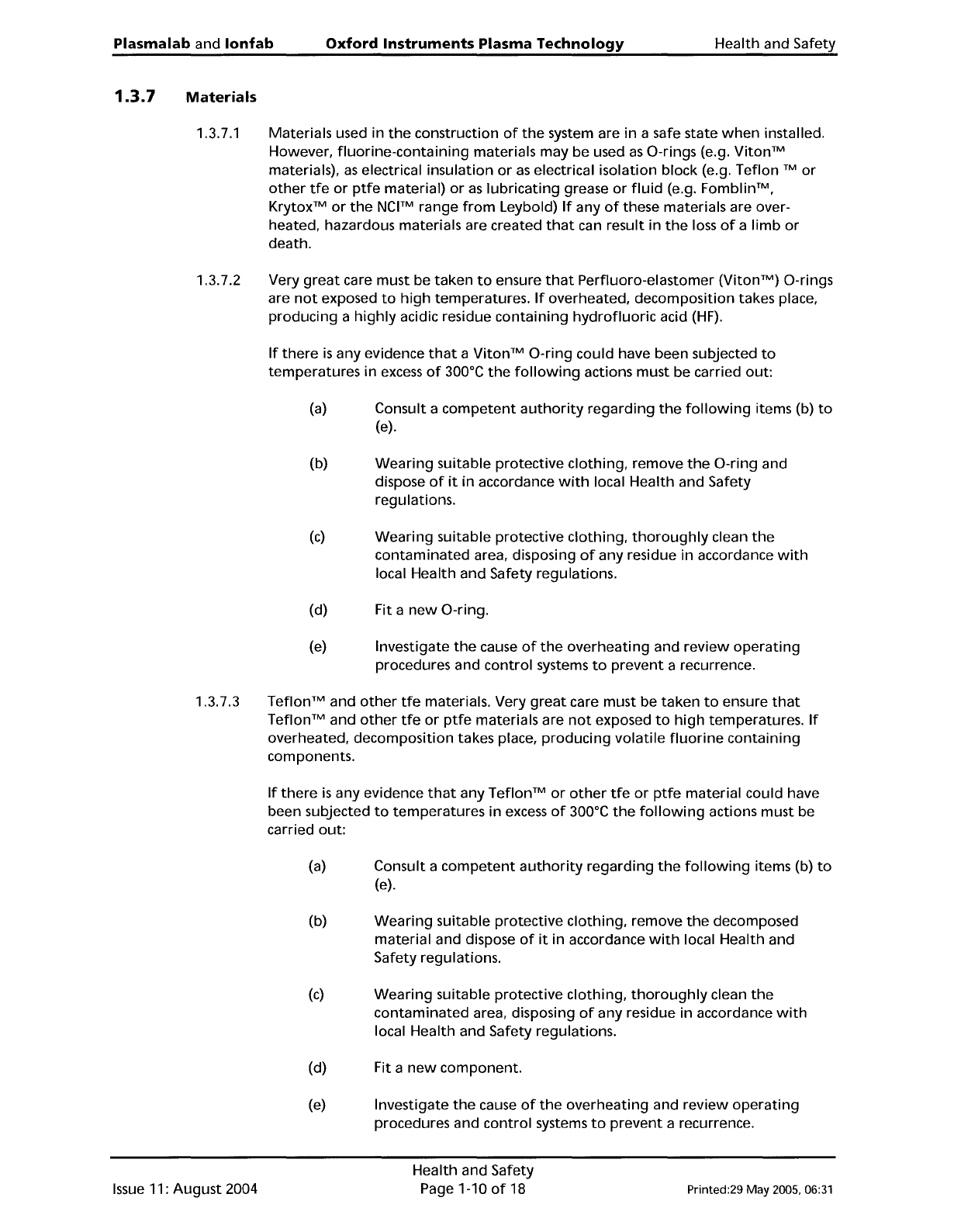
Plasma
lab
and
lonfab
Oxford
Instruments
Plasma
Technology
Health and Safety
1.3.7
Materials
1.3.7.1
1.3.7.2
1.3.7.3
Materials used in
the
construction
of
the
system are
in
a safe state
when
installed.
However,
fluorine-containing
materials may be used
as
a-rings
(e.g.
Viton™
materials),
as
electrical insulation
or
as
electrical isolation block (e.g. Teflon ™
or
other
tfe
or
ptfe
material)
or
as
lubricating
grease
or
fluid
(e.g. Fomblin™,
Krytox™
or
the
NCFM
range
from
Leybold)
If
any
of
these materials are over-
heated, hazardous materials are created
that
can result in
the
loss
of
a
limb
or
death.
Very
great
care must be
taken
to
ensure
that
Perfluoro-elastomer (Viton™)
a-rings
are
not
exposed
to
high
temperatures.
If
overheated,
decomposition
takes place,
producing
a
highly
acidic residue
containing
hydrofluoric
acid
(HF).
If
there
is
any evidence
that
a
Viton™
a-ring
could have been subjected
to
temperatures
in
excess
of
300°C
the
following
actions must be carried
out:
(a)
Consult a
competent
authority
regarding
the
following
items (b)
to
(e).
(b)
Wearing
suitable
protective
clothing,
remove
the
a-ring
and
dispose
of
it
in
accordance
with
local Health and Safety
regulations.
(c)
Wearing
suitable
protective
clothing,
thoroughly
clean
the
contaminated
area, disposing
of
any residue
in
accordance
with
local Health and Safety regulations.
(d) Fit a
new
a-ring.
(e) Investigate
the
cause
of
the
overheating
and
review
operating
procedures and
control
systems
to
prevent
a recurrence.
Teflon™
and
other
tfe
materials. Very
great
care
must
be
taken
to
ensure
that
Teflon™
and
other
tfe
or
ptfe
materials are
not
exposed
to
high
temperatures.
If
overheated, decomposition takes place,
producing
volatile
fluorine
containing
components.
If
there
is
any evidence
that
any
Teflon™
or
other
tfe
or
ptfe
material could have
been subjected
to
temperatures
in
excess
of
300°C
the
following
actions must be
carried out:
(a) Consult a
competent
authority
regarding
the
following
items (b)
to
(e).
(b)
Wearing
suitable
protective
clothing,
remove
the
decomposed
material
and dispose
of
it
in accordance
with
local Health and
Safety regulations.
(c)
Wearing
suitable
protective
clothing,
thoroughly
clean
the
contaminated
area, disposing
of
any residue in accordance
with
local Health and Safety regulations.
(d) Fit a
new
component.
(e) Investigate
the
cause
of
the
overheating
and
review
operating
procedures and
control
systems
to
prevent
a recurrence.
Issue
11:
August
2004
Health and Safety
Page 1-10
of
18 Printed:29
May
2005, 06:31
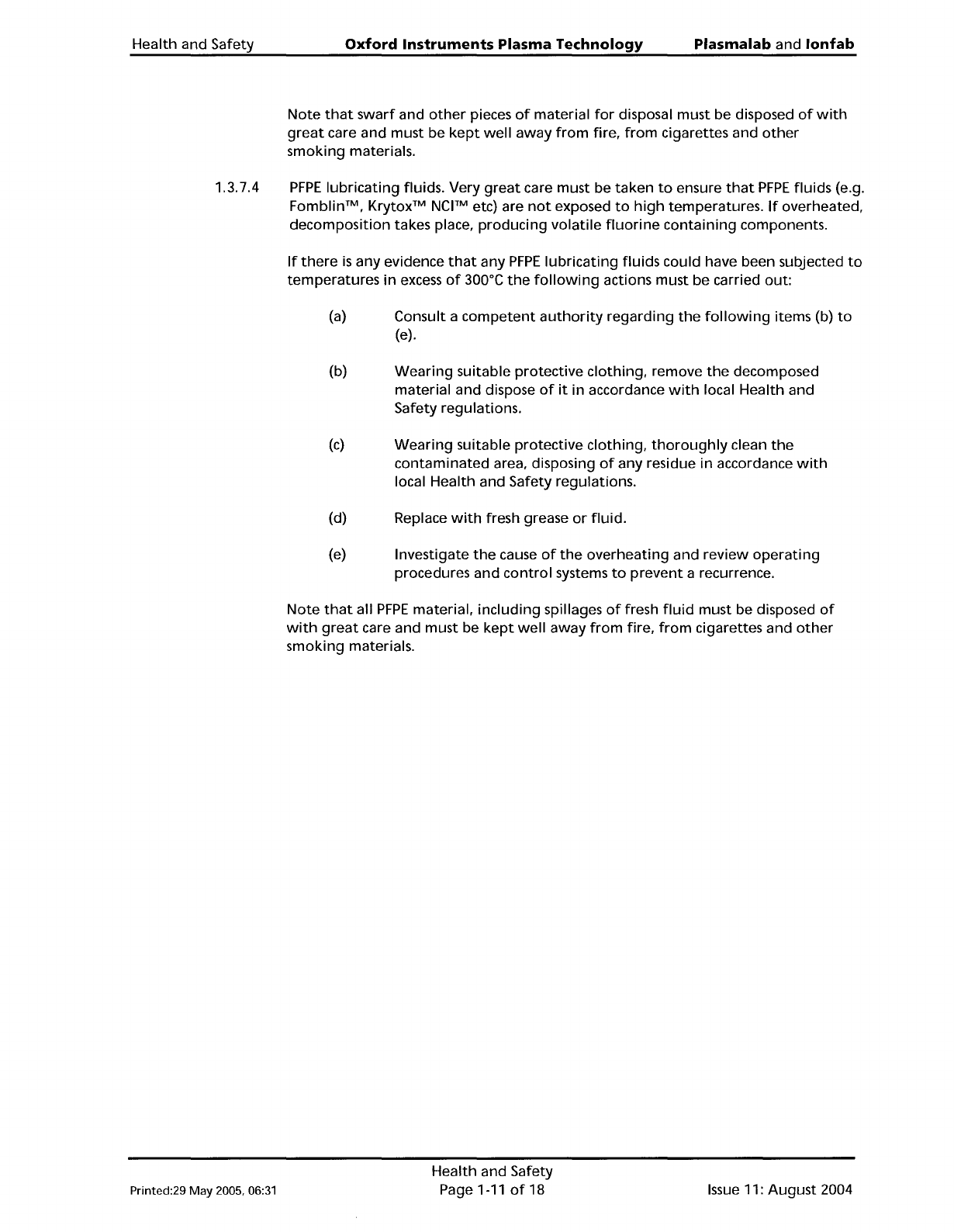
Health and Safety
Oxford
Instruments
Plasma
Technology
Plasma
lab
and
lonfab
1.3.7.4
Note
that
swarf
and
other
pieces
of
material
for
disposal must be disposed
of
with
great
care and must be
kept
well
away
from
fire,
from
cigarettes and
other
smoking
materials.
PFPE
lubricating
fluids. Very
great
care must be
taken
to
ensure
that
PFPE
fluids (e.g.
Fomblin™,
Krytox™
NCFM
etc) are
not
exposed
to
high
temperatures.
If
overheated,
decomposition
takes place,
producing
volatile
fluorine
containing
components.
If
there
is
any evidence
that
any
PFPE
lubricating
fluids could have been subjected
to
temperatures
in
excess
of
300°C
the
following
actions must be carried out:
(a) Consult a
competent
authority
regarding
the
following
items (b)
to
(e).
(b)
Wearing
suitable
protective
clothing,
remove
the
decomposed
material and dispose
of
it
in accordance
with
local Health and
Safety regulations.
(c)
Wearing
suitable
protective
clothing,
thoroughly
clean
the
contaminated
area, disposing
of
any residue
in
accordance
with
local Health and Safety regulations.
(d) Replace
with
fresh grease
or
fluid.
(e) Investigate
the
cause
of
the
overheating
and
review
operating
procedures and
control
systems
to
prevent
a recurrence.
Note
that
all
PFPE
material,
including
spillages
of
fresh
fluid
must be disposed
of
with
great
care and must be
kept
well
away
from
fire,
from
cigarettes and
other
smoking
materials.
Printed:29 May 2005, 06:31
Health and Safety
Page
1-11
of
18
Issue
11:
August
2004
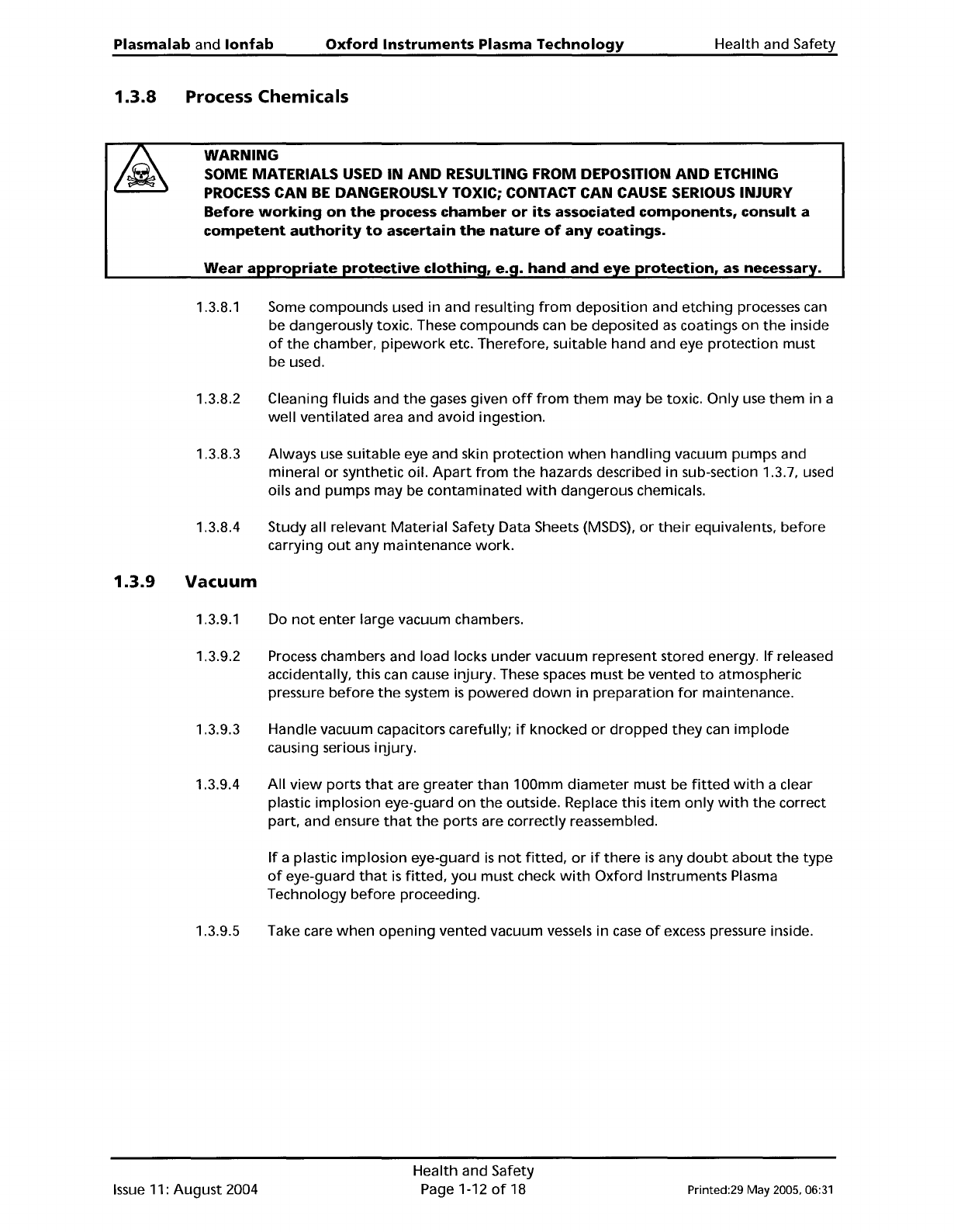
Plasmalab and
lonfab
Oxford
Instruments
Plasma
Technology
Health and Safety
1.3.8
1.3.9
Process Chemicals
WARNING
SOME MATERIALS USED
IN
AND
RESULTING FROM DEPOSITION
AND
ETCHING
PROCESS
CAN
BE
DANGEROUSLY TOXIC; CONTACT CAN CAUSE SERIOUS INJURY
Before
working
on
the
process
chamber
or
its
associated
components,
consult a
competent
authority
to
ascertain
the
nature
of
any
coatings.
Wear
a
ro
riate
rotective
clothin
, e. .
hand
and
e e
rotection,
as necessar
1.3.8.1 Some compounds used
in
and resulting
from
deposition
and
etching
processes can
be dangerously toxic. These compounds can be deposited
as
coatings
on
the
inside
of
the
chamber,
pipework
etc. Therefore, suitable hand and eye
protection
must
be used.
1.3.8.2 Cleaning fluids and
the
gases given
off
from
them
may be toxic.
Only
use
them
in a
well
ventilated
area and avoid ingestion.
1.3.8.3 Always use suitable eye and skin
protection
when
handling
vacuum pumps and
mineral
or
synthetic oil.
Apart
from
the
hazards described in sub-section 1.3.7, used
oils and pumps may be
contaminated
with
dangerous chemicals.
1.3.8.4 Study all relevant
Material
Safety Data Sheets
(MSDS),
or
their
equivalents,
before
carrying
out
any maintenance
work.
Vacuum
1.3.9.1
1.3.9.2
1.3.9.3
1.3.9.4
1.3.9.5
Do
not
enter
large vacuum chambers.
Process
chambers and load locks
under
vacuum represent stored energy.
If
released
accidentally, this can cause injury. These spaces
must
be vented
to
atmospheric
pressure
before
the
system
is
powered
down
in
preparation
for
maintenance.
Handle vacuum capacitors carefully;
if
knocked
or
dropped
they
can
implode
causing serious injury.
All
view
ports
that
are
greater
than
1
OOmm
diameter
must be
fitted
with
a clear
plastic implosion eye-guard
on
the
outside. Replace this
item
only
with
the
correct
part. and ensure
that
the
ports are correctly reassembled.
If
a plastic implosion eye-guard
is
not
fitted,
or
if
there
is
any
doubt
about
the
type
of
eye-guard
that
is
fitted,
you
must
check
with
Oxford
Instruments Plasma
Technology
before
proceeding.
Take care
when
opening
vented vacuum
vessels
in
case
of
excess
pressure inside.
Issue
11:
August
2004
Health and Safety
Page 1-12
of
18 Printed:29
May
2005, 06:31