Oxford-100-Manual.pdf - 第255页
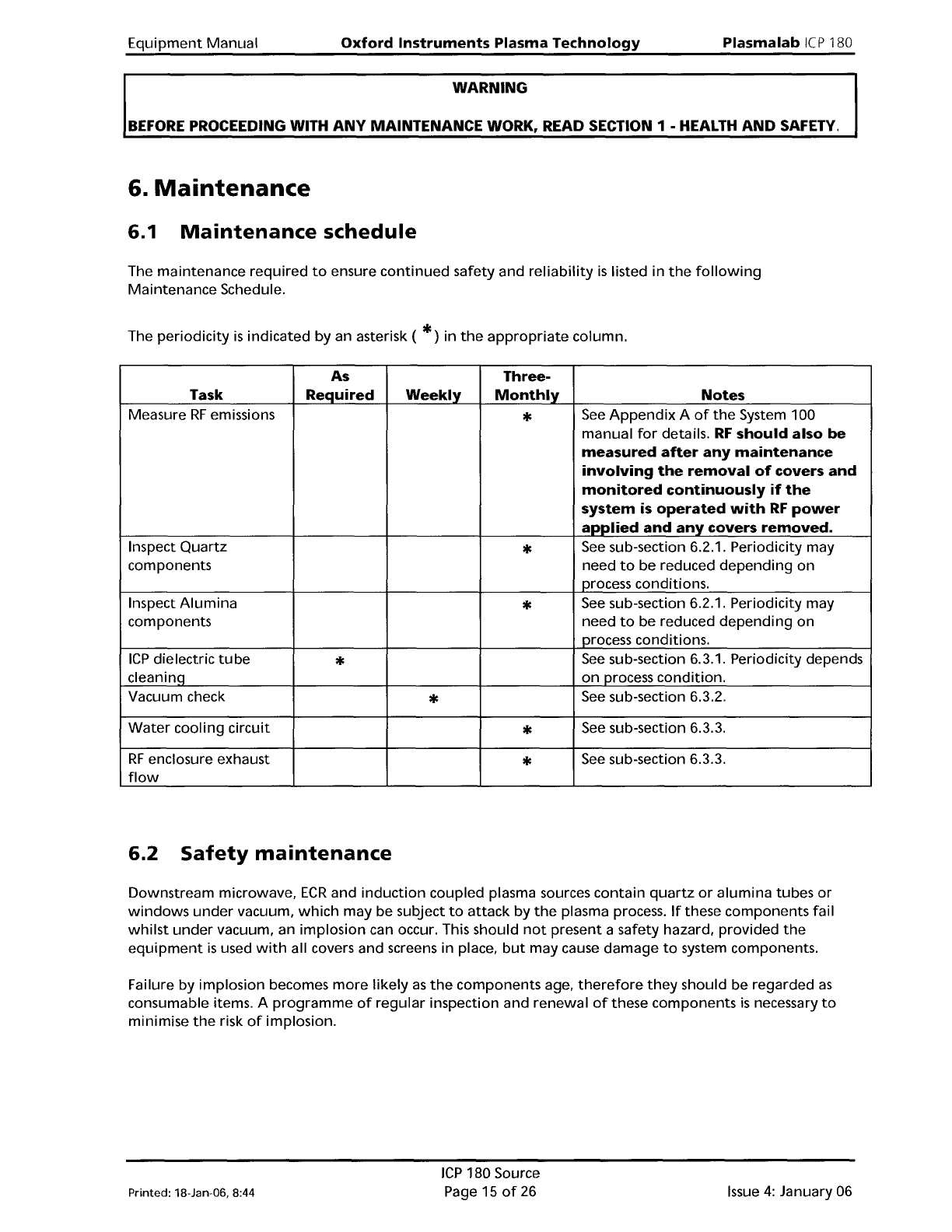
Equipment Manual Oxford Instruments Plasma Technology WARNING Plasma lab ICP 180 BEFORE PROCEEDING WITH ANY MAINTENANCE WORK, READ SECTION 1 - HEALTH AND SAFETY. 6. Maintenance 6.1 Maintenance schedule The maintenance re…
Plasma
lab
ICP
180
Oxford
Instruments Plasma Technology
Equipment
Manual
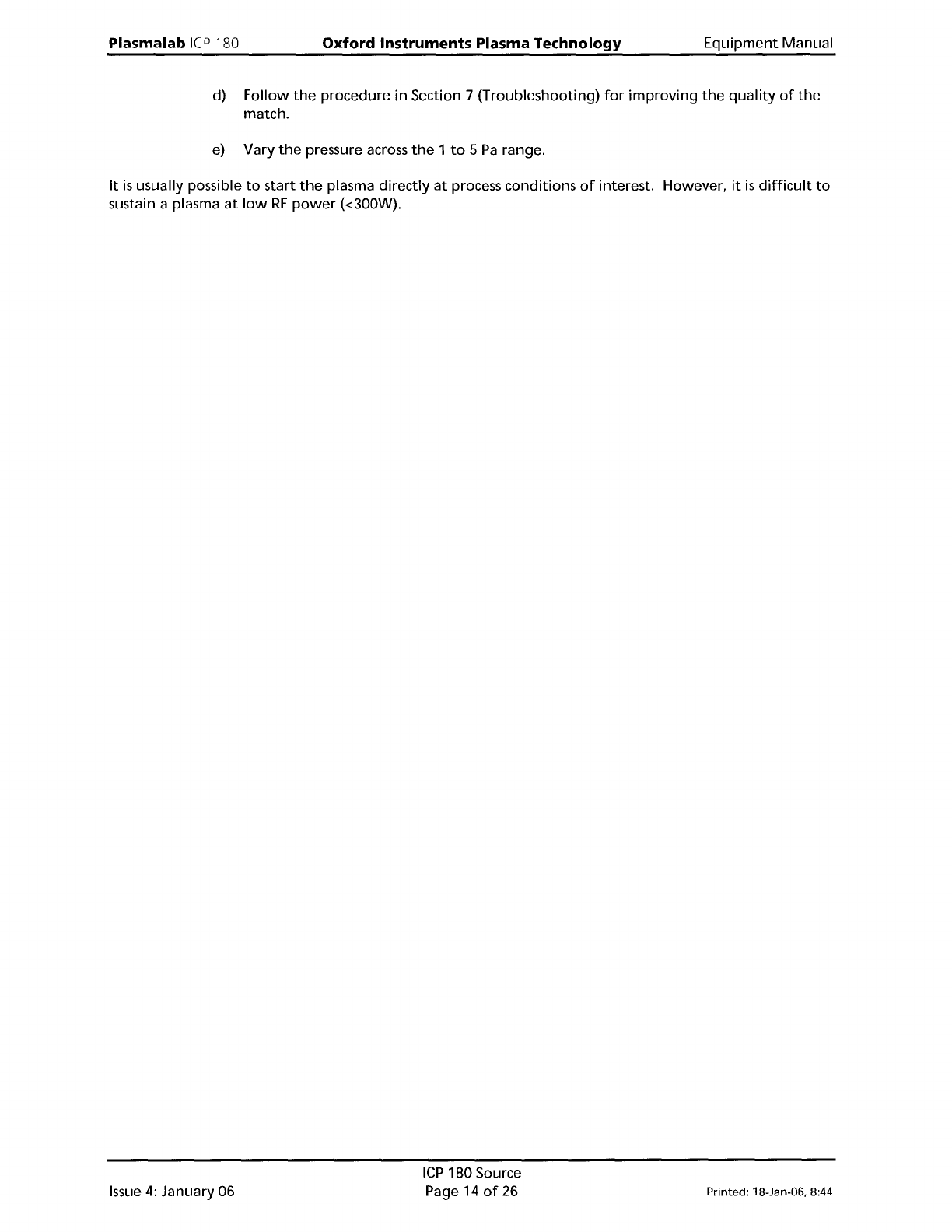
d)
Follow
the
procedure
in
Section 7 (Troubleshooting)
for
improving
the
quality
of
the
match.
e)
Vary
the
pressure across
the
1
to
5
Pa
range.
It
is
usually possible
to
start
the
plasma
directly
at
process conditions
of
interest. However,
it
is
difficult
to
sustain a plasma
at
low
RF
power
(<300W).
Issue
4:
January 06
ICP
180 Source
Page 14
of
26
Printed: 18-Jan-06, 8:44
Equipment
Manual
Oxford
Instruments Plasma Technology
WARNING
Plasma
lab
ICP
180
BEFORE
PROCEEDING WITH
ANY
MAINTENANCE WORK, READ SECTION 1 - HEALTH
AND
SAFETY.
6.
Maintenance
6.1
Maintenance
schedule
The maintenance
required
to
ensure
continued
safety and
reliability
is
listed in
the
following
Maintenance
Schedule.
The
periodicity
is
indicated by an asterisk (
*)
in
the
appropriate
column.
As
Three-
Task Required
Weekly
Monthly
Notes
Measure
RF
emissions
*
See
Appendix
A
of
the
System 100
manual
for
details.
RF
should also be
measured
after
any
maintenance
involving
the
removal
of
covers
and
monitored
continuously
if
the
system
is
operated
with
RF
power
applied
and
any
covers
removed.
Inspect
Quartz
*
See
sub-section 6.2.1. Periodicity may
components
need
to
be reduced
depending
on
process conditions.
Inspect
Alumina
*
See
sub-section 6.2.1. Periodicity may
components need
to
be reduced
depending
on
process conditions.
ICP
dielectric
tube
*
See
sub-section 6.3.1. Periodicity depends
cleaninq
on
process
condition.
Vacuum check
*
See
sub-section 6.3.2.
Water
cooling circuit
*
See
sub-section 6.3.3.
RF
enclosure exhaust
*
See
sub-section 6.3.3.
flow
6.2
Safety
maintenance
Downstream microwave,
ECR
and
induction
coupled plasma sources contain
quartz
or
alumina
tubes
or
windows
under
vacuum,
which
may be subject
to
attack
by
the
plasma process.
If
these components fail
whilst
under
vacuum, an implosion can occur. This should
not
present a safety hazard, provided
the
equipment
is
used
with
all covers and screens in place,
but
may cause damage
to
system components.
Failure
by
implosion becomes
more
likely
as
the
components age,
therefore
they
should be regarded
as
consumable items. A
programme
of
regular
inspection and renewal
of
these components
is
necessary
to
minimise
the
risk
of
implosion.
Printed: 18-Jan-DB, 8:44
ICP
180 Source
Page 15
of
26
Issue
4:
January 06
Plasmalab IeP180
Oxford
Instruments
Plasma Technology
WARNING
Equipment
Manual
BEFORE
PROCEEDING WITH
ANY
MAINTENANCE WORK, READ SECTION
1·
HEALTH
AND
SAFETY.
6.2.1
Inspection
and
renewal
WARNING
DISCARDED COMPONENTS
MAY
BE
CONTAMINATED WITH RESIDUES FROM
THE
PLASMA
PROCESS
AND
MAY
BE
ACIDIC
OR
TOXIC. DISPOSE WITH REGARD
TO
LOCAL PRACTICES.
IMPORTANT:
The
following
inspection
intervals
should
be
reduced
if
the
source is
operated
for
prolonged
periods
at
high
powers,
especially
for
quartz
components
operating
in
fluorine-containing
plasmas.
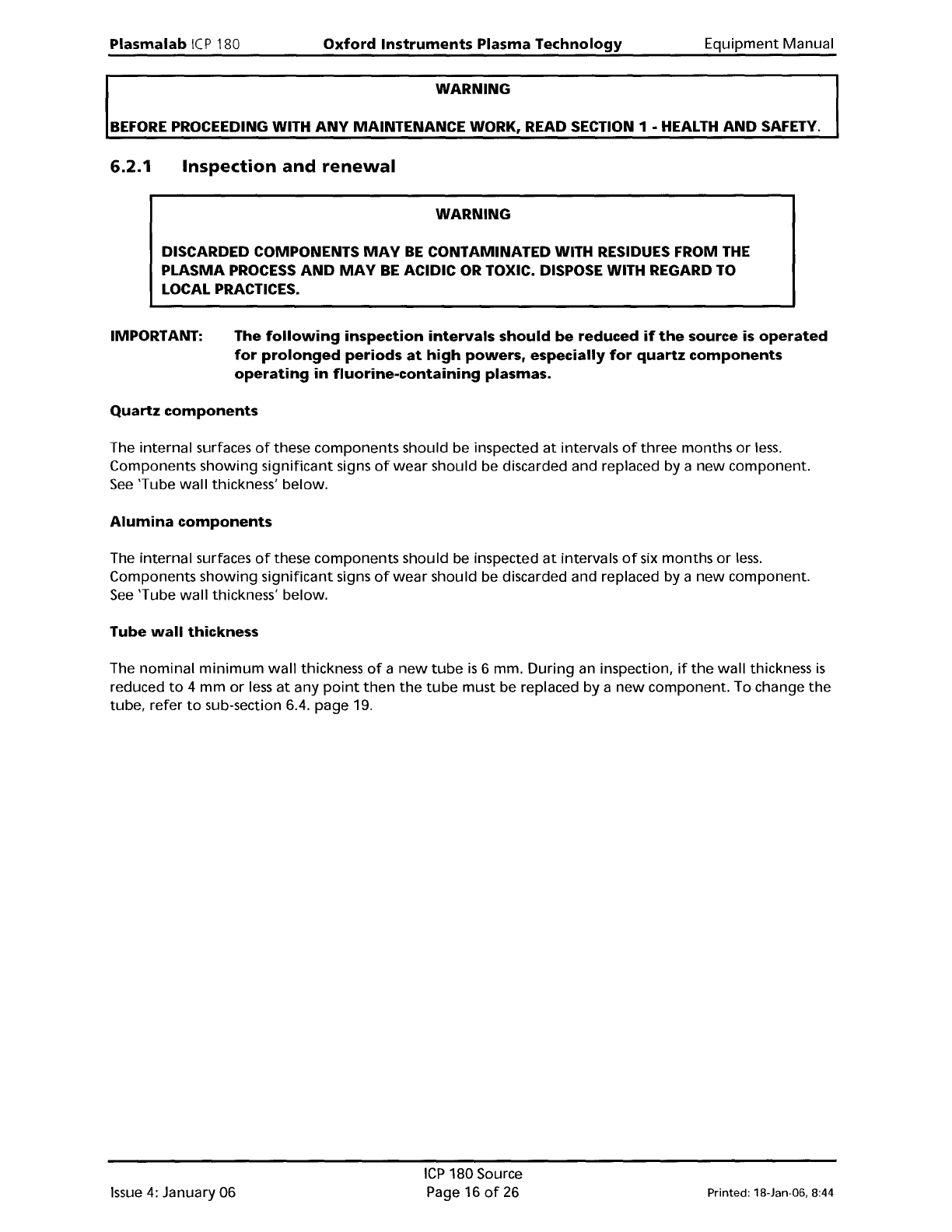
Quartz
components
The
internal
surfaces
of
these components should be inspected
at
intervals
of
three
months
or
less.
Components
showing
significant
signs
of
wear
should be discarded and replaced by a
new
component.
See
'Tube
wall
thickness'
below.
Alumina
components
The
internal
surfaces
of
these components should be inspected
at
intervals
of
six
months
or
less.
Components
showing
significant
signs
of
wear
should be discarded and replaced
by
a
new
component.
See
'Tube
wall
thickness' below.
Tube
wall
thickness
The
nominal
minimum
wall
thickness
of
a
new
tube
is
6 mm.
During
an inspection,
if
the
wall
thickness
is
reduced
to
4
mm
or
less
at
any
point
then
the
tube
must be replaced by a
new
component. To change
the
tube,
refer
to
sub-section 6.4. page 19.
Issue
4:
January 06
ICP
180 Source
Page 16
of
26
Printed: 18-Jan-06, 8:44