Oxford-100-Manual.pdf - 第26页
Plasma lab and lonfab Oxford Instruments Plasma Technology Health and Safety WARNING PINCH POINT· LIMBS, FINGERS ETC CAN BECOME TRAPPED RESULTING IN SEVERE INJURY. Ensure that all personnel are kept clear of pinch points…
Health and Safety
1.3.10
Compressed
air
Oxford
Instruments
Plasma
Technology
Plasma
lab
and
lonfab
1.3.11
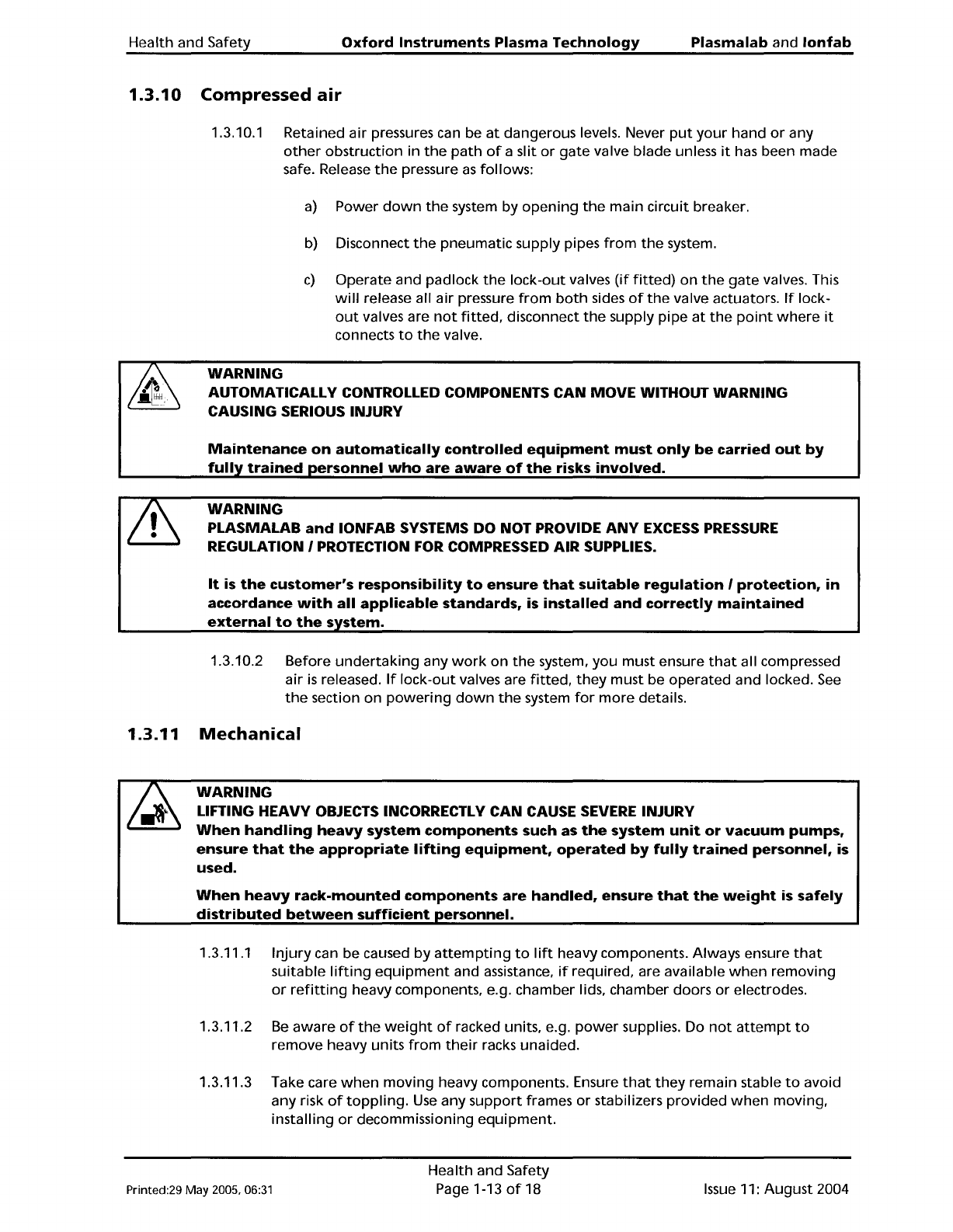
1.3.10.1 Retained
air
pressures can be
at
dangerous levels. Never
put
your
hand
or
any
other
obstruction
in
the
path
of
a slit
or
gate
valve blade unless
it
has been made
safe. Release
the
pressure
as
follows:
a)
Power
down
the
system by
opening
the
main
circuit
breaker.
b) Disconnect
the
pneumatic
supply pipes
from
the
system.
c)
Operate
and padlock
the
lock-out
valves
(if
fitted)
on
the
gate
valves. This
will
release all
air
pressure
from
both
sides
of
the
valve actuators.
If
lock-
out
valves are
not
fitted,
disconnect
the
supply pipe
at
the
point
where
it
connects
to
the
valve.
WARNING
AUTOMATICALLY CONTROLLED COMPONENTS CAN
MOVE
WITHOUT
WARNING
CAUSING SERIOUS INJURY
Maintenance
on
automatically
controlled
equipment
must
only
be
carried
out
by
fully
trained
personnel
who
are
aware
of
the
risks
involved.
WARNING
PLASMALAB
and
10NFAB SYSTEMS DO NOT PROVIDE
ANY
EXCESS
PRESSURE
REGULATION I PROTECTION
FOR
COMPRESSED AIR SUPPLIES.
It
is
the
customer's
responsibility
to
ensure
that
suitable
regulation
I
protection,
in
accordance
with
all
applicable
standards, is
installed
and
correctly
maintained
external
to
the
system.
1.3.10.2 Before
undertaking
any
work
on
the
system,
you
must ensure
that
all compressed
air
is
released.
If
lock-out
valves are
fitted,
they
must be
operated
and locked.
See
the
section on
powering
down
the
system
for
more
details.
Mechanical
WARNING
LIFTING HEAVY
OBJECTS
INCORRECTLY CAN CAUSE SEVERE INJURY
When
handling
heavy
system
components
such as
the
system
unit
or
vacuum
pumps,
ensure
that
the
appropriate
lifting
equipment,
operated
by
fully
trained
personnel,
is
used.
When
heavy
rack-mounted
components
are
handled,
ensure
that
the
weight
is
safely
distributed
between
sufficient
personnel.
1.3.11.1
Injury
can be caused
by
attempting
to
lift
heavy components. Always ensure
that
suitable
lifting
equipment
and assistance,
if
required, are available
when
removing
or
refitting
heavy components, e.g. chamber lids, chamber doors
or
electrodes.
1.3.11.2
Be
aware
of
the
weight
of
racked units, e.g.
power
supplies. Do
not
attempt
to
remove heavy units
from
their
racks unaided.
1.3.11.3 Take care
when
moving
heavy components. Ensure
that
they
remain stable
to
avoid
any risk
of
toppling.
Use
any
support
frames
or
stabilizers
provided
when
moving,
installing
or
decommissioning
equipment.
Printed:29
May
2005, 06:31
Health and Safety
Page 1-13
of
18
Issue
11:
August
2004
Plasma
lab
and
lonfab
Oxford
Instruments
Plasma
Technology
Health and Safety
WARNING
PINCH
POINT·
LIMBS, FINGERS
ETC
CAN BECOME TRAPPED RESULTING
IN
SEVERE
INJURY.
Ensure
that
all
personnel
are
kept
clear
of
pinch
points,
e.g.
chamber
doors,
hoist
mechanisms,
variable
heiQht
electrodes
etc,
while
these
components
are
movinQ.
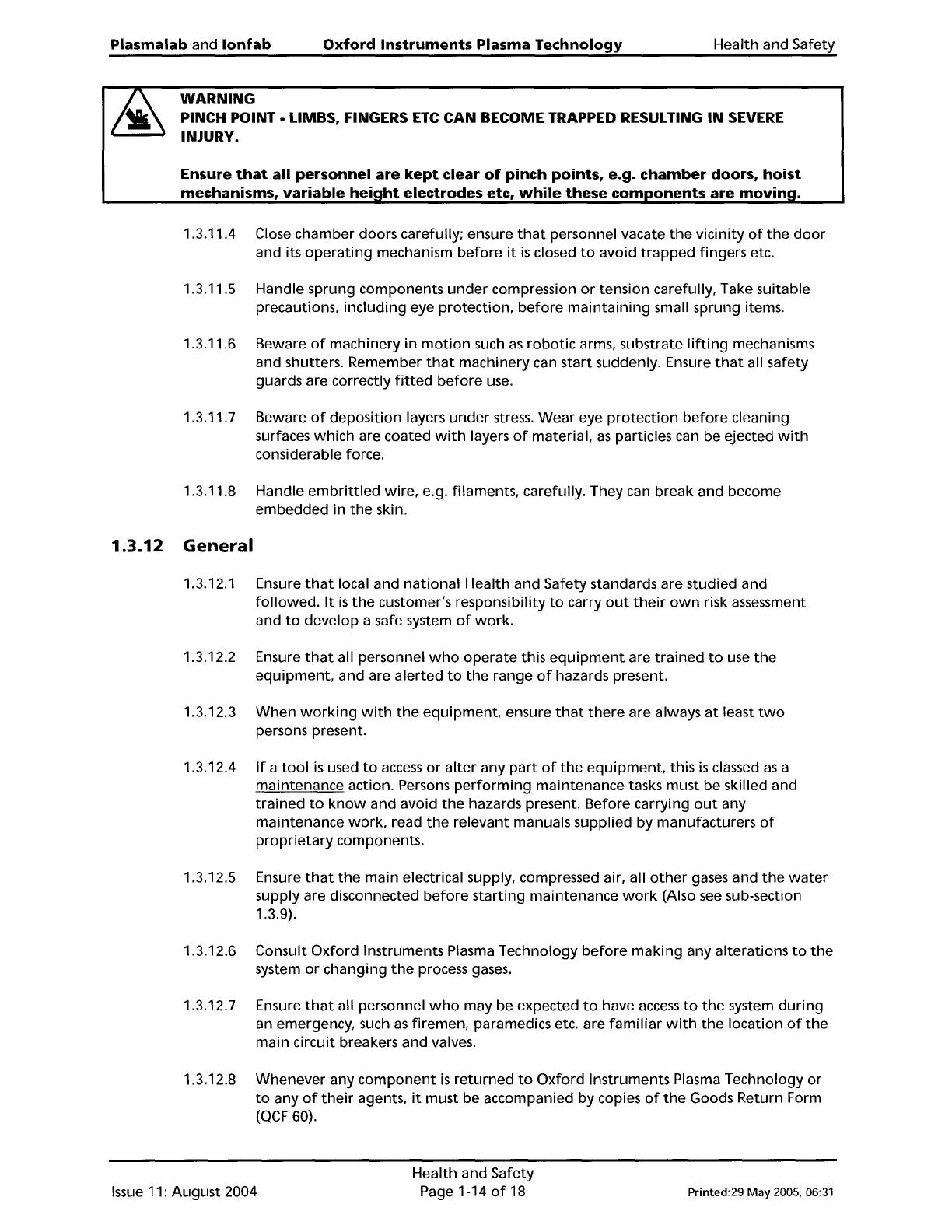
1.3.11.4 Close chamber doors carefully; ensure
that
personnel vacate
the
vicinity
of
the
door
and its
operating
mechanism
before
it
is
closed
to
avoid
trapped
fingers etc.
1.3.11.5 Handle sprung components
under
compression
or
tension carefully, Take suitable
precautions, including eye
protection,
before
maintaining
small sprung items.
1.3.11.6 Beware
of
machinery
in
motion
such
as
robotic
arms, substrate
lifting
mechanisms
and shutters. Remember
that
machinery can
start
suddenly. Ensure
that
all safety
guards are correctly
fitted
before
use.
1.3.11.7 Beware
of
deposition
layers
under
stress.
Wear
eye
protection
before
cleaning
surfaces
which
are coated
with
layers
of
material,
as
particles can be
~ected
with
considerable force.
1.3.11.8 Handle
embrittled
wire, e.g. filaments, carefully. They can break and become
embedded
in
the
skin.
1.3.12
General
1.3.12.1 Ensure
that
local and
national
Health and Safety standards are studied and
followed.
It
is
the
customer's responsibility
to
carry
out
their
own
risk assessment
and
to
develop a safe system
of
work.
1.3.12.2 Ensure
that
all personnel
who
operate
this
equipment
are
trained
to
use
the
equipment,
and are
alerted
to
the
range
of
hazards present.
1.3.12.3
When
working
with
the
equipment,
ensure
that
there
are always
at
least
two
persons present.
1.3.12.4
If
a
tool
is
used
to
access
or
alter
any
part
of
the
equipment.
this
is
classed
as
a
maintenance action. Persons
performing
maintenance tasks must
be
skilled and
trained
to
know
and avoid
the
hazards present. Before carrying
out
any
maintenance
work,
read
the
relevant manuals supplied
by
manufacturers
of
proprietary
components.
1.3.12.5 Ensure
that
the
main electrical supply, compressed air, all
other
gases and
the
water
supply are disconnected
before
starting
maintenance
work
(Also see sub-section
1.3.9).
1.3.12.6 Consult
Oxford
Instruments Plasma Technology
before
making
any
alterations
to
the
system
or
changing
the
process
gases.
1.3.12.7 Ensure
that
all personnel
who
may be expected
to
have
access
to
the
system
during
an emergency, such
as
firemen, paramedics etc. are
familiar
with
the
location
of
the
main
circuit
breakers and valves.
1.3.12.8
Whenever
any
component
is
returned
to
Oxford
Instruments Plasma Technology
or
to
any
of
their
agents,
it
must be accompanied by copies
of
the
Goods Return Form
(OCF
60).
Issue
11:
August
2004
Health and Safety
Page 1-14
of
18
Printed:29
May
2005, 06:31
Health and Safety
Oxford
Instruments
Plasma
Technology
Plasma
lab
and
lonfab
1.3.12.9 Never smoke
or
eat
in
the
'clean
room'
or
where
gases are stored.
In
addition
to
the
fire
risks and
particulate
contamination
presented by smoking, some chemicals
when
burnt
generate
carcinogenic
or
toxic
compounds.
Printed:29
May
2005. 06:31
Health and Safety
Page 1-15
of
18
Issue
11:
August
2004