Oxford-100-Manual.pdf - 第261页
Equipment Manual Oxford Instruments Plasma Technology WARNING Plasma lab Ie P 180 BEFORE PROCEEDING WITH ANY MAINTENANCE WORK, READ SECTION 1 - HEALTH AND SAFETY. 7. Troubleshooting 7.1 Customer Support Faci lities Oxfor…
Plasma
lab
ICP
180
Oxford
Instruments
Plasma Technology
WARNING
Equipment
Manual
BEFORE
PROCEEDING WITH
ANY
MAINTENANCE WORK, READ SECTION 1 • HEALTH
AND
SAFETY.
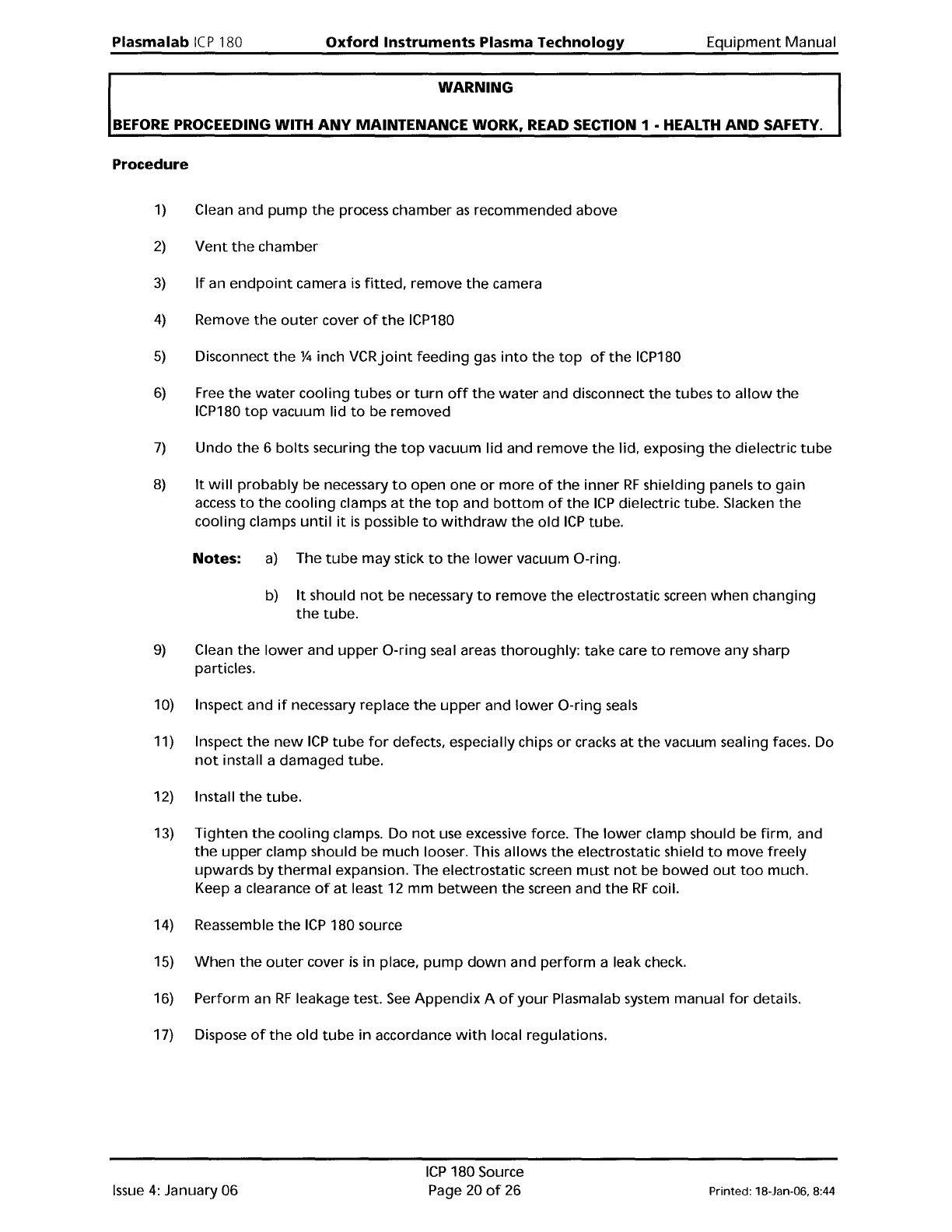
Procedure
1)
Clean and
pump
the
process chamber
as
recommended above
2)
Vent
the
chamber
3)
If
an
endpoint
camera
is
fitted,
remove
the
camera
4)
Remove
the
outer
cover
of
the
ICP180
5)
Disconnect
the
% inch
VCRjoint
feeding
gas
into
the
top
of
the
ICP180
6)
Free
the
water
cooling
tubes
or
turn
off
the
water
and disconnect
the
tubes
to
allow
the
ICP180
top
vacuum lid
to
be removed
7)
Undo
the
6 bolts securing
the
top
vacuum lid and remove
the
lid, exposing
the
dielectric
tube
8)
It
will
probably
be necessary
to
open
one
or
more
of
the
inner
RF
shielding panels
to
gain
access
to
the
cooling
clamps
at
the
top
and
bottom
of
the
ICP
dielectric tube. Slacken
the
cooling
clamps
until
it
is
possible
to
withdraw
the
old
ICP
tube.
Notes:
a)
The
tube
may stick
to
the
lower
vacuum D-ring.
b) It should
not
be
necessary
to
remove
the
electrostatic screen
when
changing
the
tube.
9)
Clean
the
lower
and
upper
D-ring
seal areas
thoroughly:
take
care
to
remove any sharp
particles.
10) Inspect and
if
necessary replace
the
upper
and
lower
D-ring
seals
11) Inspect
the
new
ICP
tube
for
defects, especially chips
or
cracks
at
the
vacuum sealing faces. Do
not
install a
damaged
tube.
12) Install
the
tube.
13)
Tighten
the
cooling
clamps. Do
not
use excessive force. The
lower
clamp should be firm, and
the
upper
clamp should be much looser. This allows
the
electrostatic shield
to
move freely
upwards
by
thermal
expansion. The electrostatic screen must
not
be
bowed
out
too
much.
Keep a clearance
of
at
least 12
mm
between
the
screen and
the
RF
coil.
14) Reassemble
the
ICP
180 source
15)
When
the
outer
cover
is
in place,
pump
down
and
perform
a leak check.
16) Perform an
RF
leakage test.
See
Appendix
A
of
your
Plasmalab system manual
for
details.
17) Dispose
of
the
old
tube
in
accordance
with
local regulations.
Issue
4:
January 06
ICP
180 Source
Page 20
of
26 Printed: 18-Jan-06, 8:44
Equipment
Manual
Oxford
Instruments
Plasma
Technology
WARNING
Plasma
lab
Ie
P180
BEFORE
PROCEEDING WITH
ANY
MAINTENANCE
WORK, READ SECTION 1 - HEALTH
AND
SAFETY.
7.
Troubleshooting
7.1
Customer
Support
Faci
lities
Oxford
Instruments Plasma Technology
has
global Customer
Support
Facilities
to
provide a co-
ordinated
response
to
customer's queries. All queries are recorded
on
our
Support Database
and
dealt
with
as
quickly
as
possible.
If
we
are
not
able
to
answer
the
query immediately,
we
will
contact
you
as
soon
as
possible.
Before contacting a Customer
Support
FaCility, please ensure
that
you have referred
to
the
appropriate
section
of
your
system manual, OEM manuals and electrical drawings.
Please
direct
all queries
through
your
nearest
support
facility
(see
below) and have
the
following
details available.
System
Type,
e.g. PlasmalabSystem100 etc.
Works
Order
No.
- This can be
found
on
the
front
cover
of
your
system manual.
Contact
Information
-
Your
name, Company and
how
we
can contact you.
Details
of
your
query
-
nature
of
the
problem,
part
numbers
of
spares required, etc.
You can contact
us
via any
of
the
following:
China
Beijing
Tel:
+861065188160
Email: pt.support@oichina.cn
Shanghai
Tel: +8621
63608530
Email: pt.support@oichaina.cn
Germany
Tel:
+496122937161
Email: info@oxford.de
Japan
Tel:
+81
352453591
Email: oikkpt@oxinst.co.jp
Singapore
Tel:
+656337
6848
Email: pt.support@oxford-instruments.com.sg
Taiwan
Tel:
+88635788696
Email: pt.support@oxford-instruments.com.tw
UK
Customer Support Hotline: +44(0) 1934837070
(0800 - 2000 UK local time)
Fax: +44(0) 1934 837071
Email: pt.support@oxinst.co.uk
USA
Concord, MA
Tel:
+1
9789933
ext. 444
Toll Free:
+1
8004474717
ext. 444
Fax:
+1
978 369 8287
Email: support.pt@ma.oxinst.com
Printed: 18-Jan-06, 8:44
ICP
180 Source
Page
21
of
26
Issue
4:
January 06
Plasma
lab
Ie
P180
Oxford
Instruments
Plasma Technology
WARNING
Equipment
Manual
BEFORE
PROCEEDING WITH
ANY
MAINTENANCE WORK, READ SECTION
1·
HEALTH
AND
SAFETY.
WARNING
WHEN CARRYING OUT
THE
FOLLOWING PROCEDURES, CONTINUOUSLY MONITOR
THE
RF
EMISSIONS AS DETAILED
IN
APPENDIX A. ON COMPLETION
OF
ALL
TESTS,
MEASURE
THE
RF
EMISSIONS TO ENSURE THAT THEY
ARE
WITHIN
SAFE
LIMITS AS
SPECIFIED IN APPENDIX A.
7.2
NOTE:
High
reflected
power
initial
checks
The
following
text
refers
to
systems
fitted
with
an
Automatch
Unit
manual
adjustment
panel.
For systems
having
software
control
of
the
Automatch
Unit,
refer
to
Section
5
(Operating
Instructions)
of
your
system
manual
and
the
Automatch
Unit's
Equipment
Manual.
If
the
indicated reflected
power
shown on
the
RF
generator
during
processing
is
greater
than
10%
of
the
indicated
forward
power
it
is
necessary
to
carry
out
the
following
checks.
1)
Check
that
the
24VDC supply
to
the
automatch
is
present.
2)
Check
that
the
24VDC fuse, located
on
the
AMU
main
PCB,
is
OK.
3)
If
the
capacitors have driven
to
their
end stops
or
settled
distant
from
a
good
match, set
both
AUTO/MANUAL switches
to
MANUAL.
4)
Operate
the
C1
MIN/MAX
switch
until
the
indicated reflected
power
reduces.
5)
Operate
the
C2
MIN/MAX
switch
to
further
reduce
the
indicated reflected power.
6)
Continue
to
operate
both
MIN/MAX
switches
until
the
minimum
indicated reflected
power
is
obtained.
7)
Set
both
AUTO/MANUAL switches
to
AUTO.
If
it
is
not
possible
to
obtain
a
reduction
of
indicated reflected
power,
check
the
mechanical drives
to
the
capacitors
as
follows:
1)
Switch
off
the
RF
power.
2)
Remove
the
automatch
covers.
3)
Set
both
AUTO/MANUAL switches
to
MANUAL.
4)
Use
the
MIN/MAX
switches
to
drive
each capacitor
to
both
of
its end stops (approximately 15
turns
of
spindle
rotation
between
end stops).
While
the
spindles are
rotating,
look
for
slipping
of
the
capacitor shafts and
for
the
mechanical
coupling
becoming disengaged.
If
required, re-engage
the
coupling
and
tighten
the
coupling
screws. Verify
that
the
electrical
end stops
limit
capacitor
adjustment
within
the
mechanical
alignment
range.
CARE:
Approach
the
mechanical limits slowly,
turning
by hand. Driving hard past a mechanical
limit
can
damage
a capacitor.
NOTE:
Capacitor spindle
rotation
clockwise decreases capacitance viewed
from
the
drive
motor
side.
Issue
4:
January 06
ICP
180 Source
Page
22
of
26
Printed: 18-Jan-06, 8:44