Oxford-100-Manual.pdf - 第56页
Plasma lab System 100 Oxford Instruments Plasma Technology System Manual 3.10.2 Functional Description The load lock, shown in Fig 3.10, is fabricated from aluminium and incorporates a hinged lid containing a view port. …
System
Manual
Oxford
Instruments
Plasma
Technology
Plasmalab System 100
3.10.1
The
automatic
load lock, shown in Fig 3.8, enables
wafer
loading
and
unloading
to
be
automatically
achieved
under
vacuum. These operations are
controlled
by
computer,
requiring
minimum
operator
involvement. The
Oxford
Instruments Plasma Technology design
results in a very compact load lock (395
mm
long
with
400
mm
of
wafer
support
travel). The
load lock
is
capable
of
handling
MESC'
standard
wafers
up
to
200
mm
diameter.
Wafer
transfer
mechanism
operating
principle
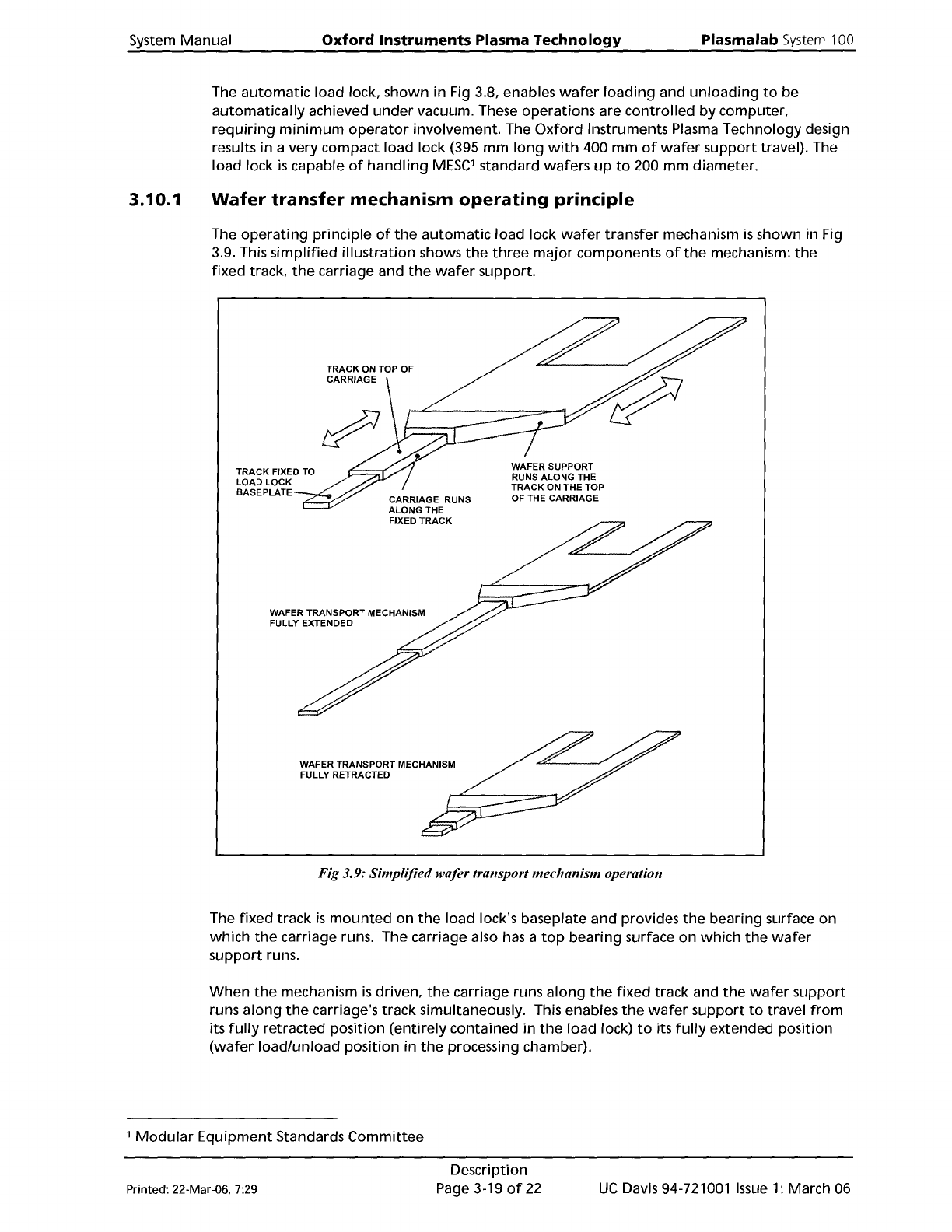
The
operating
principle
of
the
automatic
load
lock
wafer
transfer
mechanism
is
shown in Fig
3.9. This
simplified
illustration
shows
the
three
major
components
of
the
mechanism:
the
fixed track,
the
carriage and
the
wafer
support.
TRACK FIXED TO
LOAD LOCK
BASEPLATE
WAFER TRANSPORT MECHANISM
FULLY EXTENDED
WAFER TRANSPORT MECHANISM
FULLY RETRACTED
WAFER SUPPORT
RUNS ALONG THE
TRACK
ON
THE TOP
OF THE CARRIAGE
Fig 3.9: Simplified wafer transport mechanism operation
The
fixed
track
is
mounted
on
the
load lock's baseplate
and
provides
the
bearing surface on
which
the
carriage runs. The carriage also has a
top
bearing
surface on
which
the
wafer
support
runs.
When
the
mechanism
is
driven,
the
carriage runs
along
the
fixed
track and
the
wafer
support
runs
along
the
carriage's track simultaneously. This enables
the
wafer
support
to
travel
from
its
fully
retracted
position
(entirely
contained
in
the
load lock)
to
its
fully
extended position
(wafer
load/unload
position
in
the
processing chamber).
,
Modular
Equipment
Standards
Committee
Printed: 22-Mar-06, 7:29
Description
Page 3-19
of
22
UC
Davis 94-721001
Issue
1: March 06
Plasma
lab
System
100
Oxford
Instruments
Plasma Technology
System Manual
3.10.2
Functional
Description
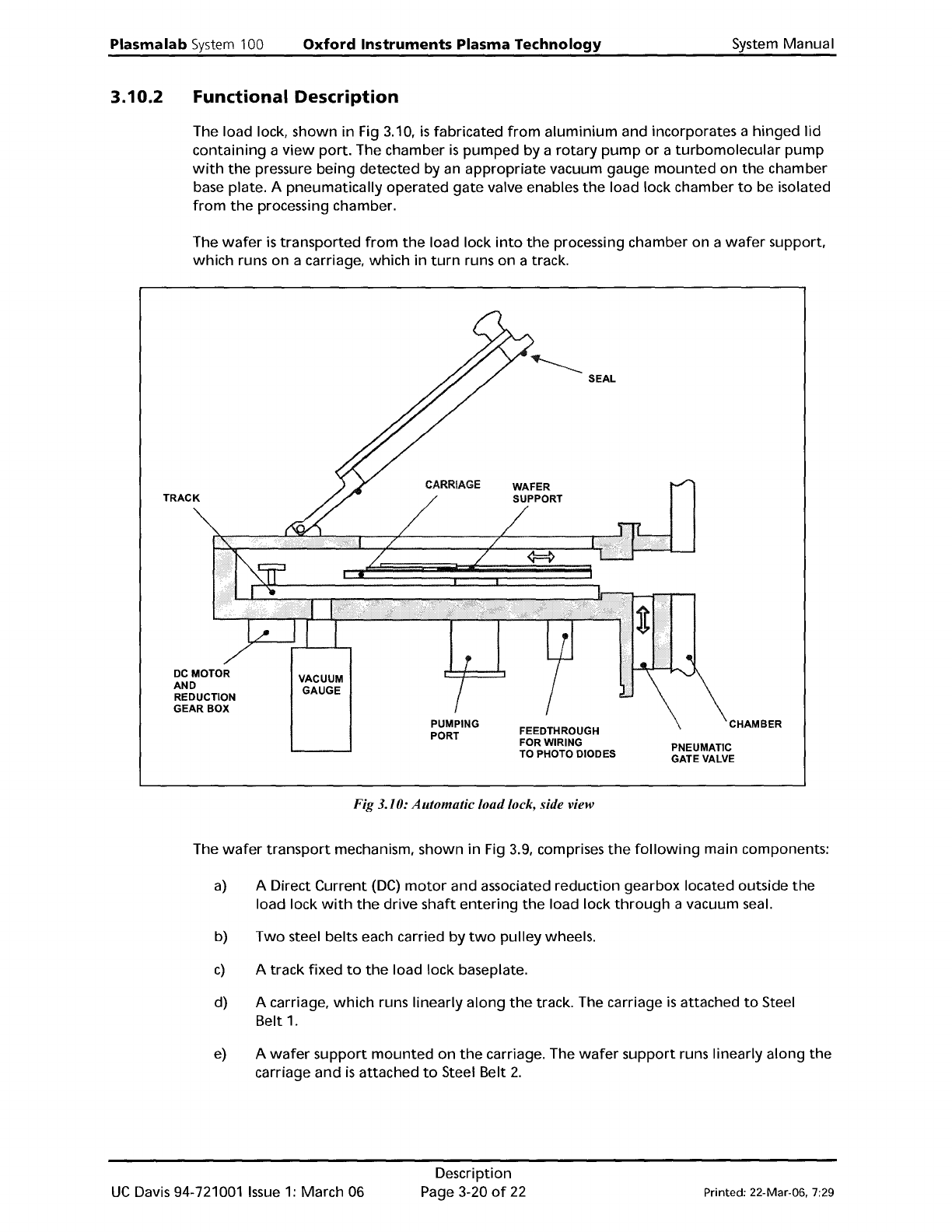
The load lock,
shown
in Fig 3.10,
is
fabricated
from
aluminium
and incorporates a hinged
lid
containing
a
view
port.
The chamber
is
pumped
by a
rotary
pump
or
a
turbomolecular
pump
with
the
pressure being detected by an
appropriate
vacuum gauge
mounted
on
the
chamber
base plate. A pneumatically
operated
gate
valve enables
the
load lock chamber
to
be isolated
from
the
processing chamber.
The
wafer
is
transported
from
the
load lock
into
the
processing chamber on a
wafer
support,
which
runs
on
a carriage,
which
in
turn
runs
on
a track.
DC
MOTOR
AND
REDUCTION
GEAR
BOX
VACUUM
GAUGE
FEEDTHROUGH
FOR WIRING
TO PHOTO DIODES
Fig 3.10: Automatic load lock, side view
CHAMBER
PNEUMATIC
GATE VALVE
The
wafer
transport
mechanism, shown in
Fig
3.9,
comprises
the
following
main components:
a)
A Direct Current
(DC)
motor
and associated reduction gearbox located outside
the
load lock
with
the
drive
shaft
entering
the
load lock
through
a vacuum seal.
b)
Two
steel belts each carried by
two
pulley wheels.
c)
A track
fixed
to
the
load lock baseplate.
d) A carriage,
which
runs linearly along
the
track. The carriage
is
attached
to
Steel
Belt
1.
e)
A
wafer
support
mounted
on
the
carriage. The
wafer
support
runs linearly along
the
carriage
and
is
attached
to
Steel Belt
2.
UC
Davis 94-721001
Issue
1:
March 06
Description
Page 3-20
of
22
Printed: 22-Mar-06, 7:29
System
Manual
Oxford
Instruments
Plasma
Technology
Plasma
lab
System
100
WAFER
SUPPORT
PULLEY
WHEEL 4
(ATTACHED TO
WAFER SUPPORT)
CARRIAGE
(ATTACHED TO
STEEL BELT
1)
PULLEY
BELT RETAINING
WHEEL 2
POST
PHOTO
DIODE
1
STEEL
BELT
1
PULLEY
WHEEL 3
(ATTACHED TO
PHOTO
CARRIAGE)
DIODE
2
PULLEY
TRACK
WHEEL 1
(DRIVEN)
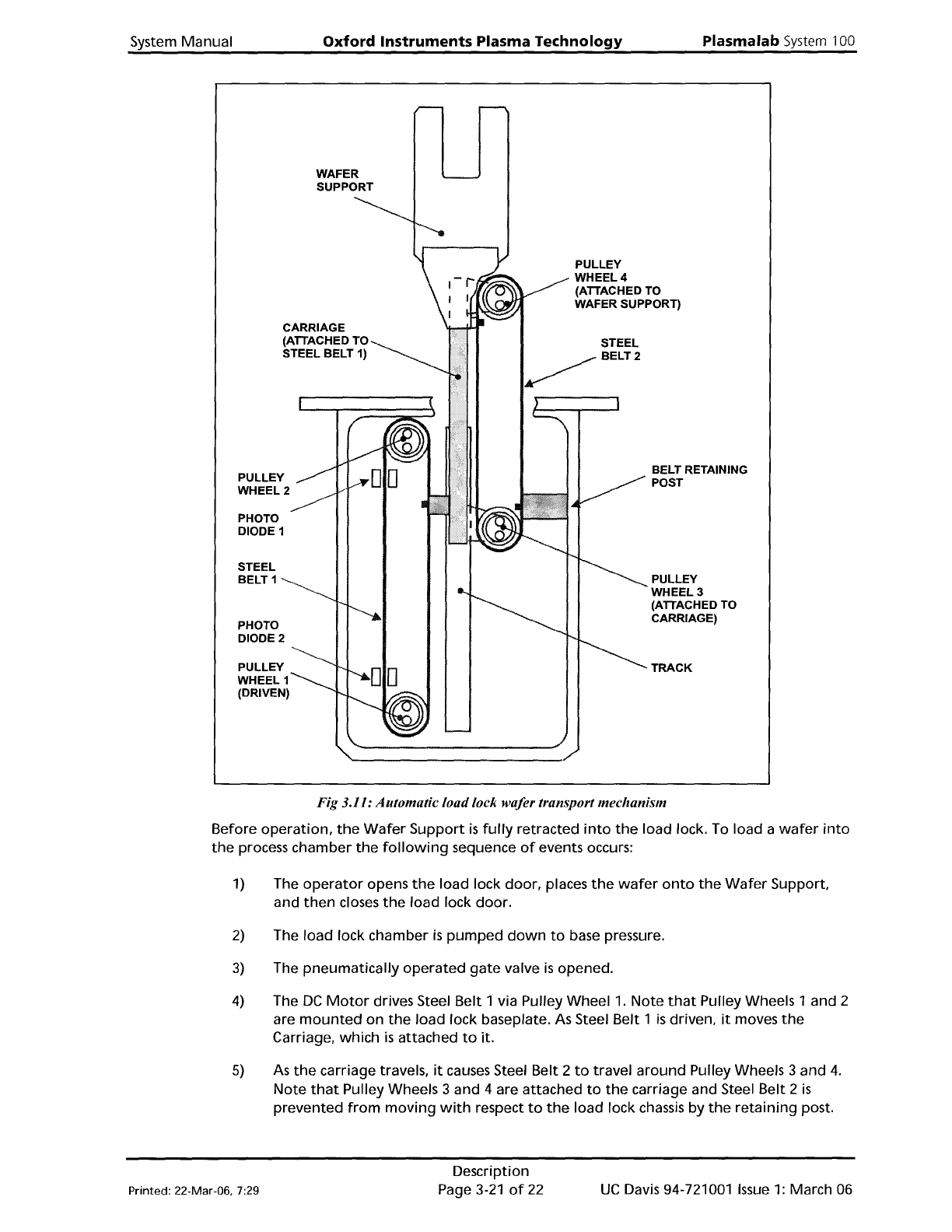
Fig 3.11: Automatic loadlock wafer transport mechanism
Before
operation,
the
Wafer
Support
is
fUlly retracted
into
the
load lock. To load a
wafer
into
the
process chamber
the
following
sequence
of
events occurs:
1)
The
operator
opens
the
load lock
door,
places
the
wafer
onto
the
Wafer
Support
and
then
closes
the
load
lock
door.
2)
The
load
lock chamber
is
pumped
down
to
base pressure.
3)
The
pneumatically
operated
gate
valve
is
opened.
4)
The
DC
Motor
drives Steel
Belt
1 via Pulley Wheel
1.
Note
that
Pulley Wheels 1 and 2
are
mounted
on
the
load
lock baseplate. As Steel Belt 1
is
driven,
it
moves
the
Carriage, which
is
attached
to
it.
5)
As
the
carriage travels,
it
causes Steel Belt 2
to
travel
around
PUlley Wheels 3 and
4.
Note
that
PUlley Wheels 3 and 4 are attached
to
the
carriage and Steel Belt 2
is
prevented
from
moving
with
respect
to
the
load lock chassis by
the
retaining
post.
Printed: 22-Mar-06, 7:29
Description
Page
3-21
of
22
UC
Davis 94-721001
Issue
1:
March 06