Oxford-100-Manual.pdf - 第66页
Plasmalab System 100 NOTES: Issue 4: March 05 Oxford Instruments Plasma Technology Installation and Commissioning Page 4-8 of 8 System Manual Printed: 16 March 200611:59
System
Manual
Oxford
Instruments
Plasma
Technology
Plasma
lab
System
100
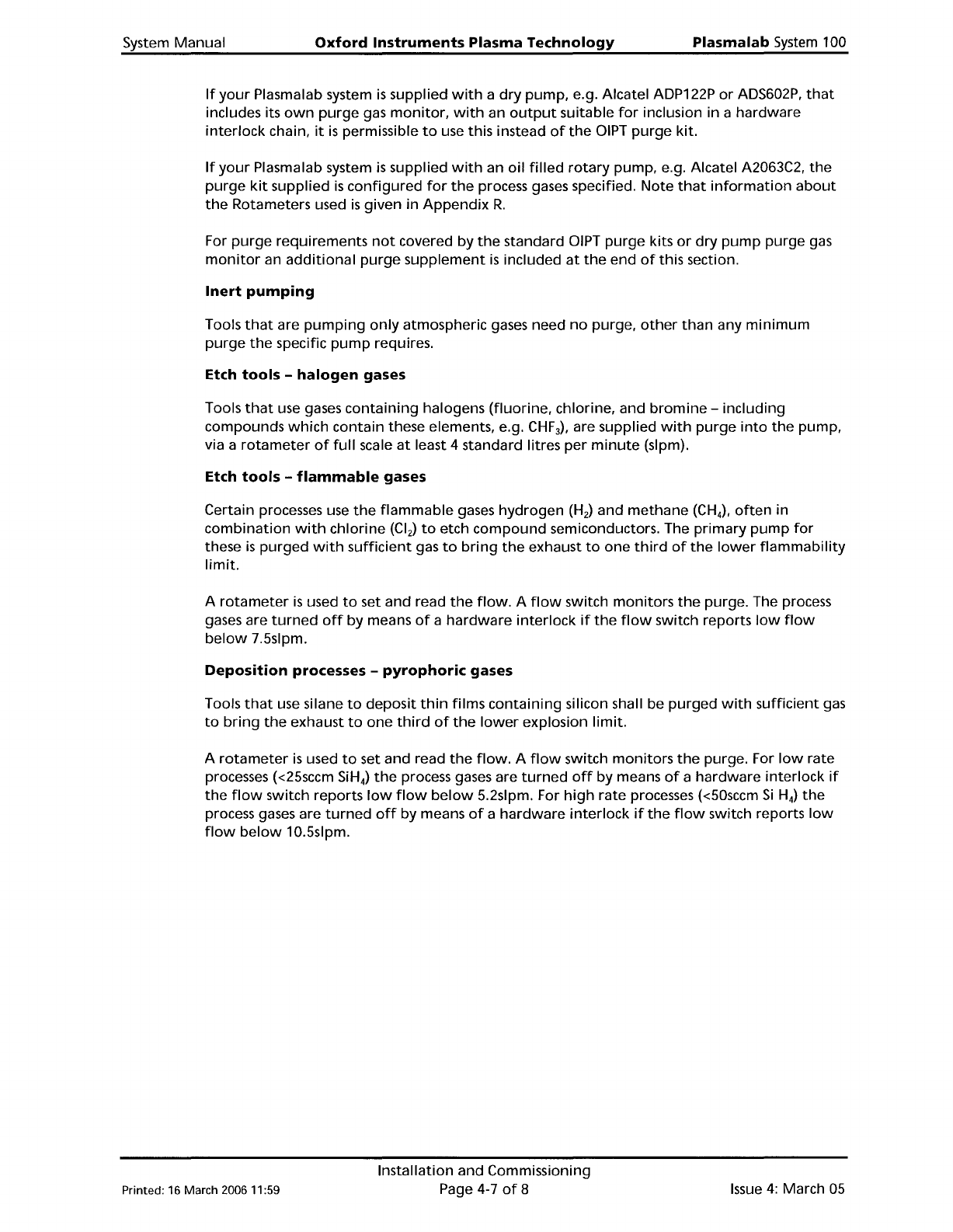
If
your
Plasmalab system
is
supplied
with
a
dry
pump.
e.g. Alcatel ADP122P
or
ADS602P.
that
includes its
own
purge
gas
monitor,
with
an
output
suitable
for
inclusion in a
hardware
interlock
chain.
it
is
permissible
to
use this instead
of
the
DIPT
purge
kit.
If
your
Plasmalab system
is
supplied
with
an
oil
filled
rotary
pump. e.g. Alcatel A2063C2.
the
purge
kit
supplied
is
configured
for
the
process gases specified.
Note
that
information
about
the
Rotameters used
is
given in
Appendix
R.
For
purge
requirements
not
covered
by
the
standard DIPT
purge
kits
or
dry
pump
purge
gas
monitor
an
additional
purge
supplement
is
included
at
the
end
of
this section.
Inert
pumping
Tools
that
are
pumping
only
atmospheric gases need
no
purge.
other
than
any
minimum
purge
the
specific
pump
requires.
Etch
tools
-
halogen
gases
Tools
that
use gases
containing
halogens
(fluorine.
chlorine, and
bromine
- including
compounds
which
contain
these elements, e.g.
CHF
3
).
are supplied
with
purge
into
the
pump,
via a
rotameter
of
full
scale
at
least 4 standard litres
per
minute
(slpm).
Etch
tools
-
flammable
gases
Certain processes use
the
flammable
gases
hydrogen
(Hz)
and
methane
(CH
4
).
often
in
combination
with
chlorine
(Cl
z
)
to
etch
compound
semiconductors. The
primary
pump
for
these
is
purged
with
sufficient
gas
to
bring
the
exhaust
to
one
third
of
the
lower
flammability
limit.
A
rotameter
is
used
to
set and read
the
flow.
A
flow
switch
monitors
the
purge. The process
gases are
turned
off
by
means
of
a
hardware
interlock
if
the
flow
switch reports
low
flow
below
7.5slpm.
Deposition
processes -
pyrophoric
gases
Tools
that
use silane
to
deposit
thin
films
containing
silicon shall be
purged
with
sufficient
gas
to
bring
the
exhaust
to
one
third
of
the
lower
explosion
limit.
A
rotameter
is
used
to
set and read
the
flow.
A
flow
switch
monitors
the
purge. For
low
rate
processes «25sccm
SiH
4
)
the
process gases are
turned
off
by means
of
a
hardware
interlock
if
the
flow
switch reports
low
flow
below
5.2slpm. For
high
rate
processes «50sccm
Si
H
4
)
the
process gases are
turned
off
by means
of
a
hardware
interlock
if
the
flow
switch reports
low
flow
below
10.5slpm.
Printed: 16 March 200611:59
Installation and Commissioning
Page 4-7
of
8
Issue
4:
March
05
Plasmalab
System
100
NOTES:
Issue
4:
March
05
Oxford
Instruments
Plasma
Technology
Installation and Commissioning
Page 4-8
of
8
System Manual
Printed: 16 March 200611:59
System
Manual
Oxford
Instruments
Plasma Technology
PlasmalabSystem100
5.
Operating
instructions
5.
Operating
instructions
5-1
5.1
Failure
of
quartz
and alumina components
under
vacuum
5-3
5.2
System
power-up
5-4
5.3
System
shut
down
and restart
5-5
5.3.1
Emergency
shut
down
5-5
5.3.2
Routine
shut
down
5-5
5.3.3 Mains Power
failure
5-5
5.3.4
Software
abort
5-5
5.3.5 System
shut-down
procedure 5-6
5.3.6 System restart
following
an emergency stop.
power
failure.
or
software
abort5-6
5.3.7 System response
to
loss
of
services
5-8
5.4
Operator
control
5-1
0
5.4.1
Turning
screen savers and
power
saver
options
off
5-10
5.4.2
Logging
on
5-11
5.4.2.1
Editing
users details
5-11
5.4.3 System alerts 5-14
5.4.4
Pumping
down
5-15
5.4.5
Automatic
process
run
5-16
5.4.6 Single
button
automatic
process
run
5-17
5.4.7 Production
mode
5-18
5.4.8
Manual
process run 5-19
5.4.9
Venting
the
system 5-20
5.5 Creating and
editing
recipes
5-21
5.5.1
Working
with
recipe steps
5-21
5.5.2
Working
with
recipes 5-22
5.6
Process
Datalog
5-24
5.6.1
Select Log page 5-24
5.6.1.1 Saving a
log
file
as
text
for
use in
Microsoft
Excel™
5-25
5.6.2 Run
log
page 5-28
5.6.3 Leak
detection
and
MFC
calibration
log
page 5-29
5.7
Operator
adjustments 5-30
5.7.1
Manual
adjustment
of
the
RF
matching
unit..
5-30
5.7.2
Adjusting
the
nitrogen
regulator
outlet
pressure
5-31
5.7.3 Rotary/dry
pump
N
2
purge
flow
rate
adjustment
5-32
5.8
PC
2000 screens 5-33
5.8.1
Pump
control
page 5-33
5.8.2
Robot
control
page 5-36
5.8.3 Recipe page 5-37
5.8.4 Production
mode
page 5-39
5.8.5 Chamber 1 process
control
page 5-40
5.8.6 Leak
detection
page 5-45
5.8.7 Mass
flow
calibration
page 5-47
5.8.8 Service
mode
5-48
5.8.8.1 Transferring
wafers
in
service
mode
5-49
5.8.8.2 Exiting
from
service
mode
5-50
5.8.9 System
log
page
5-51
5.9
Log files 5-52
Fig 5.1:
Menu
bar
5-1
0
Fig 5.2: Typical system
alert
5-14
Fig 5.3: Recipe screen
5-21
Fig 5.4: Step Commands
pop-up
menu 5-22
Fig 5.5: Select Log page 5-24
Printed: 22-Mar-06. 10:42
Operating
Instructions
Page
5-1
of
52
UC
Davis 94-721001
Issue
1:
March 06