D-serie LEVEL II.pdf - 第135页
C&P6/12 Placement Head Z-Axis Up Travel Profile - Pickup S tude nt Guide Advanced Level 2 SIPLACE D Series EN 05/2007 C&P6/12 Placement Head 8-9 8.3.2 Z-Axis U p 8.3.2.1 D et ailed St andard Pickup Procedure: Z-A…
C&P6/12 Placement Head
Travel Profile - Pickup Z-Axis Down
Student Guide Advanced Level 2 SIPLACE D Series
C&P6/12 Placement Head EN 05/2007
8-8
8.3.1.3 Special Mode "Pickup with Minimum (Very Low) Force " for Z-Axis Down
Travel profile 21 and 22
These travel profiles are currently only for the Twin head (P&P module) and are only available with a
special nozzle.
Definable pickup forces: 0.9 - 2.0 N
8.3.1.4 Standard Mode for Smaller Components (< 6x6 mm²) Picked Up with Early Vacuum, Z-
Axis Down
Benefit of standard mode for small components "early vacuum"
The function change "early vacuum" offers the following benefits:
Increases the pickup reliability for small nozzle types 901/904. The vacuum begins to build up during
the downwards movement. This ensures, that when the upwards movement begins, an exotic
component and /or a heavy component will remain safely on the nozzle.
No time loss during pickup (compared to standard pickup).
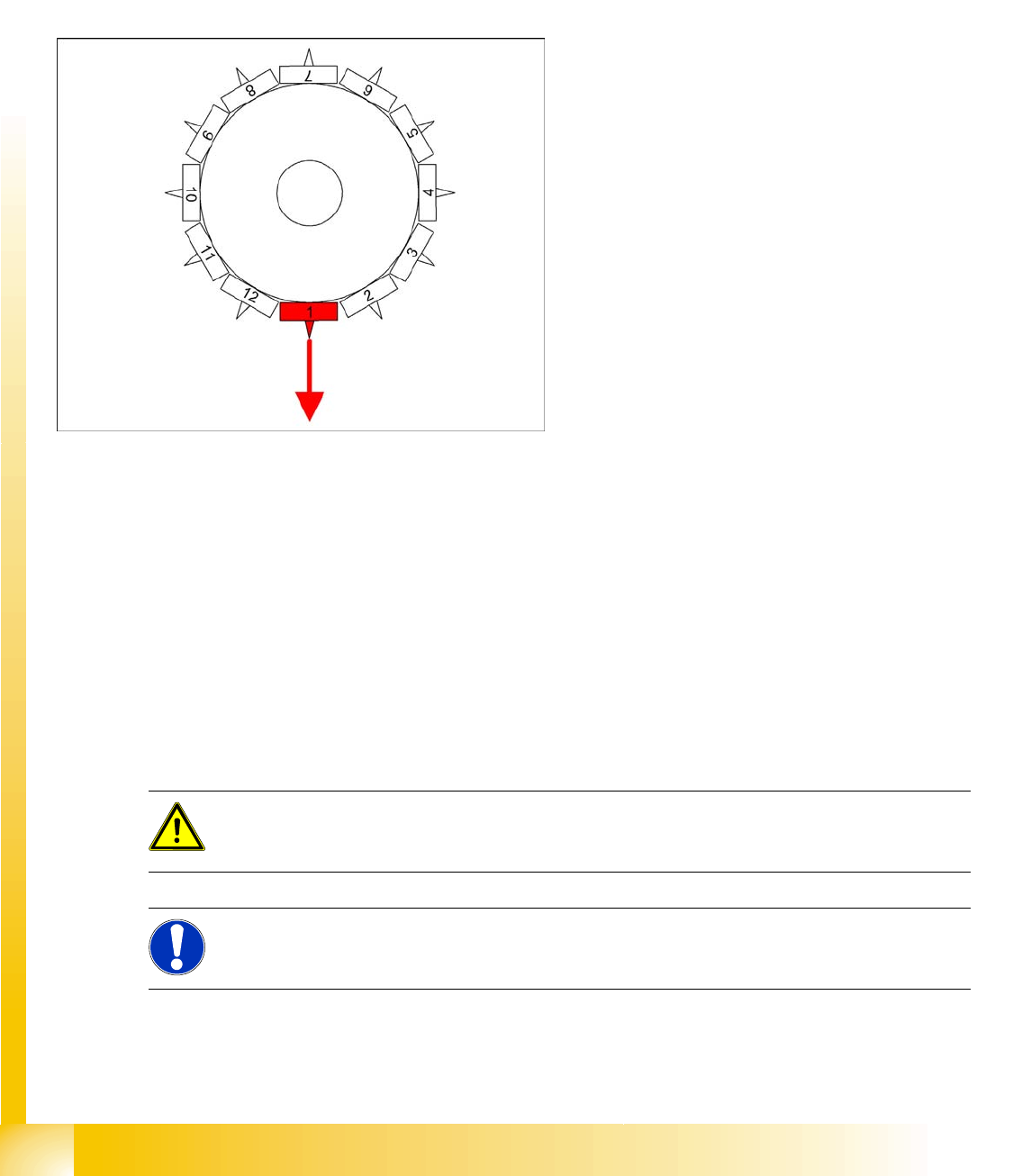
8-6: Special mode Z-axis down with "early vacuum" " vacuum ON in top
position"
Start gantry axes to pickup position of next feeder
and communication with changeover table:
Start signal to gantry axes
Signal for next feeder / this opens the feeder
flap
End position signal for X/Y and star axes:
End position signal for star axis
Enables vacuum query: "segment airtight?"
before pickup
X/Y end position signals available.
Z-axis starts:
Positioning of Z-axis down
Light barrier (LB) up switches:
Special procedure: valve positioning drive ON
for switching over to vacuum
and releases LB down function
LB down switches:
End position signal for positioning Z-axis down
ATTENTION:
The risk of head contamination is higher (without additional vacuum formation) when using
nozzle types with large openings, generally for components larger than 6 mm!
NOTE:
From SIPLACE PRO 3.0 onwards, early vacuum has been replaced by the component shape
library, for components smaller than 6x6 mm.
C&P6/12 Placement Head
Z-Axis Up Travel Profile - Pickup
Student Guide Advanced Level 2 SIPLACE D Series
EN 05/2007 C&P6/12 Placement Head
8-9
8.3.2 Z-Axis Up
8.3.2.1 Detailed Standard Pickup Procedure: Z-Axis Up
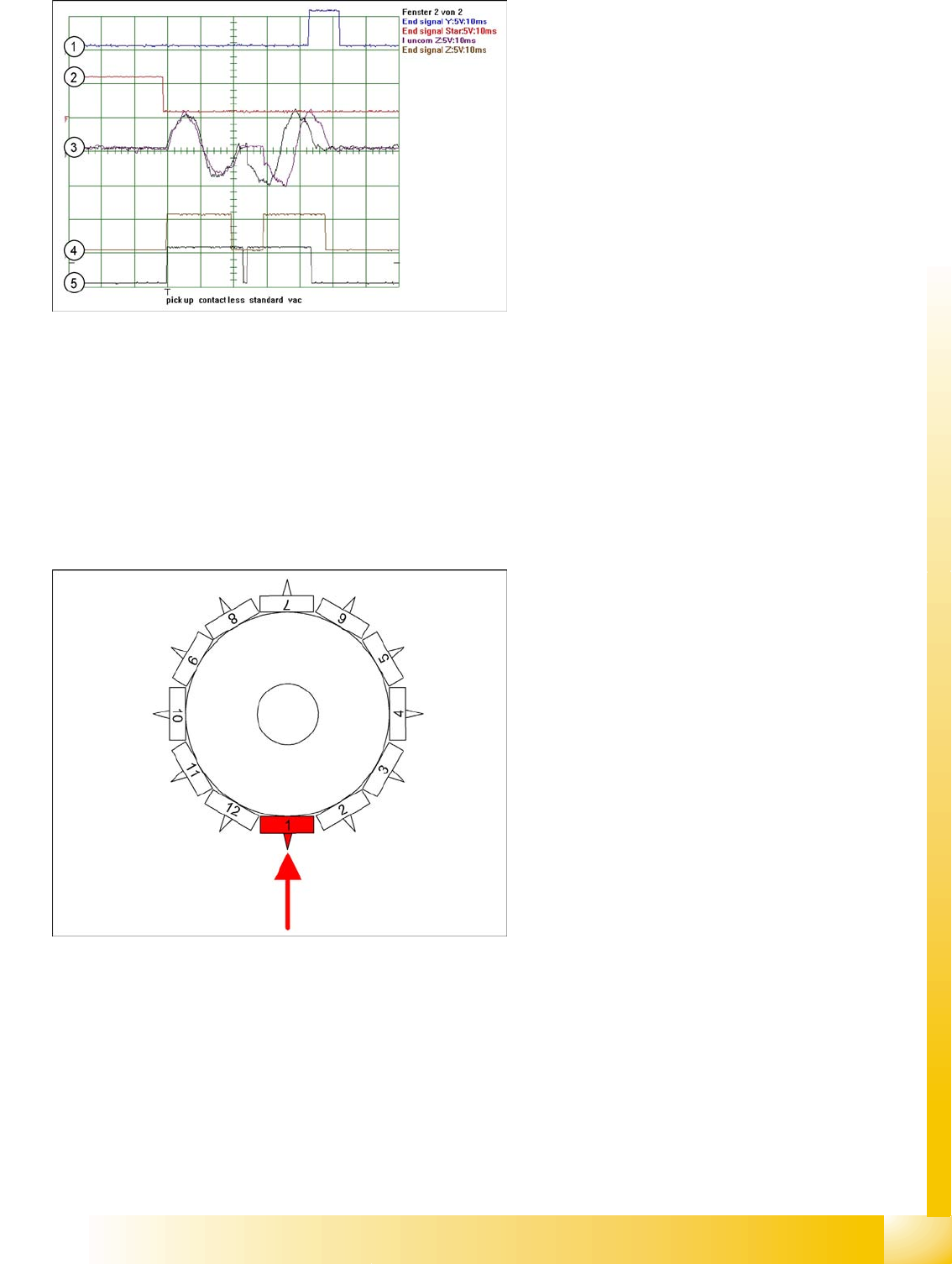
The time between "end position signal down" and
"start upwards" is shown below in the difference
between the "standard" and "early vacuum"
modes.
Standard vacuum 9.4 ms.
Early vacuum 1.2 ms
Downwards positioning takes 3 ms longer for
contactless pickup.
Legend
1. End position signal for Y-axis
2. End position signal for star axis
3. Uncommutated motor currents for Z-axis (2
modes)
4. End position signal for pickup procedure with
vacuum switched on at bottom (standard)
5. End position signal for pickup procedure with
early vacuum
8-7: Detailed pickup procedure: Z-axis up
LB down switches:
End position signal for Z-axis down and valve
drive "ON" for vacuum
Both actions completed?
Start signal for upwards movement
Z-axis starts:
Positioning of Z-axis upwards
LB up switches:
Reset the LB down signal
1. vacuum query "Component picked up?"
(reply OK) start release for gantry axes
Communication with the changeover table:
"Close feeder flap" and feeder lift
Z-axis end position signal (Z-axis at 0 position, DP
station swiveled out): 2. vacuum query
"Component picked up?" Start release for star axis
C&P6/12 Placement Head
Travel Profile - Pickup Z-Axis Up
Student Guide Advanced Level 2 SIPLACE D Series
C&P6/12 Placement Head EN 05/2007
8-10
8.3.2.2 Special Mode Pickup with "Reduced Speed" Z-axis Upwards
If the reduced Z-axis speed is set to 98.1 % for the nozzle, the SR/MC 40X/501/502 SW will position as
follows in this special mode. From LRU/LRL 503 and SIPLACE Pro 1.4/2.0, this can be selected as "slow
start upward" in the component shape programming of stations with SW version SR/MC 503 or higher.
8.3.2.3 Benefits of the Special Mode "Slow Speed Upwards" and "Creep Speed Start"
The function change "slow speed" (reduced speed SR/MC 407) offers the following benefits:
Increases the pickup reliability for all nozzle types and for heavy/exotic COs. During the slow start,
the vacuum has the chance to develop its full holding force. An exotic component and /or a heavy
component will therefore remain safely on the nozzle!
There is no danger of head contamination for nozzle types with large openings.
However, this option makes the pickup procedure around 20 ms longer than the standard pickup
procedure.
Irrespective of the special modes, the acceleration values in the nozzle handling from SW version
503 onwards can be reduced further if required.
You can also specify the Z-axis down waiting period if you are using special feeder constructions.
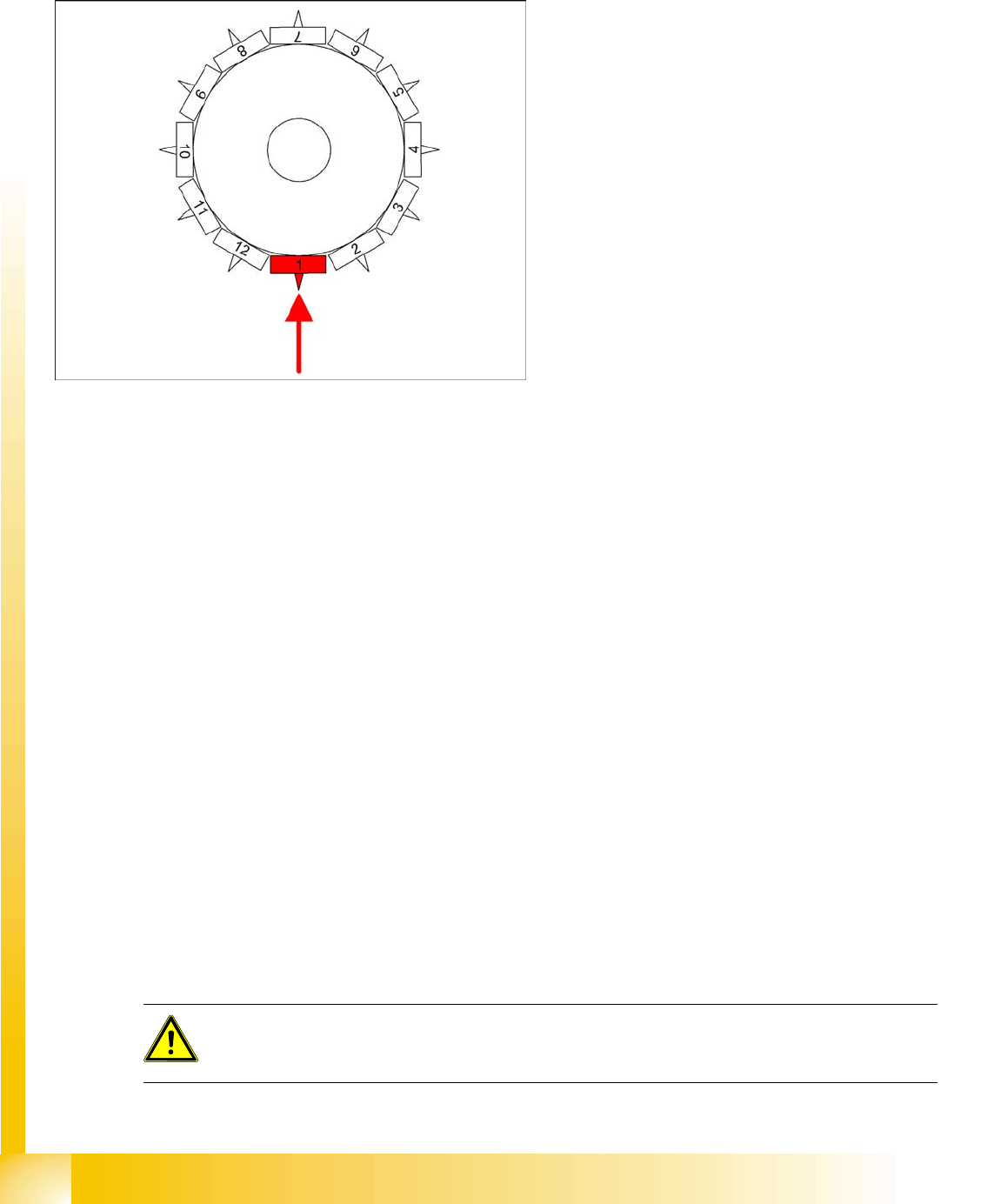
8-8: Detailed pickup procedure: Z-axis upwards with reduced speed
LB down switches:
End position signal for positioning Z-axis
down; Both actions completed? (switched to
vacuum and end position signal Z-axis)
Start signal for upwards movement
Z-axis starts:
Positioning of Z-axis upwards
Special procedure: with low starting speed for
the first mm (takes approx. 20 ms longer), so
that the vacuum in the nozzle has time to
develop completely (up to 502 / this is
activated with 98% of normal acceleration).
After this, the speed depends on the selected
reduced value.
LB up:
Reset the LB down signal
1. vacuum query "Component picked up?"
Start signal for gantry axes
Communication with the changeover table: all
feeders (in this special mode): "Close feeder
flap" and feeder lift
Z-axis end position signal (Z-axis at 0 position, DP
station swiveled out):
2. vacuum query "Component picked up?"
Start signal for star axis
ATTENTION:
The mode "creep speed start" does not usually provide any additional benefits (except in the
case of pickup from surftape) but does reduce the placement performance considerably.