0197787-01_UM_HeadVerification_708_EN.pdf - 第39页
SIPLACE Head V erification User Manual Edition 01/2015 39 4.6.2 Explanation of Measurement Results in Progress Menu After com pletion of the measurem ent, the following res ults appear in the " Progress" m enu:…
SIPLACE Head Verification
User Manual Edition 01/2015
38
5. The gantry is then moved again over the height reference run position on the conveyor side.
6. The Z axis is moved downwards using the travel profile TP5 [TP5 LIGHT BARRIER] and
segment 1 picks up the calibration component (in CPP simulated on hardened height
reference run fiducial) with 0°. At the same time, the Vacuum 0° [mbar] value is measured for
the emitted light barrier Z-down end position signal.
7. The Z axis then moves back to the top position.
8. The Z axis is moved downwards again using the travel profile TP5 [TP5 LIGHT BARRIER] and
segment 1 picks up the calibration component once more (in CPP simulated on hardened
height reference run fiducial) with 90°. At the same time, the Vacuum 90° [mbar] value is
measured for the emitted light barrier Z-down end position signal.
9. The Z axis then moves back to the top position.
10. The Z axis is moved downwards again using the travel profile TP5 [TP5 LIGHT BARRIER] and
segment 1 picks up the calibration component once more (in CPP simulated on hardened
height reference run fiducial) with 180°. At the same time, the Vacuum 180° [mbar] value is
measured for the emitted light barrier Z-down end position signal.
11. The Z axis then moves back to the top position.
12. The Z axis is moved downwards again using the travel profile TP5 [TP5 LIGHT BARRIER] and
segment 1 picks up the calibration component once more (in CPP simulated on hardened
height reference run fiducial) with 270°. At the same time, the Vacuum 270 [mbar] value is
measured for the emitted light barrier Z-down end position signal.
13. The Z axis then moves back to the top position and the star steps segment 2 into the pickup
position.
14. Steps 6-12 are now performed for all other head segments.
15. The values determined for the four angle measurements Vacuum 0°- Vacuum 270° [mbar]
are used to calculated the maximum deviation Delta vac. 0-270° [mbar]. The maximum
dispersion from minimum to maximum shows the air-tightness for that segment over 360°.
16. The head then moves over the calibration component and picks it up with travel profile TP5
[TP5 LIGHT BARRIER]. At the same time, the Vacuum calib part [mbar] value is measured
at emission of the end position signal light barrier Z-down, for use as a reference for
components picked up.
This value at calibration component pickup Vacuum calib part [mbar] is compared with the
Vacuum closed [mbar] value from the open-closed measurement. The difference from
Vacuum closed [mbar] - Vacuum calib part [mbar] provides the Delta calib-closed [mbar]
value.
Delta calib-closed [mbar] is an indicator for the segment (nozzle) that the vacuum values
determined during nozzle reference run correspond to the vacuum values during component
pickup.
17. After each placing down of the calibration component, the vacuum is switched off and the
vacuum value is measured at the nozzle to make sure that it is reliably reduced and to ensure
that no components remain hanging from the nozzle, due to an existing underpressure.This
value is known as Calib part dev [mbar].
18. Following this, an air blast of 200mbar is switched through to each segment, to measure the
air blast value which actually arrives at the segment.This value is known as Air [mbar] and
indicates that the air blast is switched through correctly for rejection or switchover between
holding and placement.
19. After switching off the air blast, it is measured once again to see how it is reduced at the
nozzle tip. The value measured is known as Vacuum zero [mbar] and indicates how reliably
the pressure is reduced at the nozzle tip.
SIPLACE Head Verification
User Manual Edition 01/2015
39
4.6.2 Explanation of Measurement Results in Progress Menu
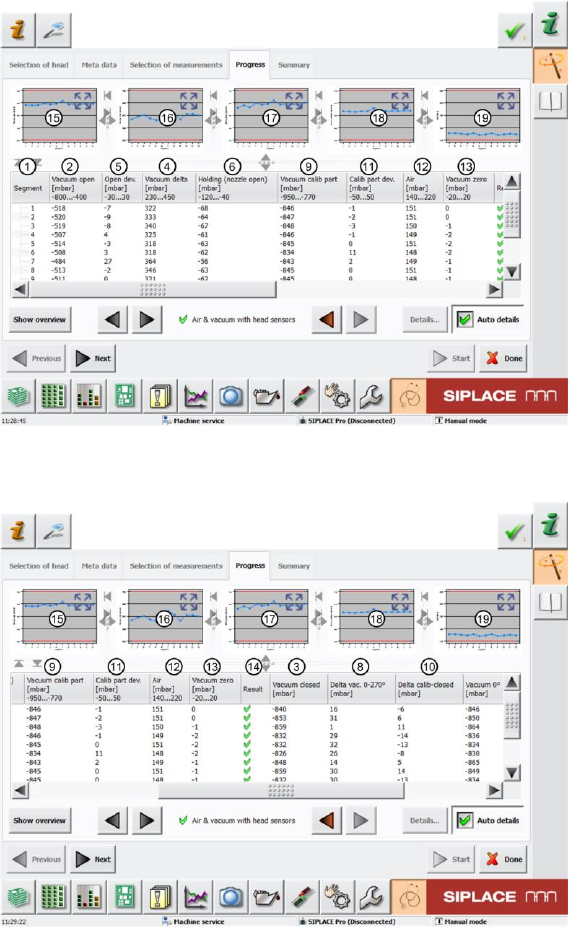
After completion of the measurement, the following results appear in the "Progress" menu:
Figure 24: Air & vacuum with head sensors 1 result
Figure 25: Air & vacuum with head sensors 2 result
SIPLACE Head Verification
User Manual Edition 01/2015
40
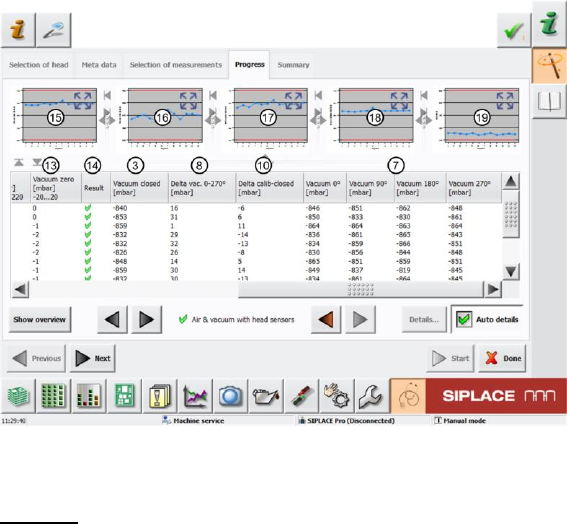
Figure 26: Air & vacuum with head sensors 3 result
Legend:
1. Segment measured
2. Value determined Vacuum open [mbar]
This value is determined when the Z axis moves downwards with the travel profile TP5 and
while the vacuum is measured at the open nozzle. This value must be within a plausible
tolerance (in this case for the CPP head with nozzle 2057 -800…400mbar).
3. Value determined Vacuum closed [mbar]
This value is determined when the Z axis meets the component (in this measurement at the
height reference run position), the light barrier Z-down end position signal has been emitted
and the nozzle is understood to be closed. This is an absolute value and must not be within a
tolerance!
4. The Vacuum delta [mbar] value is calculated by finding the difference between the Vacuum
closed [mbar] (3) values and the Vacuum open [mbar] (2) value. Since the threshold value
for Vacuum open [mbar] is prescribed by the head and nozzle type parameters and the
Vacuum closed [mbar] value is an actual vacuum value at the closed nozzle during pickup,
the Vacuum delta [mbar] value is also within a defined tolerance.
(in this case for CPP head with nozzle 2057 230…450mbar).
Vacuum delta [mbar] = Vacuum closed [mbar] – Vacuum open [mbar]
5. The Open dev. [mbar] will not be explained further and is not currently used for the head
verification.
6. The Holding (nozzle open) [mbar] describes the value measured at the vacuum present at
an open nozzle during rotation of the complete holding circuit.
This value depends on the use of a vacuum pump and must also be within a plausible
tolerance.
(in this case for CPP head with nozzle 2057 -120..-40mbar)
7. This shows the vacuum values determined for the closed nozzle during simulated pickup
(either calibration component or height reference run plate) at the moment of light barrier Z-
down action (end position signal) in the pickup angles 0°, 90°, 180° and 270°. These "Vacuum
0°"-"Vacuum 270°" values provide an overview of the vacuum at different pickup and
placement angles.
8. The Delta vac. 0-270° [mbar] value is calculated by finding the difference between the lowest
and highest values from the "Vacuum 0°"-"Vacuum 270°" (7) measurement.
If this value is exceptionally high, compared to other segments, this indicates that the segment
has a problem at one of the angles. The angle overview (7) helps you to identify where the