0197787-01_UM_HeadVerification_708_EN.pdf - 第44页
SIPLACE Head V erification User Manual Edition 01/2015 44 The positioning tim e for rotation of the DP at 180° (pl ace) after 0° (pick up) is also determined. 7. Segment 1 is then m oved back up again with travel pr ofil…

SIPLACE Head Verification
User Manual Edition 01/2015
43
4.6.4 Meaning of the Results
"Vacuum open" / "Vacuum delta" / "Vacuum delta" errors at all segments:
1. Defective vacuum pump
2. Seal (four-hole rubber disk) for holding circuit incorrectly fitted or damaged
Check the seal position or replace it
3. Holding circuit dirty Clean in ultrasound bath
"Vacuum open" / "Vacuum delta" / "Vacuum delta" errors at individual segments:
1. Check filter disks for air-tightness of nozzle seat Replace filter disks
2. Check nozzle Replace nozzle
3. Dirty or damaged vacuum hose to segment Replace vacuum hose
4. Holding circuit dirty Clean in ultrasound bath
"Delta vac. 0-270°" error at individual segments:
1. DP/segment defective Rotation or no planarity of nozzle contact surface Replace
DP/segment
2. Internal DP/segment vacuum cycle defective Replace DP/segment
4.7 "Head Endurance Run 01005" Measurement
The following tools are required for these measurements:
CPP: 12x nozzle type 2057 03070280-01 (calibration nozzle)
CP20A: 20x nozzle type 1235 03015222-01 (calibration nozzle)
4.7.1 Explanation of Measurement – Procedure
This measurement determines the Z actual position deviation at pickup and placement. This Z actual
position deviation is an indication of how reliably the Z axis system is working and whether it is
damaged.
This measurement is important primarily for contactless placement, for example, with 0201 or 01005
components.
The positioning speed of the DP or segments and their reliability is also checked.
The results of these measurements provide feedback about the following sources of errors:
1. Segment guides with difficulty moving or worn out
2. Linear guide of Z axis with difficulty moving
3. Defective Z motor
4. P drive or turning station of segment defective
Measurement steps:
1. The head is positioned over the height reference run position on the fixed conveyor side.
2. Segment 1 now moved towards the conveyor side very slowly with travel profile TP34 [TP34
01005 CRAWL] . As soon as the nozzle tip touches the conveyor side, the current monitoring
of the Z axis rises and the Z axis is understood to have reached the reference position for
calculating the contactless Z pickup position.From this position, a distance needed for
contactless component pickup is calculated. This position is now the target position for the
following pickup or placement cycles.
3. The Z axis now moves back up again with travel profile TP1.
4. The Z axis then determines the Z pickup position contactless for all other segments, as
described in point (2)
5. The actual determination of measurement values starts now.
6. Pickup:
Segment 1 is now moved downwards with travel profile TP34 [TP34 01005 CRAWL] and a DP
pickup angle of 0° and contactless positioned at the determined Z pickup position. The actual
Z position determined when the end position signal is emitted is known as Z-Pick [µm].
SIPLACE Head Verification
User Manual Edition 01/2015
44
The positioning time for rotation of the DP at 180° (place) after 0° (pickup) is also determined.
7. Segment 1 is then moved back up again with travel profile TP1.
8. Placement:
Segment 1 is now moved downwards with travel profile TP34 [TP34 01005 CRAWL] and a DP
placement angle of 180° and is contactlessly positioned at the determined Z pickup position.
The actual Z position determined when the end position signal is emitted is known as Z-Place
[µm].
The positioning time for rotation of the DP at 0° (pickup) after 180° (place) is also determined.
9. Segment 1 is then moved back up again with travel profile TP1.
10. This procedure is now executed 30x for segment 1, which means a total of 60x Z axis
movements (30x pickup / 30x place) and also 60x DP positioning times.
11. All pickup positions Z-Pick [µm] are saved internally and the minimum (Z min pick [µm]) and
maximum (Z max pick [µm]) positions are used for the analysis.
12. All placement positions Z-Place [µm] are saved internally and the minimum (Z min place
[µm]) and maximum (Z max place [µm]) positions are used for the analysis.
13. The positioning times for rotation of each segment by 180° are also analyzed, to provide a
minimum (Min DP Time [ms]) and maximum (Max DP Time [ms]) value for each segment.
14. The star now turns segment 2 into the placement position
15. Measurements 6-14 are now performed for all other segments.
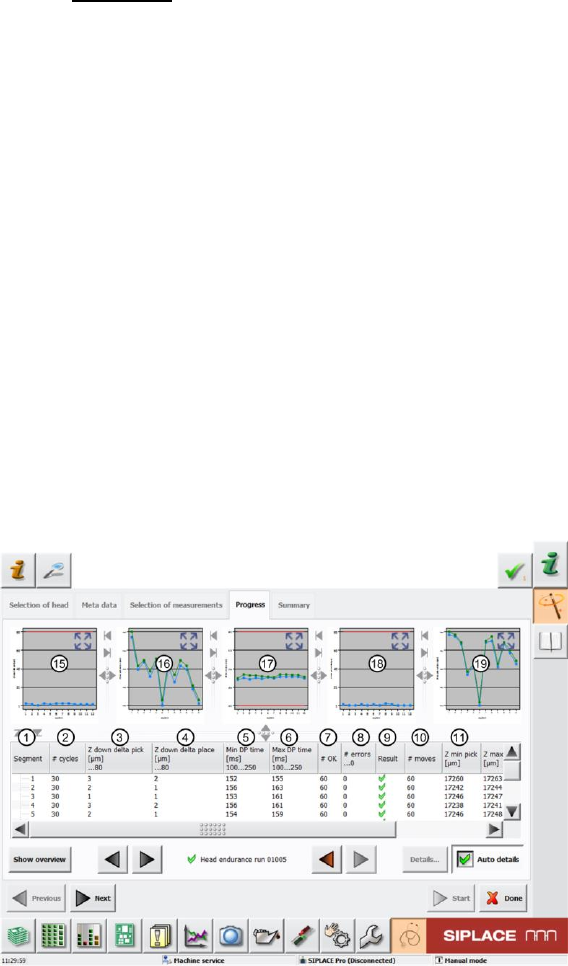
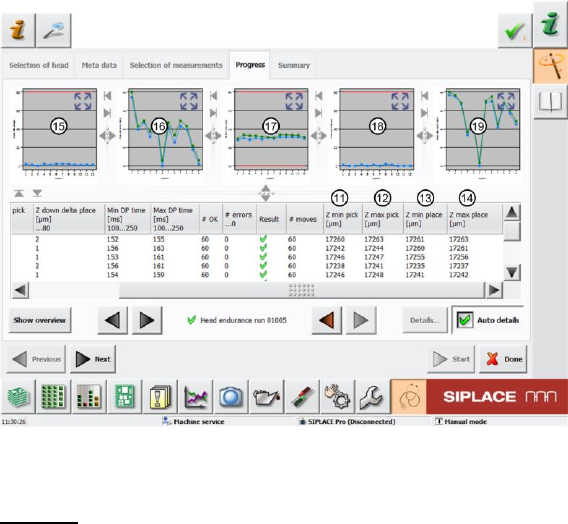
4.7.2 Explanation of Measurement Results in "Progress" Menu
After completion of the measurement, the following results appear in the "Progress" menu:
Figure 28: Head endurance run 01005_1 result
SIPLACE Head Verification
User Manual Edition 01/2015
45
Figure 29: Head endurance run 01005_2 result
Legend:
1. Segment measured
2. Total number of cycles
3. Value determined Z down delta pick [µm]
This value is calculated by finding the difference between the lowest (Z min pick [µm] (11))
and the highest (Z max pick [µm] (12)) Z axis positioning value during the pickup cycles.
This value must be within a plausible tolerance (in this case 0..80µm).
Z down delta pick [µm] = Z max pick [µm] - Z min pick [µm]
4. Value determined Z down delta place [µm]
This value is calculated by finding the difference between the lowest (Z min place [µm]
(13)) and the highest (Z max place [µm] (14)) Z axis positioning value during the pickup
cycles.
This value must be within a plausible tolerance (in this case 0..80µm)!
Z down delta place [µm] = Z max place [µm] - Z min place [µm]
5. The Min DP time [ms] value is the shortest DP positioning time reached during positioning at
180°. This value must be within a plausible tolerance (in this case 100..250µm)!
6. The Max DP time [ms] value is the longest DP positioning time reached during positioning at
180°. This value must be within a plausible tolerance (in this case 100..250µm)!
7. Results display for number of successful strokes
8. Number of errors during 30x total cycles.
9. Results display (OK green tick / NOK red X)
10. Number of individual Z axis movements (in our case 30x down + 30x up = 60)
11. Z min pick [µm] is the lowest Z axis positioning value achieved during the pickup cycles.This
value is used to calculate the Z down delta pick [µm] (3) value.
12. Z max pick [µm] is the highest Z axis positioning value achieved during the pickup
cycles.This value is used to calculate the Z down delta pick [µm] (3) value.
13. Z min place [µm] is the lowest Z axis positioning value achieved during the placement
cycles.This value is used to calculate the Z down delta place [µm] (4) value.
14. Z max place [µm] is the highest Z axis positioning value achieved during the placement
cycles.This value is used to calculate the Z down delta place [µm] (4) value.
15. This diagram illustrates the "Z down delta pick [µm] (3)" values for the segments.
Blue line Z down delta pick [µm]
Red border Min and max tolerances (in our case 0..80µm)