0197787-01_UM_HeadVerification_708_EN.pdf - 第70页
SIPLACE Head V erification User Manual Edition 01/2015 70 Figure 48 : ZDS sen sor values_2 r esults Legend: 1. Segment m easured 2. Analog voltage value f or the Z -down light barri er receiver Sensor value [m V] at a se…
SIPLACE Head Verification
User Manual Edition 01/2015
69
6. The Z axis is in the bottom position, so that the nozzle tip stands in the component sensor
beam.
7. During the rotation, measurements are taken at each rotated 1°:
- Voltage value for Z-down light barrier (sensor value [mV] / 1°) Min value [mV]
and Max value [mV]
- Change in nozzle length in component sensor (change in length determined / 5°
Radial runout 5° [µm])
- Change in voltage for Z-down light barrier (sensor value [mV]/5° Variation 5°
[mV]
- These saved values are used to determine the maximum voltage fluctuations of
the Z-down light barrier during a 360° rotation. This is provided by the delta
between the maximum voltage value and the minimum voltage value for the Z-
down light barrier Variation 360° [mV]
- The saved values can also be used to determine the maximum change in nozzle
length for the component sensor measurement during a 360° rotation. This is
provided by the delta between the maximum nozzle length and the minimum
nozzle length in the component sensor across 360° Radial runout 360° [µm]
8. This measurement is now performed for all other segments.
4.13.2 Explanation of Measurement Results in "Progress" Menu
After completion of the measurement, the following results appear in the "Progress" menu:
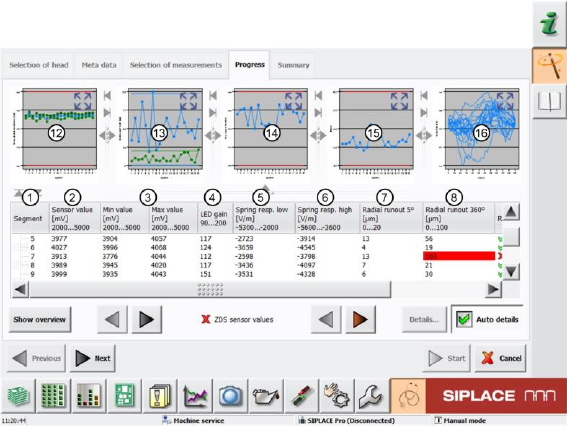
Figure 47: ZDS sensor values_1 results
SIPLACE Head Verification
User Manual Edition 01/2015
70
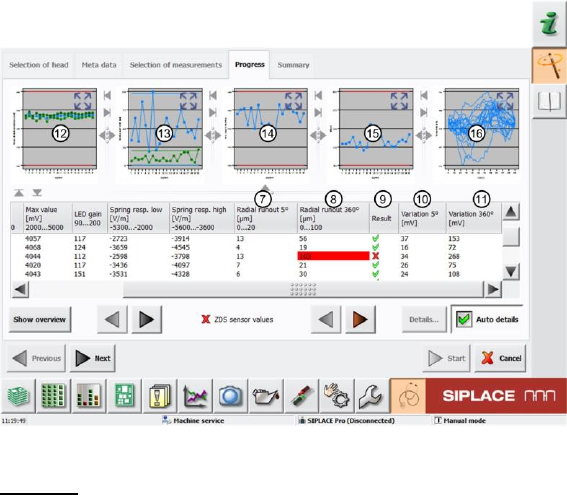
Figure 48: ZDS sensor values_2 results
Legend:
1. Segment measured
2. Analog voltage value for the Z-down light barrier receiver Sensor value [mV] at a segment
setting of 0°, during the LED brightness adjustment as receiver (4) with the value LED gain.
This voltage value shows the distance between the light barrier and the switching ring at a DP
setting of 0°. A type of light-dark determination (adjustment) is performed. This value must be
within a plausible tolerance (in our example 2000..5000mV)!
3. Lowest analog voltage value determined Min value [mV] for the Z-down light barrier during a
complete rotation of the segment by 360°. This value illustrates the largest distance between
the Z-down light barrier and the switching ring. You can also say that the light of the light
barrier is darker when the distance is greater. This value must be within a plausible tolerance
(in our example 2000..5000mV)!
Highest analog voltage value determined Max value [mV] for the Z-down light barrier during a
complete rotation of the segment by 360°. This value illustrates the smallest distance between
the Z-down light barrier and the switching ring. You can also say that light of the light barrier is
brighter when the distance is smaller. This value must be within a plausible tolerance (in our
example 2000..5000mV)!
4. Brightness value for Z-down light barrier LED (transmitter) during referencing. The LED gain
reflects the brightness of the LED which must be shown in the result of the Z-down light barrier
measurement Sensor value [mV] (2). The LED gain value must be within a plausible
tolerance (in our example 90..200).
5. The Spring resp. low [V/m] value describes the analog voltage value for the Z-down light
barrier, when the Z axis moves towards the conveyor edge, at a DP angle of 0°, and the light
barrier is switched by the switching ring. This value also stands for the distance between the
Z-down light barrier and the switching ring at this point, when the spring force is applied to the
switching ring. This value must be within a plausible tolerance (in our example -5300..-
2000V/m)!
6. The Spring resp. high [V/m] value describes the analog voltage value for the Z-down light
barrier, when the Z axis moves towards the conveyor edge with full force, at a DP angle of 0°,
and the segment spring is fully compressed. This value stands for a distance between the Z-
down light barrier and the switching ring at this position, when maximum force is applied to the
segment by the Z axis. This distance between the Z-down light barrier and the switching ring
is determined here.This value must be within a plausible tolerance (in our example -5600..-
3600V/m)!
7. The Radial runout 5° [µm] value describes the highest change in nozzle length determined
during segment rotation across 360° in a 5° area. The Radial runout 5° [µm] value specified
is the largest change in nozzle length which can be identified within a rotation of 5°. This value
must be within a plausible tolerance (in our example 0..20µm)!

SIPLACE Head Verification
User Manual Edition 01/2015
71
8. The Radial runout 360° [µm] value describes the complete change in nozzle length
determined during segment rotation across 360°. This value is calculated by finding the
difference between the smallest (shortest measurement) nozzle length and the largest
(longest measurement) nozzle length found during rotation across the entire 360°. This value
must be within a plausible tolerance (in our example 0..100µm)!
9. Results display (OK green tick / NOK red X)
10. The Variation 5° [µm] value is the highest increase in voltage for the Z-down light barrier
during rotation of the segment in an area of 5°, while rotating around the full 360°
11. The Variation 360° [µm] value is the voltage difference for the Z-down light barrier by rotation
of the segment around the full 360°. This difference is calculated by finding the greatest
analog voltage value Max value [mV] for the Z-down light barrier and the smallest analog
voltage value Min value [mV] during a complete rotation of the DP around the full 360°.
12. This diagram illustrates the Sensor value [mV] (2) / Min value [mV] (3) / Max value [mV] (3)
values for the segments.
Blue line Sensor value [mV]
Light green line Min value [mV]
Dark green line Max value [mV]
Red border Min and max tolerances (in our case 2000..5000mV)
Use the button to zoom in on the diagram.
13. This diagram illustrates the Radial runout 5° [µm] (7) / Radial runout 360° [µm] (8) values
for the segments.
Blue line Radial runout 360° [µm]
Green line Radial runout 5° [µm]
Blue border Tolerances for "Radial runout 360° min and max" (in our case 0…100µm)
Green border Tolerances for "Radial runout 5° min and max" (in our case 0…20µm)
Use the button to zoom in on the diagram.
14. This diagram shows the Spring response low [V/m] (5) value.
Blue line Spring response low [V/m]
Red border Tolerances for "Spring response low [V/m]" (in our case -2000..-5300V/m)
Use the button to zoom in on the diagram.
15. This diagram shows the LED gain value.
Blue line LED gain
Red border Tolerances for "LED gain" (in our case 90..200)
16. This diagram shows the Sensor Value [mV] values as a curve for each segment during the
360° rotation.
Blue lines Each segment has its own curve, illustrating the path of the analog voltage
values for the Z-down light barrier during the 360° rotation. The analog voltage value is an
indication for the distance between the switching ring and the light barrier at each position
during the rotation. Due to the light-dark recognition, contaminants (dust) can be detected on
the black surface of the switching ring.