CP43维护手册.pdf.pdf - 第160页
Chapter 19 V ideo Signal Gain and Offset 19.3 Setting Gain and Offset (1) Press [SET], [MANUAL] and [VISION]. An ID code must be enter ed to access vision commands. (2) Press [BRIGHT]. (3) Press [MARK CAMERA] to set gain…

19 – 1
Version 7.0
Chapter 19 Video Signal Gain and Offset
19.Video Signal Gain and Offset
Gain and offset are parameters to which the vision system refers when
converting a camera’s analog signal to a digital signal for processing. Gain and
offset must be properly set for the mark and parts cameras to provide usable
images. These settings are made at the factory before the machine is shipped,
and normally the user has no need to change them. However, if image contrast
decreases as the result of damage to a camera, or if the marks on a set of boards
do not contrast well with the background, the user may adjust the gain and
offset as necessary.
19.1Gain
Gain determines the contrast of an image. The smaller the number, the
higher the gain. If the gain is set too high, background noise may increase
to an unacceptable level.
Gain can be set from 0 to 255.
19.2Offset
Offset determines the brightness of an image. The value defines the point
below which signals are ignored. Since noise levels rise as gain increases,
offset must be raised accordingly to exclude noise from the image.
Offset can be set from 0 to 255.
Note: The offset value can be changed if there is difficulty in reading the fiducial
mark or the part, but chances of this type of problem occurring are very
rare. Normally the user should not change the offset value.
CP IV-3 Maintenance

Chapter 19 Video Signal Gain and Offset
19.3Setting Gain and Offset
(1) Press [SET], [MANUAL] and [VISION]. An ID code must be entered
to access vision commands.
(2) Press [BRIGHT].
(3) Press [MARK CAMERA] to set gain and offset for the mark camera.
Press [NARROW VIEW] to set gain and offset for the narrow view
parts camera.
Press [WIDE VIEW] to set gain and offset for the wide view parts
camera.
When any of the above function keys is pressed, the monitor displays
a realtime image from the selected camera. The image changes
dynamically as gain and offset are adjusted.
(4) Press [SELECT] to choose between gain and offset adjustment.
Note: Refer to Part 3 of the CP IV-3 Operation Manual for details of the gain
and offset setting commands.
19 – 2
Version 7.0
CP IV-3 Maintenance
20 – 1
Version 7.0
Chapter 20 Memory Board Installation
20.Memory Board Installation
The user must initialize memory board RAM when a new board is
installed. Initialize new boards only. Do not initialize a memory board
that contains data.
20.1Initializing Memory Board RAM
Follow the steps below to initialize memory board RAM.
(1) Turn on the power and boot up the machine. Delete all production
programs from machine memory using the MCS “Delete M/C
program” command in the Transmission menu.
Note: Refer to the MCS/2 System Instruction Manual, Part 3, for a
detailed explanation of the “Delete M/C program” command.
(2) Turn the machine power off. Open the control box and put on the
anti-static wristband.
(3) Make sure that the SCSI ID switch settings on the board are correct
and that the jumpers on the VME rack are shorted. Mount the
memory board in the VME rack in the designated position.
Note: See section 4.5 for an explanation of SCSI ID switch settings and
VME rack jumpers.
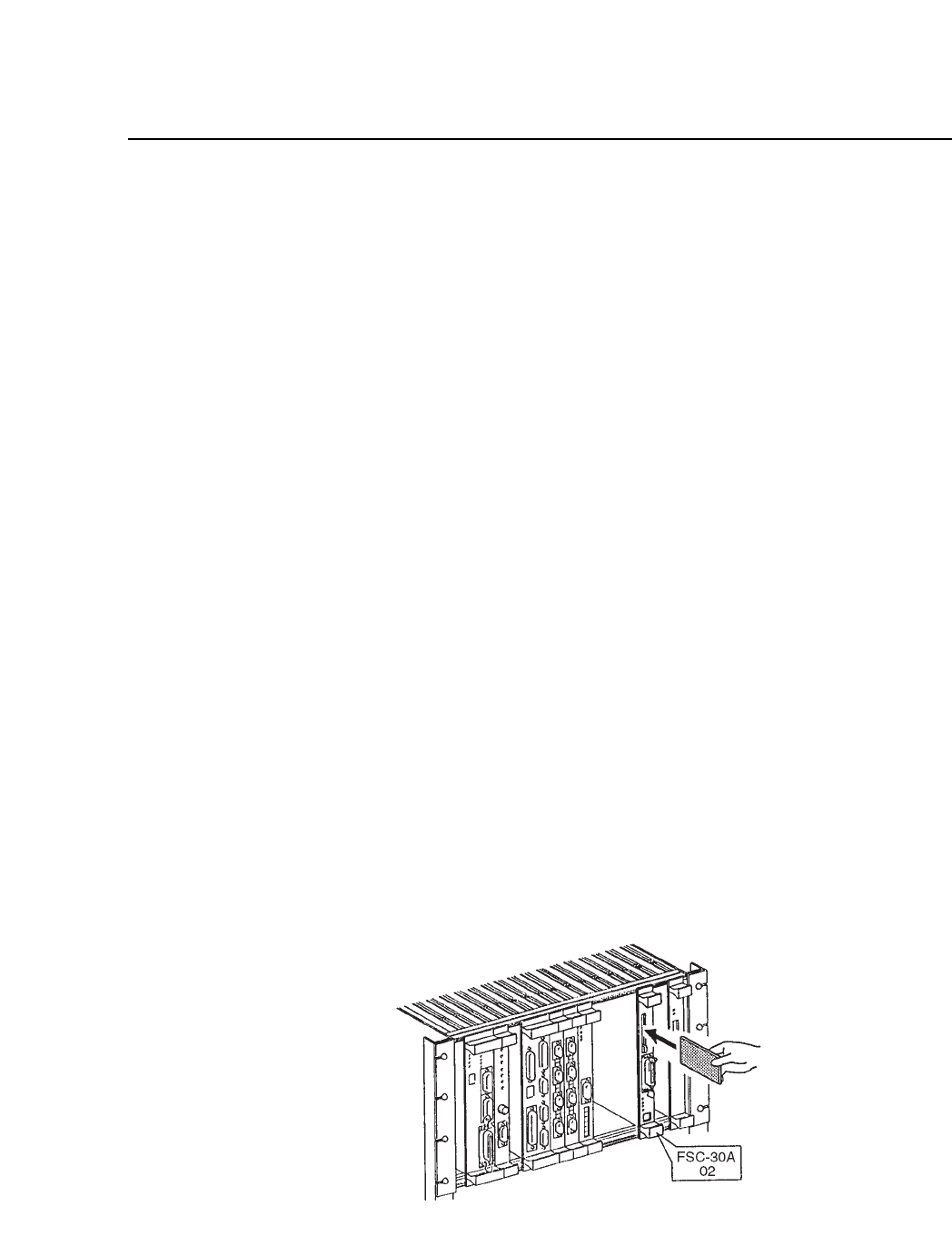
(4) Insert the vision software ROM memory card in the memory card slot
until the eject button sticks out. Attach the SCSI cable to the connector
on the board, as shown below.
Fig. 20-1 Attaching the SCSI Cable to the Board
CP IV-3 Maintenance