PR-NEG-8EN.pdf
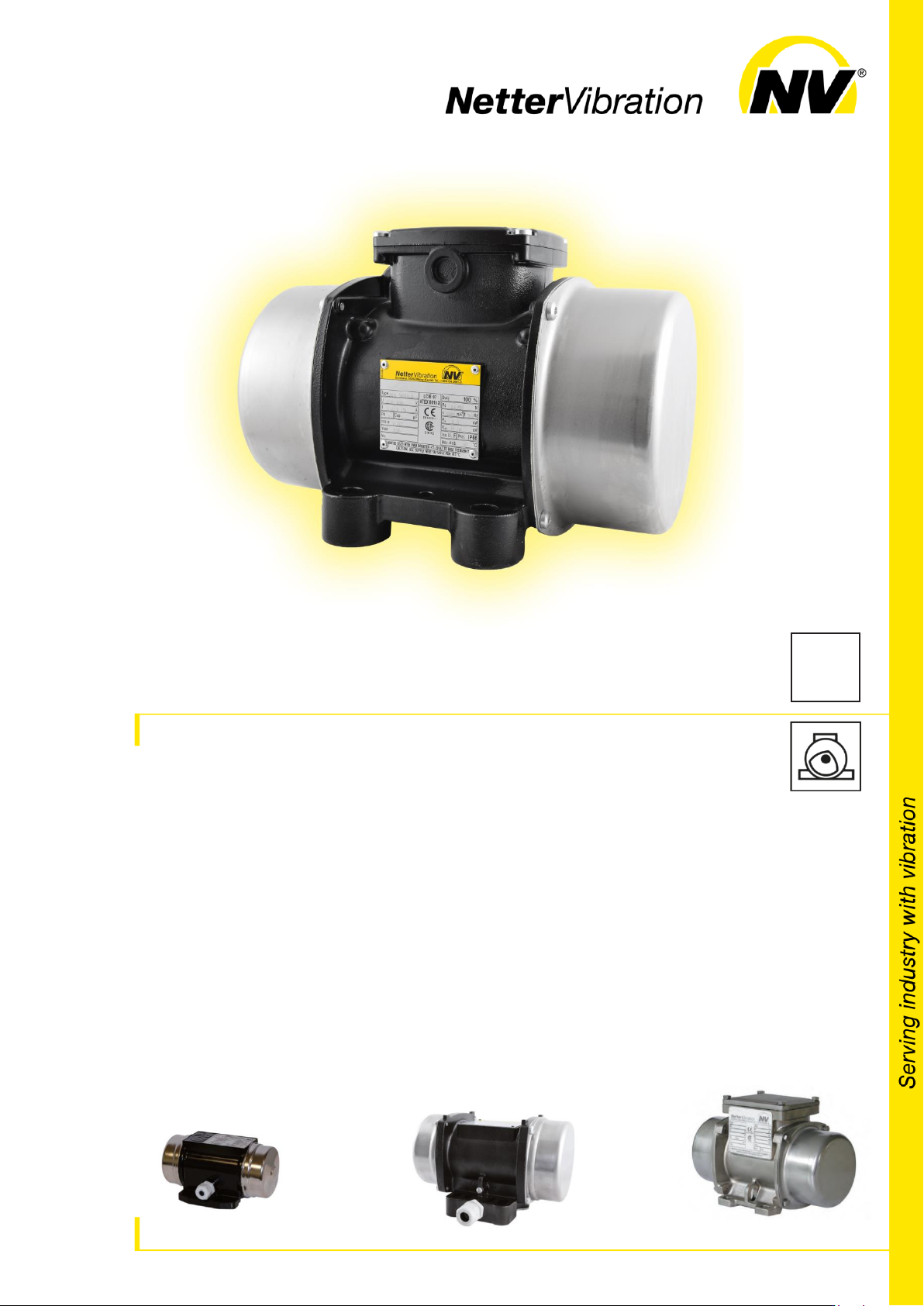
Electric External Vibrators • Circular v ibration • Nominal frequency from 7 50 min – 1 to 6.000 mi n – 1 • Centrifugal force from 40 N to 2 1 7 . 7 4 9 N • Smooth housin g surface • Stainless steel unbalance covers • Av…
Electric External Vibrators
•
Circular vibration
•
Nominal frequency from 750 min
–1
to 6.000 min
– 1
•
Centrifugal force from 40 N to 217.749 N
•
Smooth housing surface
•
Stainless steel unbalance covers
•
Available for ambient temperatures up to 55 °C
•
Ex tc IIIC (dust ignition proof) available
•
Ex e IIC available
•
Degree of protection IP 66-7, insulation class F
•
Stainless steel versions available
8
2
Electric External Vibrators
Contents
Page
Notes on vibrator design 2
Designs 3
and ambient conditions
Information 3
on the NEG/NEA/NED series
Applications, design and function
NEG series 4–7
Three-phase alternating current
NEA series 8–9
Single-phase alternating current
NED series 8–9
Direct current
Page
NEG E series 10–11
NEG as ATEX version
NEG S series 12
Stainless steel, especially smooth surface
NES series 13
Stainless steel, for chemically aggressive
ambient conditions
NEG/NEH series 14
High frequency electric external vibrators
Special designs 15
Accessories
15–16
Notes on Vibrator Design
Formulary
working moment
M = s x
m
centrifugal force
F = a
(g)
x
m x 9,81
acceleration
a
(g)
= s x
(
𝑛
1000
)
)
2
x 5,59
centrifugal force
F = M x
(
𝑛
1000
)
)
2
x 54,84
Symbols and units
Which kind of vibration for which task?
All external vibrators manufactured by NetterVibration comply with the applicable EU directives and bear the CE mark.
Many external vibrators made by NetterVibration meet the standard C22.2 no. LR100-95, file no. LR100948 Part B.
Class 421101 Motors and Generators (North America).
s
vibration width
cm
m
weight with vibrator
kg
F
centrifugal force
N
n
frequency
min
-1
M
working moment
cmkg
a
(g)
acceleration
g
circular
directed
750 – 3000
1000 – 1500
1500 – 3000
1500 – 3000
2 – 5
3 – 4
3 – 5
2 – 3
0,15 – 0,2 of the material weight
in the conical part of the silo
2 – 4
0,8 – 1,5
0,5 – 5
large
large
medium
medium
1500 – 3000
1500 – 6000
3000 – 9000
300 – 6600
medium
small
adjustable
3
Electric External Vibrators
Designs and ambient conditions
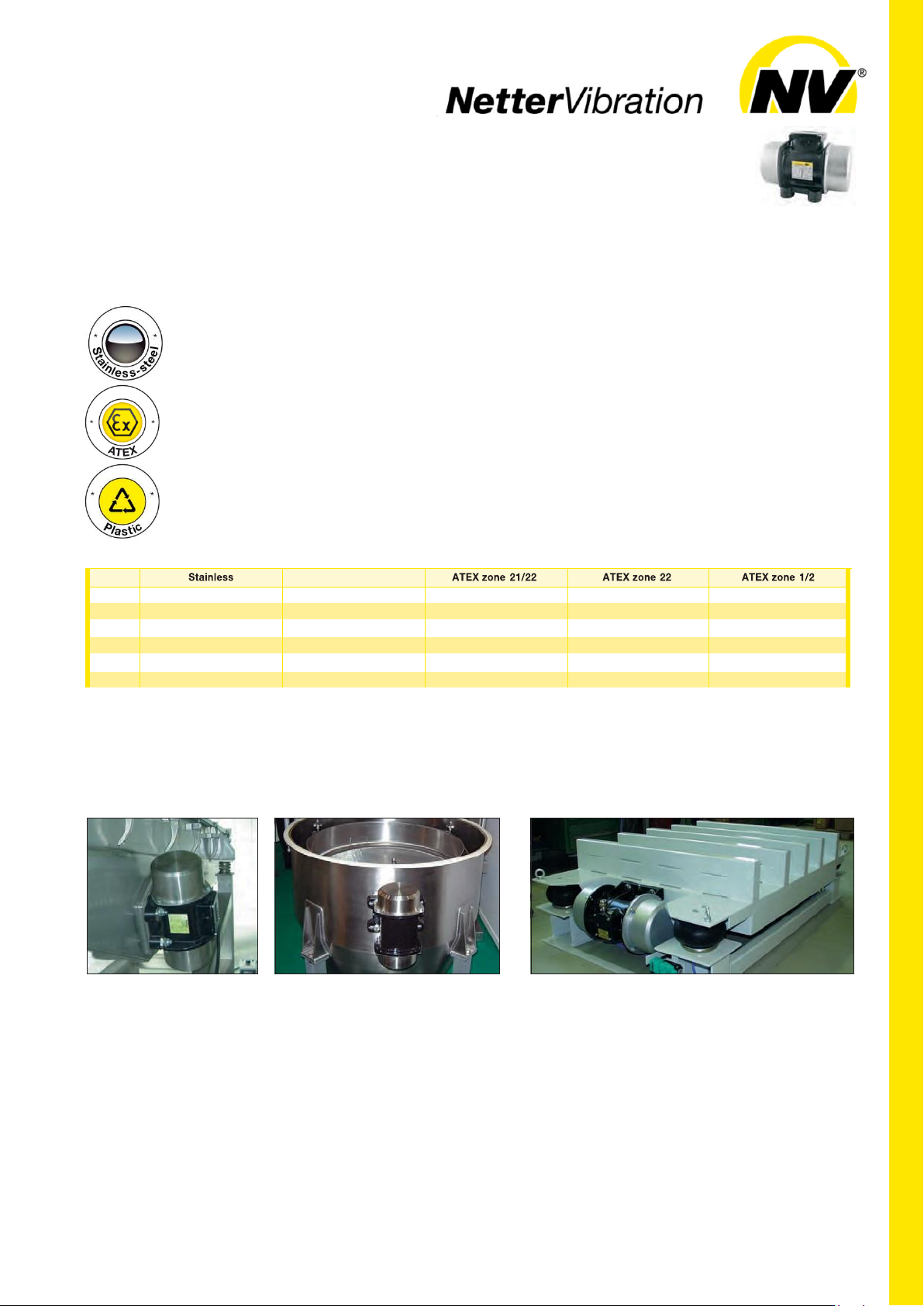
Stainless steel vibrators are resistant to very harsh environmental conditions. Especially the chemical, pharmaceuti-
cal and food industries use this resistance in production areas with aggressive, liquid and gaseous media.
ATEX vibrators allow operation in explosive atmospheres (ATEX Zones 1, 2, 21 and 22) using special design
measures in which gases, vapours, mists and dusts are used. These vibrators, which meet very high safety stand-
ards, find a use especially in the chemical and petroleum industry.
Plastic vibrators have the advantages of stainless steel devices, but are much lighter. The useful properties of
these vibrators are used in the manufacture of dairy products (e.g. cheese), throughout the food industry and in
extreme industrial applications.
Information on the NEG, NEA and NED series
Conveying
Sieving
Compacting
Applications
The electric external vibrators of the series
NEG, NEA or NED are always used when,
for example, conveyor troughs or sieves
have to be driven.
In addition, these vibra-
tors can loosen product jams and deposit
build-ups in silos. When used on concrete
formwork, a high surface quality and com-
paction of the concrete is achieved by a
particularly uniform vibration.
One special feature of the NEG is the
maintenance-free operation even under
harsh environmental conditions.
Design and function
External electric vibrators are unbalance
motors based on the short circuit rotor
principle and, apart from a few decisive
differences, are very similar to commercial-
ly available electric motors. The NEG
three-phase vibrators run on 230/400 V,
50 Hz, depending on the number of poles,
at 750, 1.000, 1.500 or 3.000 min
-1
.
The NEA AC units run on 230 V, 50 Hz at
3.000 min
-1
. Further voltages are available.
The NED DC vibrators run on 12 or 24 V at
3.000 min
-1
(NED 601110 only on 24 V,
3.600 min
-1
).
There are unbalances on both shaft ends,
which generate an omnidirectional, sinus-
oidal vibration with the frequency of the
corresponding speed.
All NEG/NEA are also designed for use at
60 Hz, the speed is then correspondingly
20 % higher than the values at 50 Hz. The
unbalance is adjusted, if necessary.
Generously dimensioned roller bearings
guarantee a high degree of operational
safety. All NEG are fully suitable for opera-
tion with Netter frequency converters.
Series
NEG
NEA
NED
NEG E
NEG S
NES
Plastics
up to GG 60
●
●
●
●
●
●
●
●
●
●
3