SIPLACE Vision Customer_en.pdf - 第130页
SIPLACE Vision - Teaching Fiducials What are Fiducials? PCB Position Rec ognition Fiducials in the PCB Layou t S tudent Guide SIPLACE V ision (Customer) SIPLACE Vision - T eaching Fiducials Edition 12/2008 EN 130 Fiducia…
SIPLACE Vision - Teaching Fiducials
PCB Position Recognition Fiducials in the PCB Layout What are Fiducials?
Student Guide SIPLACE Vision (Customer)
Edition 12/2008 EN SIPLACE Vision - Teaching Fiducials
129
6.1.1 PCB Position Recognition Fiducials in the PCB Layout
The number of fiducials in the PCB layout results in the following options for placement quality
optimization:
1 fiducial The X/Y position of the PCB can be measured in the conveyor - placement area of the
machine. ATTENTION: Is not sufficient for SIPLACE machines and is blocked by the SW.
2 fiducials The X/Y position of the PCB and the PCB angular position can be determined in the
conveyor - placement area of the machine. This is the minimum required for SIPLACE machines!
3 fiducials If the fiducials are arranged appropriately on the PCB layout (L shaped), a PCB offset can
be recognized and corrected.
More than 3 fiducials can be programmed, although only the first 3 will be used. When using the
long board option, up to 6 programmed fiducials are used, depending on the relevant placement
stop. There is also a possibility that coordinates are programmed for multiple coordinates but are
then intentionally deactivated.
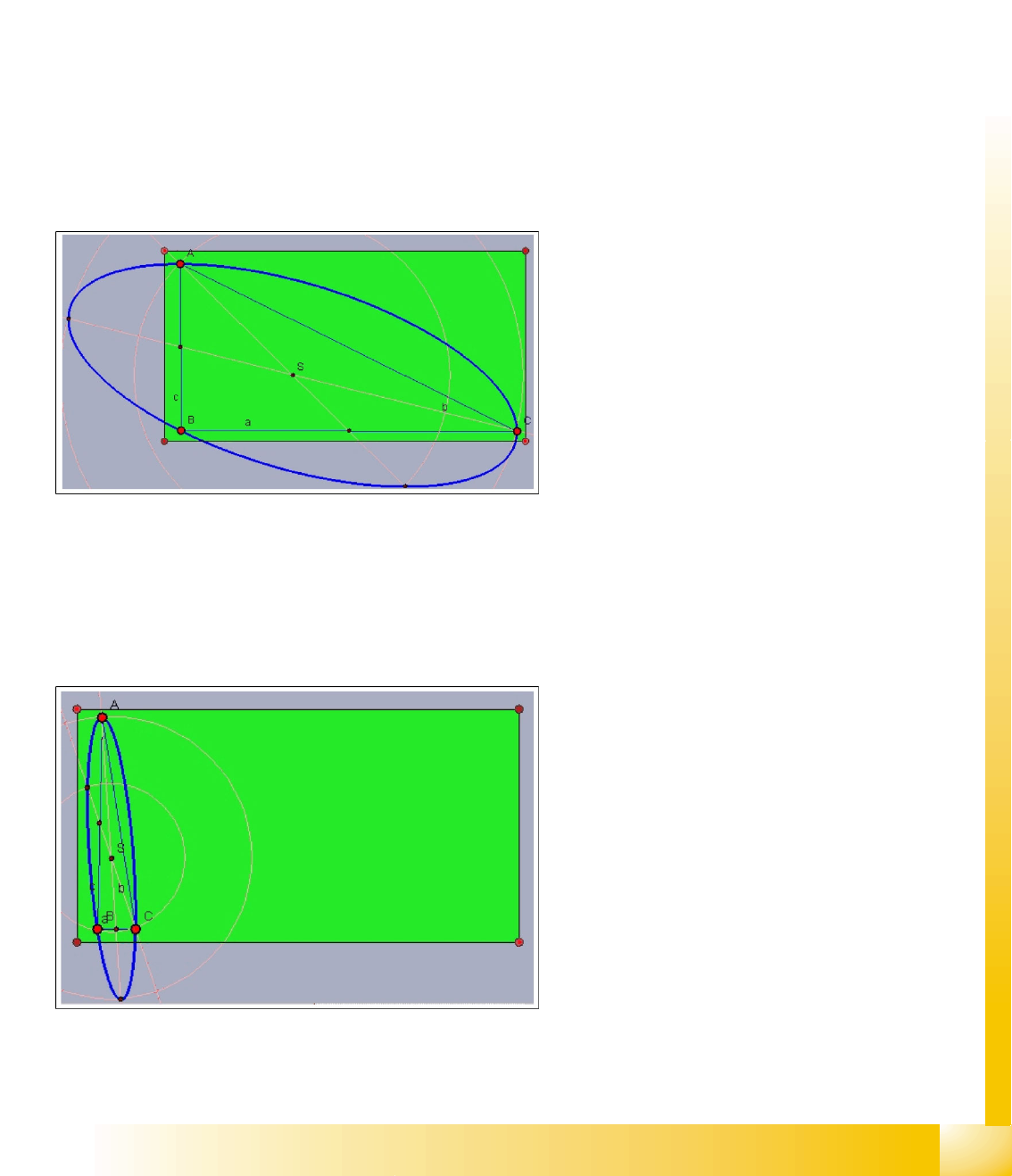
The arrangement of fiducials can be more or less favorable for the placement process.
6-1: Favorable arrangement of PCB position recognition fiducials
The following accuracy parameters apply for
extreme accuracy requirements:
If a position error occurs during fiducial
recognition, a placement error in the vicinity of the
central position (the intersection of the medians) of
the triangles would be approx. 0.6 x fiducial
measurement error.
In the area of the ellipse, the error would be as
large as the measurement error during position
recognition.
In the area of the double ellipse, the placement
error would also be doubled.These geometric
relations are independent of the Vision system and
should encourage you when selecting the fiducials
to take at least half the PCB dimensions as the
distance between fiducials.
6-2: Non-recommendable arrangement of PCB position recognition fiducials
If the distance of the fiducials programmed for
PCB position recognition was as near as in items
B and C, the right PCB edge would show a PCB
position recognition measurement error as a
multiplied (in this case about 20 fold) placement
position error.
A PCB production offset along the length would
not be recognized here.
This discussion about the two fiducial position
layouts should encourage you to select the
fiducials wisely.
If the programmed distances for the position
recognition fiducials on the whole PCB are not
observed, some SW versions will issue a
plausibility error.
SIPLACE Vision - Teaching Fiducials
What are Fiducials? PCB Position Recognition Fiducials in the PCB Layout
Student Guide SIPLACE Vision (Customer)
SIPLACE Vision - Teaching Fiducials Edition 12/2008 EN
130
Fiducial arrangement layout
When arranging fiducials for PCBs with multiple consolidated panels, this arrangement of fiducials can
either be recorded once for the entire PCB or each of the individual switching circuits can be assigned
its respective fiducials and recorded.
You can not program and use the PCB position recognition both for the entire board AND for a single
panel at the same time. If this is programmed, the PCB position recognition will give the panel priority
and the fiducials for position recognition of the entire board will not be approached and centered.
The following description explains the special case of the "long board" option.
Layout for fiducial arrangement if the "long board" option is used
In the long board option, the PCB is stopped twice in the placement area of the machine: once at the
laser light barrier – PCB placement area of the 1st stop and then at the mechanical stopper of the long
board option - PCB placement area of the 2nd stop. 3 fiducials for PCB position recognition can be
distributed throughout the length of the relevant placement stop area.
Fiducials in the overlap area can be used for position recognition of both the 1st and the 2nd area. This
means that 4 to 6 fiducials in total can be programmed for position recognition of a "long board".
As can be seen in the diagram labeled "Non-recommendable arrangement of PCB position recognition
fiducials" (see above), it is not advisable to concentrate the PCB position recognition fiducials for both
placement areas just in the overlap area.
Fiducials in the panels if the "long board" option is used
If all fiducials and placement positions are in the placement area of the respective stop, you can also use
the position recognition fiducials for the panels (see the 3 crosshairs in each panel).
If one placement position is located in the placement area of the other stop, this type of PCB position
recognition will not function in the machine with the long board option.
After performing PCB position recognition, the fiducials for other optical PCB recognition runs will be
approached. From the introduction of SIPLACE Vision, position recognition is ALWAYS performed
BEFORE inkspot recognition.
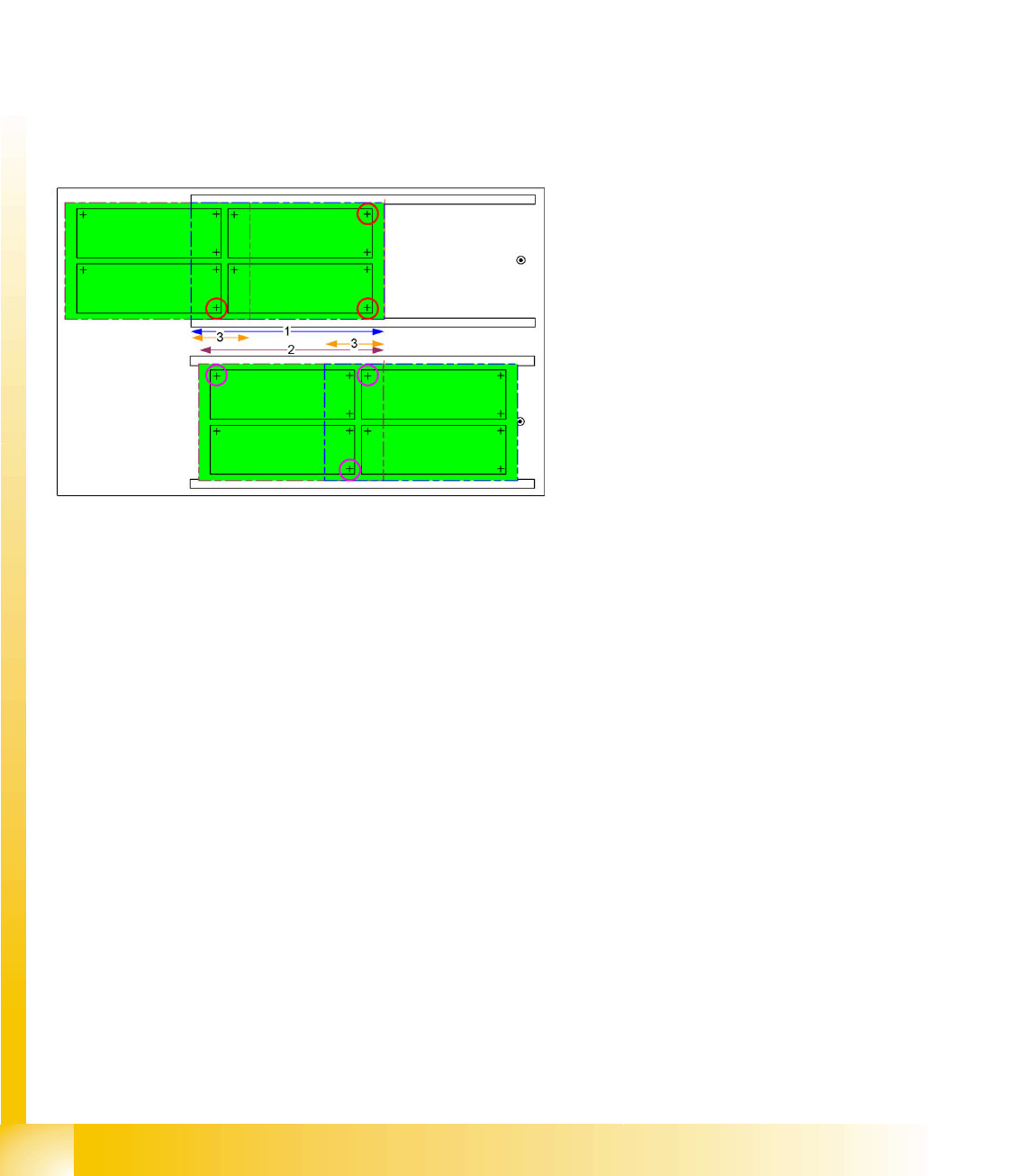
6-3: Possible distribution of PCB position recognition fiducials for long board
option
The PCB stopped at the laser light barrier can be
placed in the area marked as '1'.
2 fiducials from the front row of 4 fiducials and one
fiducial in the overlap area (2nd row of four) form
the 3 fiducials for the placement area of the 1st
stop.
2 fiducials in overlap area ’3’ and one in the row of
2 fiducials at the end of the PCB form the fiducials
for the placement area of the 2nd stop (arrow ’2’)
at the mechanical stopper for the long board
option.
SIPLACE Vision - Teaching Fiducials
Placement Position Recognition What are Fiducials?
Student Guide SIPLACE Vision (Customer)
Edition 12/2008 EN SIPLACE Vision - Teaching Fiducials
131
6.1.2 Placement Position Recognition
A fiducial on a PCB can also be used for exact measurement of a placement position. The position
coordinates relate to the Overall PCB zero point or the Panel zero point and not to the placement
position to be measured. The fiducials can either be positioned diagonally on the corners of the
placement layout at the placement position or in the center. The measurement results and centering
steps for PCB position recognition or placement position determination do not differ from one another!
6.1.3 Good/Bad Board Recognition of So-Called Inkspot Recognition
Boards with multiple panels often need to have panels with a defect or ones for prior production omitted,
so that expensive components are not placed where it is not necessary.
In contrast to the two previous applications, explained above, this procedure does not involve
determining position coordinates during the fiducial measurement but, instead, just the relevant optical
impression, brightness or contrast.
To save time, a so-called "global inkspot" has been created.
When recognized as OK, this global inkspot defines that all panels are OK and suitable for
placement.
If recognized as bad, this global inkspot defines that at least one panel is NOT OK and is therefore
to be omitted after the relevant fiducials have been scanned.
The fiducial for good/bad panel recognition is often also on the overall PCB. This saves placement space
on the individual panel, although it does make work more difficult for the programmer and line operator.
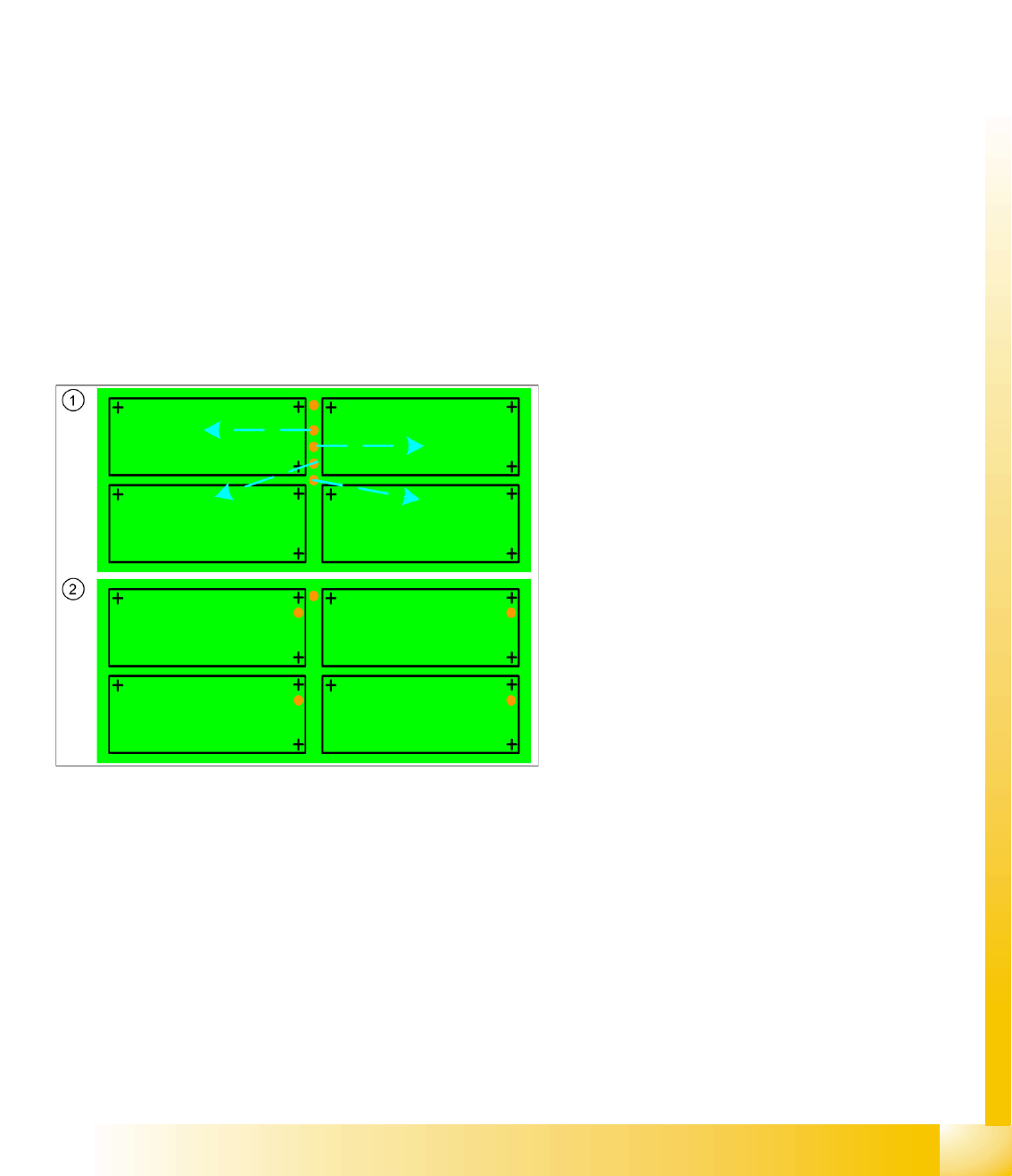
Legend
1. Inkspot fiducials for panels on the entire PCB
frame or edge
This arrangement of inkspots requires
individual programming of each panel!
It is also essential that the operator knows
which inkspot is assigned to each panel.
2. Inkspot fiducials in the panels
In the standard arrangement of inkspot
fiducials in the panel , this is "automatically"
clear due to the duplicate arrangement in the
panel.